How to top-graft Camellia onto large Camellia oleifera rootstocks? A detailed explanation of the grafting technique
How to graft Camellia onto large Camellia oleifera rootstocks? The technique of top-grafting Camellia onto large Camellia oleifera rootstocks
How to graft Camellia onto large Camellia oleifera rootstocks? The technique of top-grafting Camellia onto large Camellia oleifera rootstocks. Camellia is a plant of the genus Camellia in the family Theaceae, an evergreen shrub or small tree, and one of China's ten traditional famous flowers. It has the splendor of the peony and the character of the plum blossom. It is suitable both for potted cultivation at home and for landscape greening, with extremely high ornamental value, and is one of the five golden flowers (azalea, Fubai chrysanthemum, camellia, rose, apricot blossom) that Macheng City focuses on developing. Camellia oleifera has a long history of cultivation in Macheng City and a relatively large cultivation area; because some Camellia oleifera trees in Macheng City are small old trees with very low seed yield, these low-yielding Camellia oleifera trees can be put to use as rootstocks for grafting camellia, so that the camellia cultivated in this way is large in size, long-lived and highly ornamental. Among the various propagation techniques for camellia, grafting is an important means of expanding and accelerating the propagation of superior varieties. Using Camellia oleifera as a rootstock for grafting can both preserve the original excellent characteristics and improve the camellia's adaptability to the environment, while also increasing the camellia's growth, advancing flowering and extending the ornamental period of the camellia flowers. With the camellia top-grafting and variety-change technique, a good crown can be formed in the second year after grafting, and the grafted seedlings obtained in this way grow faster than seedlings raised from seed or cuttings, greatly increasing the growth rate of the camellia. This grafting technique has already been widely adopted in the Wunaoshan National Forest Park of Macheng City. Through grafting onto Camellia oleifera trees, Macheng City has already cultivated more than 600 camellia varieties, and camellia cultivation in Macheng City has a history of more than 1600 years.
Test site conditions: Wunaoshan Forest Farm of Macheng City, also known as Wunaoshan National Forest Park of Macheng City, is located in the northeastern part of Hubei Province, on the southern foot of the middle section of the Dabie Mountains, at the junction of the three provinces of Hubei, Henan and Anhui, at 30°52′~31°36′ N and 114°40′~115°28′ E. The altitude is 25~1 337 m. It has a subtropical continental monsoon climate, with the characteristics of abundant sunshine, mild climate, ample rainfall, rain and heat in the same season, and four distinct seasons. The average annual rainfall is 1 223.7 mm, the maximum rainfall in a wet year is 2 009.0 m (1954), and the minimum in a dry year is 683 mm (1978), with uneven distribution within the year, and the flood season from May to September. The average annual temperature is 16 ℃. The extreme maximum temperature is 41.5 ℃ (1959), and the minimum is minus 15.3 ℃ (January 1977). The annual sunshine hours are 2 036.7~2 153.1 h, and the sunshine percentage is 46%~49%. The total light radiation energy is 108.2~113.3 ka/cm2. The frost-free period is 228 d. The soils include yellow-brown soil, fluvo-aquic soil and paddy soil, with soil pH in the range of 5.60~6.68, soil organic content between 0.6%~2.5%, total nitrogen content between 0.5%~0.2%, alkaline hydrolyzable nitrogen content 30~15 ppm, and available potassium content 30~200 ppm.
1 Preparation before grafting
1.1 Rootstock preparation
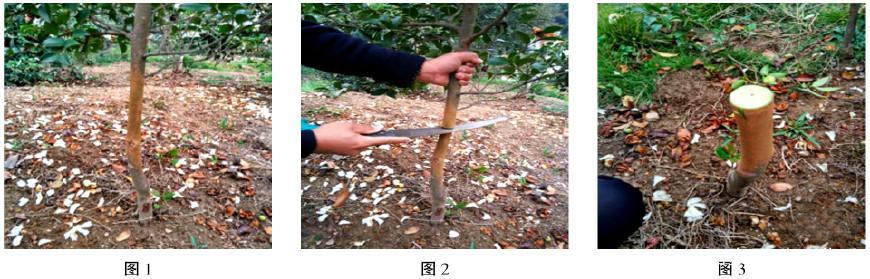
(1) Selection and transplanting of large low-yielding Camellia oleifera trees. Using low-yielding Camellia oleifera for improvement can both reuse resources and greatly shorten the time needed to cultivate rootstocks. In existing low-yielding Camellia oleifera forests, select large Camellia oleifera trees aged 30~50 a, with a ground diameter of 5~10 cm, growing vigorously and free of pests and diseases, and transplant them as rootstocks (Figure 1).
(2) Shaping and pruning of the rootstock before grafting. 1~2 months before grafting the large Camellia oleifera trees, cut off the rootstock's water sprouts, dead branches, weak branches, diseased branches and crossing or overlapping branches, so as to facilitate ventilation and light, reduce the occurrence of pests and diseases, avoid useless nutrient consumption, make the plant grow vigorously, and ensure that the rootstock grows vigorously. Before grafting, saw off the main trunk of the Camellia oleifera at 50~100 cm above the ground (as shown in Figures 2 and 3).
1.2 Scion preparation
Macheng City has more than 600 excellent camellia varieties. Precious varieties such as Magu Xianzi, Hua Foding, Shiba Xueshi, Zhuangyuan Hong, Bai Mudan, Hong Furong, Fenxia, etc. can be selected as scions. Select well-developed, robust, plump-axillary-budded, vigorously growing, pest- and disease-free, 1~2-year-old lignified or semi-lignified branches from mature camellia trees as scions; the branch length is 5~10 cm, and the basal thickness is more than 0.25 cm. After grafting, the growth vigor is relatively strong and flower buds form early. Collect and graft immediately; the collected scions should be well labeled and kept clonal. If long-distance transport is required, collection should be done in the early morning or evening or in cool weather, and attention should be paid to temperature control and moisture retention during transport.
2 Grafting
2.1 Grafting time
The time for top-grafting camellia onto Camellia oleifera is mostly chosen in the late spring and early summer period from early May to early June, and grafting can also be done appropriately in autumn.
(1) Spring grafting. In spring it is neither cold nor hot, the sap flow rate is moderate, the plant's callus tissue is easily produced and healed, and the grafting survival rate is high. The top-grafting and variety-change of camellia is suitable in spring, and the best grafting time in Macheng City is early May, when the rootstock has not yet fully sprouted and unfolded its leaves; this is the best time to select camellia scions and carry out grafting. After grafting, the crown recovers relatively quickly, and the ornamental flowering period can be advanced.
(2) Summer and autumn grafting. In summer, both temperature and humidity are relatively high, and the phloem cortex of Camellia oleifera is distinct, which facilitates grafting of camellia scions; at this time the cambium cells of both the rootstock and the scion are very active, callus tissue is easily formed, and the grafting survival rate is relatively high. Because young branches are rich in growth hormones and grow fast, the grafting survival rate is high, so 1~2-year-old branches are commonly used as scions for camellia grafting. Using large Camellia oleifera trees as rootstocks for grafted seedling cultivation can be done in early June in summer; because in summer the Camellia oleifera rootstock has already consumed a large amount of nutrients to complete sprouting and leaf unfolding, it is difficult for it to provide the nutrient supply for the camellia top-grafting and variety-change, the plants after successful grafting do not have strong growth vigor, and their resistance to pests and diseases is also not strong. In autumn the temperature gradually drops and humidity decreases, the grafting survival period is long, and at this time grafting should be done with attention to moisture retention, and the grafting survival rate is not high. In the camellia top-grafting and variety-change, attention should be paid to checking the growth after spring grafting; if the grafting fails or the effect is poor, a small amount of supplementary grafting can be done in summer and autumn, which can increase the grafting survival rate.
2.2 Grafting technique
(1) Cutting the scion. The fresh scions collected should be given moisture-retention treatment before grafting. First, spray the scions with water for moisture retention and cover them with plastic film. When grafting, select plump axillary buds or terminal buds, make one cut each at 0.5 cm below the two sides of the leaf bud to form a thin wedge shape, with the cut surface about 1 cm long; the two sides are required to be even and smooth, then cut off at 0.5 cm above the tip of the bud to make one scion. When cutting the scion, the knife is required to be sharp, and the cut surface should not be cut back again (Figure 4). To prevent water transpiration, the leaves on the scion need to be cut off by half, leaving half for photosynthesis. Before grafting, for moisture retention it is best to place the cut scions in a basin containing clean water.
(2) Cutting the rootstock. First wipe the cut surface of the rootstock clean with a clean towel, then use a grafting knife to smooth the saw cut of the rootstock, and make two parallel cuts from top to bottom at the two ends of the rootstock, shaped like the Chinese character "door", reaching deep into the xylem, then lift and pull open the bark (Figure 5).
(3) Inserting the scion. Insert the cut scion into the rootstock slot where the bark has been torn open, align the inner cut surface of the scion with the rootstock, then cover the torn-open rootstock bark over the top of the scion (Figure 6).
(4) Binding. After inserting the scion, the grafting site should be bound immediately with plastic binding tape. When binding, the grafted bud must not be damaged, and the grafting site needs to be bound as tightly as possible.
(5) Adding a cover. In order to maintain the humidity of the grafted seedling, after binding a plastic cover needs to be tied over the scion site. The plastic cover forms a lantern shape at the position of the grafted bud, and the plastic cover must be strictly prevented from touching the scion's leaves, so as to avoid burning the leaves. The tied plastic cover must be tight and airtight, otherwise it will not serve the purpose of moisture retention and will affect the survival of the grafted seedling (Figures 7 and 8).
3 Management after grafting
3.1 Management of the plastic cover
After grafting, a plastic bag needs to be quickly put over the plastic cover to ensure that the relative humidity inside the bag reaches above 95%. After grafting, prevent insects from biting the moisture-retention bag; if damage is found, the moisture-retention bag should be replaced immediately. About one month after grafting, the scion grows rapidly; at this time a small hole can be cut in the bag to allow proper ventilation for the branches and leaves after the scion grows. When the new shoots have grown to about 2 cm, the camellia leaf buds show stable growth, and the camellia leaves turn dark green, the moisture-retention bag can be cut open or removed in the evening, but shading is still needed for 1-2 weeks. Because the branches of camellia grow out quickly after top-grafting, a small stick should be tied near the interface after grafting as support, to facilitate enlarging the space of the plastic cover and ensure that the scion is not broken by the wind. (Figure 9).
3.2 Removing sprouts and suckers
Because the trunk of the top-grafted Camellia oleifera rootstock is relatively thick, after grafting most of the latent buds on the original trunk may sprout. If the Camellia oleifera sprouts are not removed in time, their sprouts and suckers will grow too fast and will inevitably compete for nutrients with the camellia scion, ultimately causing the camellia scion to grow slowly until it stops, and finally dies. Therefore, the Camellia oleifera sprouts and suckers on the rootstock should be cleared away in time to ensure that the camellia new shoots grow quickly after successful grafting.
3.3 Water and fertilizer management
After top-grafting camellia onto Camellia oleifera, take care to keep appropriate humidity at the graft interface, as this can promote the formation of callus tissue. In addition, after grafting, because of the cutting of the rootstock and the healing of the interface, the trunk needs water and favors fertilizer, so nitrogen fertilizer must be applied in a timely manner, in small amounts and multiple times, combined with irrigation, watering whenever the soil is dry, without waterlogging, to promote rapid plant growth, increase the plant's leaf area, strengthen photosynthesis, and improve the plant's various growth parameters.
3.4 Pest and disease control
Camellia itself has no unique pests or diseases, but when new buds sprout, special attention must be paid to preventing common insects such as scarab beetles, scale insects and aphids from harming the camellia's new shoots. When the damage is severe, first cut off the branches where insects have laid eggs and the branches already damaged, then spray a 1 000~1 500 times dilution of Dushiben; scale insects will cause camellia to be infected with sooty mold. When it occurs severely, in addition to spraying Dushiben once every 10 d, an old toothbrush or bamboo strip can also be used to brush them off. Mature camellia branches are relatively stable, and tortricid moths may be encountered in spring and summer, but they generally do not cause major damage, and simply picking off the tortricid larvae is enough. In summer, with high temperature and high humidity, special attention should be paid to strengthening management. In order to improve the plant's disease resistance, once diseased branches and leaves are found, the diseased leaves should be picked off as early as possible, and fungicides should be sprayed at the same time to prevent infection by pathogens such as gray leaf spot disease.
3.5 Shaping and pruning
Too many flower buds borne on camellia branches will weaken the tree vigor. In the year after grafting, in order not to let it bloom, the flower buds need to be thinned out to ensure rapid growth of the camellia branches and the formation of a good crown. In the later management of top-grafting and variety-change, attention should also be paid to cutting off overly dense branches, crossing branches, pest- and disease-damaged branches, and overlapping branches. This can make the tree shape attractive with luxuriant foliage, and at the same time can also improve the ventilation and lighting conditions of the crown; in addition, in order to speed up the metabolism of the camellia after grafting and improve photosynthetic efficiency, some old leaves should also be removed, and reasonable shaping and pruning must be carried out. This can maintain the balance between the camellia plant's vegetative growth and reproductive growth, ensure vigorous plant growth, and reduce the occurrence of pests and diseases.