What is Sedum spurium? Let us introduce you to this succulent plant
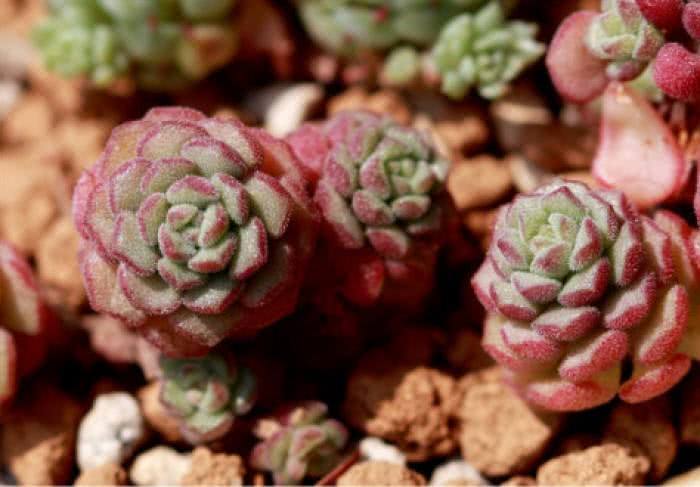
Sedum spurium is a succulent plant of the genus Rhodiola, also known as a Sedum plant. Little Pearl Rose has a delicate and subtle appearance. It has strong cold resistance, strong drought resistance and strong reproductive capacity. It is suitable for protecting lawns or turfgrass. Under high temperature and sunlight conditions, the leaf color becomes more vivid and red.
Sedum spurium
Morphological characteristics:
A creeping perennial herbaceous plant. It easily produces new branches and easily forms a cluster. The stems and leaves usually turn purplish-red in autumn and winter or in a warm environment.
Stem
The stem of a mature plant is about 5-15 cm long. Smooth, hairless, occasionally with wart-like spots.
Leaf
The leaf surface is hairless; the pairs are obovate or round, wedge-shaped, with rounded serrations along the leaf margin; opposite, occasionally alternate; the petiole is absent or short. A single leaf is about 1.5-3.5 cm long and about 1-1.2 cm wide.
Inflorescence
The flowering stem is creeping or upright, with small wart-like spots on the surface. It is usually about 10-30 cm long. A dense umbel, usually divided into 3-5 branches, each bearing about 15-30 flowers. The bracts are lanceolate or elliptic, with wart-like protrusions.
Flower
Usually five petals, occasionally six; almost sessile or with a short pedicel; the sepals are 1 cm long, triangular in shape, blunt, blunt to the tip. The petals are upright, usually extending upward from the base, roughly elliptic, short and pointed, slightly curved at the tip, with protrusions, about 0.7-1.2 cm long, pure white to dark red. The anthers are red.
Sedum spurium
Maintenance methods:
Lighting: Little Pearl Rose likes warmth, dryness and plenty of sunlight, so give them enough light. If there is not enough light and too much water, it will cause the Little Pearl Rose to grow leggy (elongation of stems and stalks, spreading of leaves, and a change to green). Enough light and a temperature difference will make the stems and leaves of the Pearl Rose turn dark red, and the plant shape will remain very compact and beautiful, no less than a rose.
Potting soil: The potting soil should be as loose and breathable as possible. Beginners are advised to use a breathable pot, such as a clay pot or a pot with holes in the bottom, to avoid rot caused by water accumulation.
Reference soil: peat soil + vermiculite + perlite, mixed at 1:1:1 (relatively expensive perlite and volcanic rock can also be used instead of vermiculite and perlite). Perlite and vermiculite will cause soil compaction due to the powdering of vermiculite, resulting in reduced soil permeability. Therefore, it is recommended to change the soil once a year.
Watering: In spring, autumn and winter, watering is not necessary. Properly controlling the watering frequency helps maintain vivid color and a compact plant shape. In summer, the plant should be placed in a shady spot to avoid sunburn. Water should be given at night or in the evening when temperatures are low. When the temperature is above 30°C or below 5°C, the watering frequency should be reduced, or watering should even be stopped until the temperature recovers.
Sedum spurium
Propagation methods:
The cutting method is usually chosen. As the Little Pearl Rose grows, the shedding of basal leaves makes the stem long, and the branches can be pruned to promote branching and growth. The cut branches can be used for cuttings, and they root easily. Try to avoid the cold winter during the propagation season.
Because the specific planting area is different, attention should be paid to local conditions, and local climatic conditions (humidity, temperature, etc.) should be considered.