Why do succulents stop growing after they fill their pots?
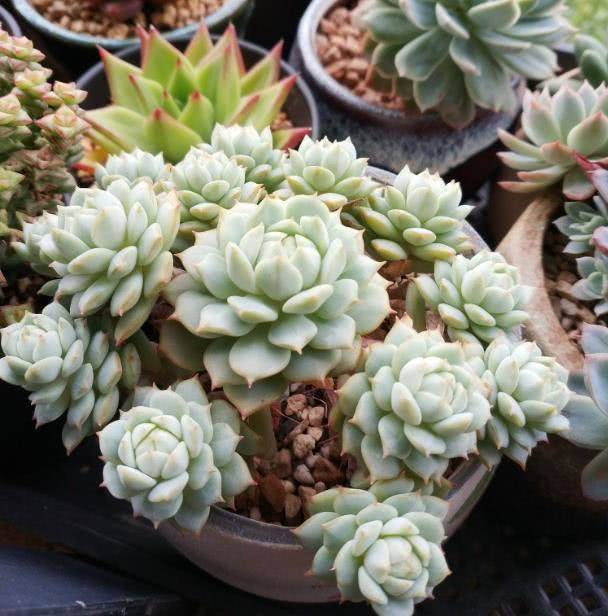
If a succulent shows no obvious signs of growth for a long time, then something somewhere must have gone wrong. Let's analyze it together. First, check whether the soil has become compacted. Generally speaking, after a succulent has grown for one or two years, the soil needs to be replaced once, to prevent soil compaction from causing poor root respiration and suffocating the plant.
If something is wrong with the roots of a succulent, most cases of succulents that never grow are due to rotten roots. Once the roots rot, respiration becomes poor, let alone taking up water properly. At this point you can remove the succulent from the soil and check the roots. As soon as you find rotten or dried-up roots, be sure to cut them off in time, then soak the plant in a fungicide. This is roughly the same as the aftercare for root trimming. Once the wounds have dried, you can replant it.
Why do your leaf-propagated succulent seedlings never grow bigger? Many people believe succulents should be watered sparingly, because succulents do not like water, and they apply this idea to the care of leaf-propagated seedlings too. So even though the leaf-propagated seedlings have sprouted shoots and roots, they stay in a "half-dead" state and eventually dry up and die. Watering succulents is a process of gradually decreasing from small to large plants. Seedlings like water, especially leaf-propagated seedlings. When ventilation is good and the temperature is suitable (around 25 degrees), they can be watered almost once a day, and keeping the potting soil constantly moist is no problem at all. As the leaf-propagated seedlings grow, you can reduce the frequency and amount of watering. So if your leaf-propagated seedlings never grow bigger, it is probably because you dare not water them. Go back and give your leaf-propagated seedlings a bit more water, and you will find a surprise coming right away.
Why do succulents you bought never grow? It has to do with the growing environment and care method, such as watering and light. Bright but no direct light. Potting soil that is damp but not wet is actually good for acclimating the plant, but it easily grows leggy. If the light is too strong, the plant may stay in a state of constant consumption and never grow bigger. Many beginners know that succulents need light to look good, but they do not realize that too much light during the acclimation period and soil that is too dry inhibit growth. For example, in the spring season (bought in March), if a succulent stays in the same state as when you bought it, then it is undoubtedly a problem of too much light or too dry potting soil. In addition, for old plants and succulents with aging roots, stem cuttings actually take root faster than acclimating the plant, because the mother plant may remain in a state of false dormancy due to a poor environment.
If a succulent has been grown for a long time and never grows, repotting and changing the soil is also necessary. The soil has actually used up most of its nutrients, and soil without nutrients is not enough to support rapid growth of a succulent. It is already quite good that the plant has not died, so repotting succulents at the right time is also very necessary.
A flower friend asked: the succulent they just bought was a very large plant, then it started dropping one after another, and later they planted the dropped parts beside it. Now it has been in a half-dead state, and they do not know what is going on. During the growing season of succulents, sun exposure is crucial. Without sun and with too much watering, not only will it not grow bigger, but it will also grow deformed, meaning it will only grow vertically and lose its plump, round succulent character. So give it more sun and less water, water once every two weeks.
This is a gathering place for succulent lovers, sharing succulent care tips. Welcome to follow and exchange ideas.