Why orchids must not be watered with partial watering and the harm it causes
Most orchid growers have read some books and found that the content in them is largely the same, and some of the authors are not orchid growers at all, but have just copied bits and pieces from here and there. Take the saying about watering orchids, "Don't water if not dry, water thoroughly when you do." But no one ever explains what "watering thoroughly" means, why you should water thoroughly, and what consequences will arise if you don't.
Believing everything in books is worse than having no books at all. You will only truly understand and remember something when you know the real reason behind it; otherwise you will always have a half-baked understanding. Haoshe Farmer will use a farmer's experience to explain and analyze with everyone why orchids should be watered thoroughly.
Most orchid growers use deep pots for their orchids. We have actually talked a lot before about watering orchids, and growers should already know when to water, so I won't repeat that. "Orchids dread partial watering most" is a saying from books, but beginners often don't know: what on earth is partial watering? So-called partial watering means that each time you water, you don't water thoroughly and only wet the upper half of the orchid pot. Partial watering has many drawbacks.
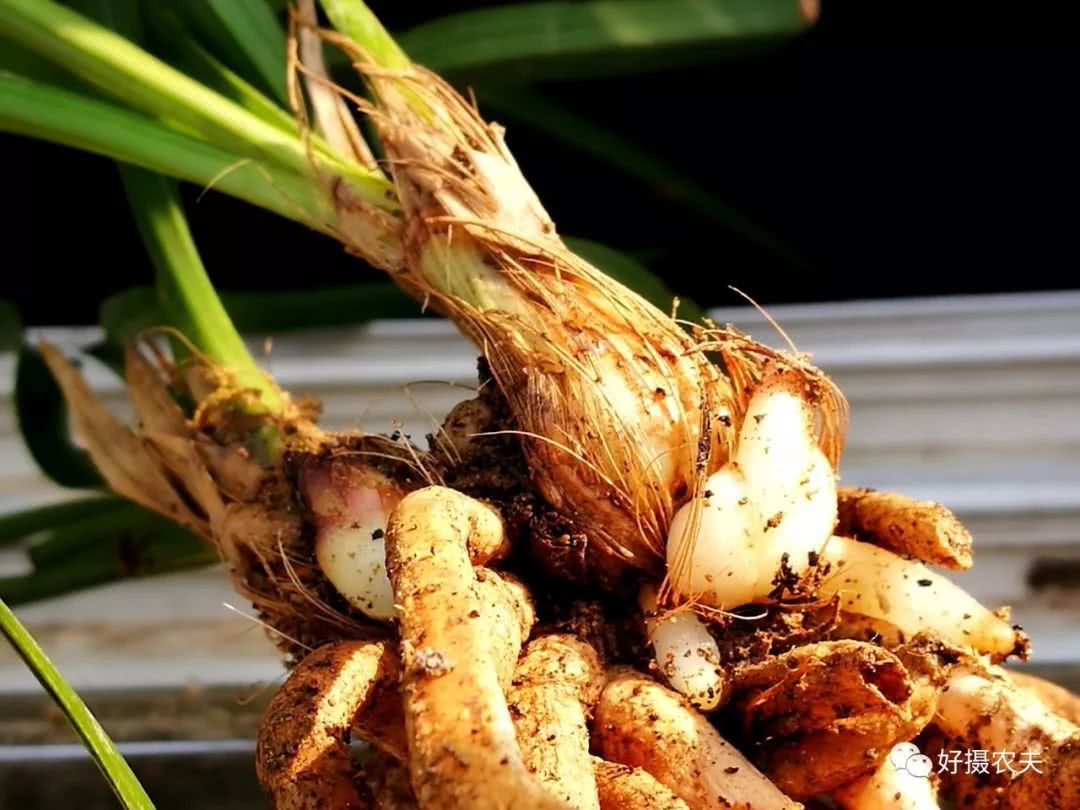
First, long-term partial watering causes orchid roots to absorb water unevenly, leading to the lower half of the orchid roots being short of water, drying out, and becoming hollow. But this phenomenon cannot be discovered in time, because the upper half is not short of water and there will be no sign of leaf water shortage in a short period. By the time a problem is found, the orchid has basically suffered severe damage.
Second, in the air we live in, in the potting medium, and in the water, there are varying degrees of inorganic salts, as well as some harmful substances that are bad for plant growth. This is unavoidable. If you water partially for a long time, it is equivalent to forming a small-environment saline-alkali soil. These inorganic salts and harmful substances are dissolved out by water, yet cannot be discharged, and can only accumulate in the orchid pot. The principle that small amounts of water draw up alkali is exactly the same.
So Haoshe Farmer often says that no matter what kind of green plant we grow, it is the same: we should refer to the survival laws of nature, and we don't have to apply books with a half-baked understanding. Of course, if you can truly understand what the book means, that is fine too.
The reason orchids should be watered thoroughly is exactly this. Watering thoroughly not only solves the problem of consistent water demand between the upper and lower parts of the orchid pot, but also washes away the harmful substances that have been dissolved out. Especially after fertilizing, you must water thoroughly to wash away unnecessary fertilizer residue.
What Haoshe Farmer means by watering thoroughly is that there must be a continuous strong flow of water coming out of the drainage hole at the bottom of the orchid pot. Do orchid growers now know why orchids must be watered thoroughly?
If you like it, follow this official account and share it with more friends.