Market Prospects and Economic Benefit Analysis of Ginkgo Leaf Plantations
Market Prospect Analysis and Economic Benefit Analysis of Ginkgo Leaf Plantations
1 Market Prospect Analysis of Ginkgo Leaf Plantations
As traditional Chinese medicine has been widely recognized in Europe, Japan and North America in recent years, Chinese-made traditional Chinese medicine products are very popular in foreign markets. At the same time, as the domestic population ages, many middle-aged and elderly people suffer from cardiovascular and cerebrovascular diseases such as high blood pressure, and the domestic demand for cardiovascular and cerebrovascular drugs is very large, with annual usage showing an upward trend. The medicinal components of ginkgo leaf extract are mainly ginkgo flavonoids and terpene lactone compounds, which are widely used in the treatment of cardiovascular and cerebrovascular diseases and the prevention and treatment of senile dementia. In particular, the bioactive substances mainly consisting of flavonoid glycosides among the flavonoids can increase cardiovascular and cerebrovascular flow, reduce cardiovascular and cerebrovascular resistance, and improve vascular circulation function. They are indispensable main medicinal materials for treating coronary heart disease, angina pectoris, high blood pressure and other diseases.
Taking Jiangsu Pizhou Xinyuan Biological Products Co., Ltd. as an example, this company is the largest ginkgo leaf processing enterprise in China. In recent years, its annual purchase of dried ginkgo leaves has been above 8,000 t, equivalent to 25,000 t of fresh leaves, processing and extracting 200 t of flavonoids, with about 80 t of products exported to the United States, Germany and Japan respectively, and 120 t sold in the domestic market. The purchase price of dried ginkgo leaves is 16,000-17,500 yuan per ton, equivalent to a purchase price of 4.6-5.3 yuan per kg of fresh leaves, and the market is very stable. Therefore, ginkgo leaf plantations, with the business purpose of collecting and selling ginkgo leaves, have broad market prospects.
2 Ginkgo Cultivation Techniques
Select a plot that does not accumulate water. According to the requirements of deep furrows and high beds, when preparing the nursery land, dig middle furrows and back furrows 40-50 cm deep and compartment furrows 20 cm deep. Apply 1,500 kg of compound fertilizer and 200 kg of cake fertilizer per hectare, or 4,000 kg of organic fertilizer. When planting, select 1-2 a-old seedling stock, with ground diameter above 0.6 cm, spacing of 50 cm x 60 cm, and a planting density of 37,500-42,000 plants per hectare, planted from January to March each year. In terms of management, the first year focuses on weed control, topdressing, drought resistance, drainage and other work. In the second year, the seedlings are basically closed in canopy, the labor input is relatively reduced, and benefits begin at this time. The annual fresh leaf picking period is from late July to mid-September.
3 Economic Benefit Analysis
Ginkgo leaf plantations begin to enter the full production period from the fourth year. When the seedlings grow to the sixth year and reach a height of more than 3 m, it is inconvenient to pick fresh leaves, so the seedlings are cut back to the trunk, and new vigorous branches sprout again the following year, allowing leaf picking in that same year. Therefore, the benefit cycle of a ginkgo leaf plantation is 6 years. Jingshan County, Hubei Province is located in central Hubei and is a major forestry county, with a forest land area of 168,000 hm2 in the county, accounting for 51% of the land area. In addition, Jingshan County began ginkgo cultivation in the 1990s. At present, the ginkgo cultivation area in the county reaches 2,600 hm2, and ginkgo cultivation techniques are mature. Taking Jingshan County as an example, the economic benefits of ginkgo leaf plantations are analyzed.
The input for a ginkgo leaf plantation mainly includes four aspects: land preparation, purchase of seedlings and planting, routine management and protection, and leaf picking. Its output is the sale of fresh leaves.
3.1 Input Calculation
The input costs of a ginkgo leaf plantation are mainly divided into: mechanical full reclamation and land preparation, seedling purchase, fertilizer purchase, and labor costs for planting, weed control, fertilization, leaf picking and so on.
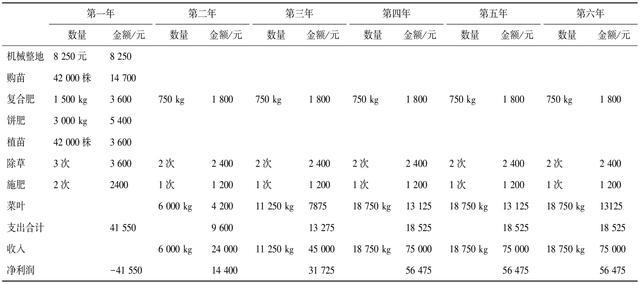
(1) Using mechanical full reclamation and land preparation, including trenching and ditching, requires about 8,250 yuan per hectare.
(2) For seedling purchase, select 1-2 a-old seedling stock, plant 42,000 plants per hectare, at a unit price of 0.35 yuan per plant, amounting to 14,700 yuan per hectare.
(3) Fertilizer costs. In the first year, 3,000 kg of cake fertilizer (1.8 yuan/kg) and 1,500 kg of compound fertilizer applied twice (2.4 yuan/kg) are needed per hectare. Thereafter, 750 kg of compound fertilizer is needed once each year.
(4) Labor costs. Planting requires 45 work hours per hectare. Weed control is done 3 times in the first year and fertilization 2 times; thereafter, weed control is done 2 times and fertilization 1 time each year, requiring 15 work hours per hectare each time, at 80 yuan per work hour. The labor cost for fresh leaf picking is calculated by weight, at about 0.7 yuan per kg.
3.2 Output Calculation
The output of a ginkgo leaf plantation is fresh leaves, and the price per kg is calculated at 4 yuan.
Table 1 Economic Benefit Analysis Table per Hectare of Ginkgo Leaf Plantation
3.3 Economic Benefit Analysis
The total input per hectare of a ginkgo leaf plantation over 6 years is about 120,000 yuan, with an average annual input of 20,000 yuan; the total benefit is 294,000 yuan, with an average annual benefit of 49,000 yuan; the net profit is 174,000 yuan, with an average annual profit of 29,000 yuan. It can be seen that its profit is far higher than that of ordinary crops, and compared with other forestry industries, it has a short benefit cycle and low later-stage input. For areas with sufficient labor, its benefits will be further increased.
4 Suggestions
In view of the stable market, large demand, low cultivation technique requirements and low human resource consumption of this industry, and in combination with the current situation of rural labor, farmers are encouraged to adopt various business models such as independent operation, joint-household operation and land shareholding, and to promote ginkgo leaf plantations in mountainous rural areas as a project for targeted poverty alleviation and transformation of agricultural development modes. The government and relevant departments should issue corresponding support policies, combine them with targeted poverty alleviation work, rationally use poverty alleviation funds, develop ginkgo leaf plantations, and fully mobilize farmers' enthusiasm for planting ginkgo leaf plantations. Forestry departments should do a good job in planning, technical guidance, market information collection and product sales, and provide good services for increasing forest farmers' income.