In folk tradition, it is called "swelling-dispelling herb"; it looks like amaranth, and its root is a rare treasure.
Warm reminder
Hemu Report aims to share and popularize information about various plants and their uses, for reference only. If medicinal use is needed, it is advisable to consult a professional physician to avoid problems!
Everyone has a love of beauty. For female friends who love beauty, dyeing nails is one of the must-do routines. As a child, I often planted many garden balsams (Impatiens balsamina) around the house, and together with the girls in the village I used them to dye our nails red, thinking it was both fun and pretty. The love of beauty knows no age. In ancient China, people also used plants to dye their nails, because ancient cosmetics craftsmanship was not so advanced; they all used pure natural plants to dye nails and make rouge. There is a kind of wild grass that seems to have grown precisely for women who love beauty. Its fruit is purplish-red, and when lightly squeezed by hand, it releases bright-colored juice with strong coloring power. In ancient times it was called "rouge grass," commonly used to dye nails, and women also used it to dab their temples as rouge.
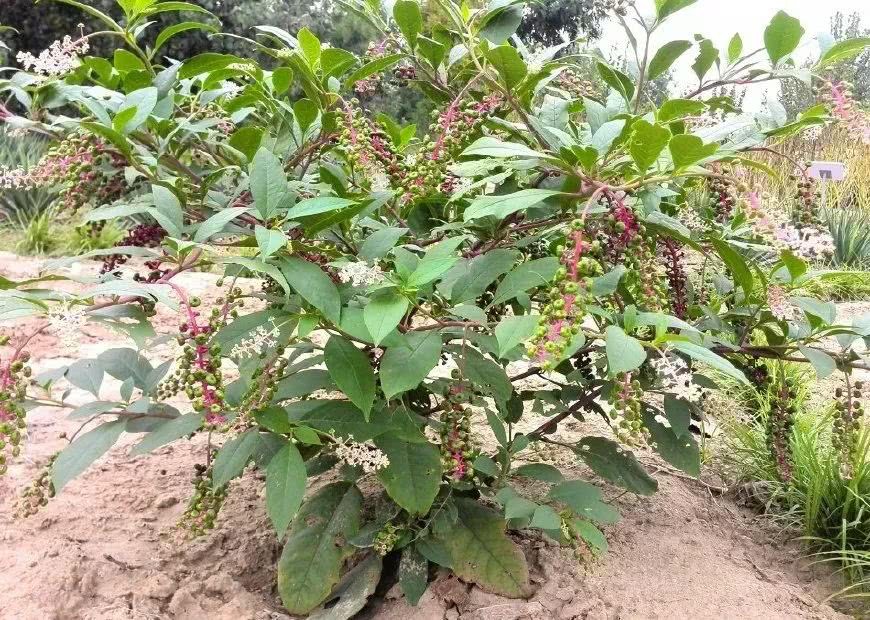
The leaves of rouge grass are relatively broad and look extremely similar to amaranth leaves. In the ancient book "I Ching," it is called "xianlu." Nowadays in some rural areas of southern China, quite a few farmer friends also call it "large amaranth." Although it looks like amaranth, that does not mean it is edible like amaranth. The scientific name of xianlu is "pokeweed" (Phytolacca acinosa). For people familiar with plants, this name belongs to a very famous plant. Because pokeweed is a toxic plant, especially its root, which contains neurotoxic substances and is relatively strong in toxicity, it absolutely must not be eaten as a wild vegetable.
Although pokeweed is toxic, its root is a rare treasure. In "Fu on Drug Properties" its effects are described this way: "Pokeweed treats swelling." This sentence highly summarizes pokeweed's effects, namely treating edema, dissipating masses, and promoting both urination and defecation. Therefore, pokeweed also has another name; in folk tradition it is called "swelling-dispelling herb." There are two kinds of pokeweed: one with red stems and another with green stems. The red-stemmed pokeweed is more toxic and is called "drooping pokeweed" (Phytolacca americana), named because its fruit spike droops. In folk tradition, drooping pokeweed is usually used only externally, to treat skin sores, toxicity and swelling.
The root of pokeweed grows relatively large and closely resembles the purslane-family plant "Talinum paniculatum." Because Talinum paniculatum is also called "false ginseng," some people cultivate pokeweed as false ginseng and use its root to make infused liquor for consumption. The consequences of doing so are very serious and can lead to poisoning. In mild cases there is numbness of the mouth and tongue, headache, and muscle twitching; in severe cases it can cause paralysis of the respiratory system and even fatal consequences. So everyone must be sure to recognize pokeweed clearly and not mistakenly eat it as a wild vegetable or ginseng.
To use pokeweed as "swelling-dispelling herb," it needs to go through strict processing procedures, so it is not recommended that everyone collect and dig up this toxic wild grass on their own. If needed, please consult a professional doctor. Dear readers, do you know pokeweed?
Text/Hemu Report, Images/Internet
If you like Hemu's articles, you are welcome to follow.