No matter how miserable the succulents look, succulent growers still dare to face it head-on
Follow
Follow the Encyclopedia · Meet the Beauty (WeChat ID: duoroubaike)
The main text begins:
Thanks to the author [Nuan Xi] for theoriginal exclusive authorizationsharing
Edited and compiled by: Encyclopedia Jun
Location: Jinhua, Zhejiang
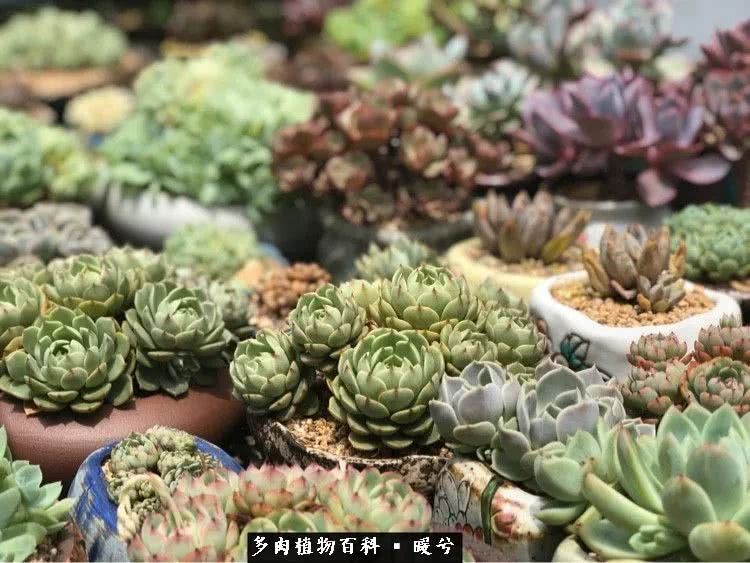
Start of summer has arrived, and the succulents grown outdoors in the free-shipping region are like this
Then look at the succulents in winter
So you see, comparison photos and such are the most damaging of all
It shows that no flower stays red for a hundred days, but still, it is so good to be alive!
As long as you are alive, there is hope, and when autumn and winter come, there will be brilliant colors again
Just like our lives. The good thing about being at the lowest point in life is that no matter which direction you work hard toward, it is upward.
The same goes for succulents. They can be green or leggy, but they cannot fail to try hard, because the climate of the free-shipping region for succulents and for succulent growers means that trying hard may work, but not trying hard definitely will not!
If we do not work hard today, and do not work hard tomorrow either, then our lives are merely repeating themselves.
We must firmly believe that what wakes you up every day is not the alarm clock, but the dream in your heart.
A new day has begun, and the only person we should strive to surpass is the self we were yesterday.
Having gone through two scorching summers and bid farewell to many beloved succulents, the third summer has come. Fear and worry cannot solve problems, and leaving the hobby is also hard because of the love for succulents, so I still have to sum up experience and lessons
About watering.In the first two summers, I once watered around the edge once a week, later extended it to two weeks, and when the temperature was high I sprayed into the air. None of this kept the succulents alive. After repeatedly consulting succulent friends in the free-shipping region, this year I decided to try: control water in May, basically cut off water from June to September (when a typhoon comes, if the temperature is below 30°C and there is relatively low-temperature weather for more than three days, give a small amount of water), give a small amount of water in October, and then slowly return to normal watering. For ordinary watering, you cannot measure it by how often you water, but by whether the outer one or two rings of leaves have become soft. The general principle is that if the air is humid and stuffy, the soil must not be wet; the two must not appear at the same time.
About ventilation.Humidity and stuffiness are typical climate features of Jiangnan, and succulents are also juicy plants, so they are most prone to turning to water and black rot, which is why ventilation is key. Last summer I once kept a batch of Peach Eggs and White Bears on the office windowsill, enjoying air conditioning together during work hours, with the windows open at night and on weekends, and not a single one died. The Bear Eggs in the corridor at home almost all died completely, which shows that in summer in the free-shipping region, succulents are suited to air-conditioned rooms, but many people do not have this condition, so for environments where ventilation is not very good, fans must run constantly. Even in Korean greenhouses, there are fans on top, buzzing all day long.
About soil mixing.I once was especially superstitious about gritty soil, but practice has proven that even gritty soil at more than 90 percent failed to keep the succulents alive, and with too much grit, over time the succulents do indeed become thin and weak, which is not good for filling the pot and producing pups. I think that in the free-shipping region, a grit content of 60 to 80 percent in the soil mix is more suitable. If anyone thinks this is wrong, please do not flame me.
About pot selection.Indeed, different materials have completely different water permeability. Succulents in the free-shipping region are not very suited to fully glazed pots, and especially for some hard-to-grow varieties, they must be used with caution.
About light.In summer, high temperatures are common nationwide, and for succulents, they cannot be directly exposed to the sun. In the sun, it can reach 40°C in minutes, so shading is a must. Moreover, in the free-shipping region, May and June are the rainy season, June and July are the plum rain season, and July and August are the typhoon season. There really is a lot of rain, and shading alone without rain protection will not do. In order not to get rained on, I would rather not let them get sun, so some varieties will become a bit leggy, but at least they will not die on you.
In short, plan a little ahead, be a little more diligent and hardworking, and more succulents will always survive, and then when you least expect it, they will arrive in full splendor! This is the beauty of succulents.
AdvertisementADVERTISEMENT
This article has beenexclusively authorizedby the author to the WeChat public account: Succulent Plant Encyclopedia (ID: duoroubaike). The content of the article does not represent the views or stance of the public account
- Review of last issue's wonderful posts -
- Encyclopedia featured articlesrecommended -