Summary of propagating Pelargonium 'Angel's Eye' from cuttings: high rooting rate, plenty of flowers and beautiful
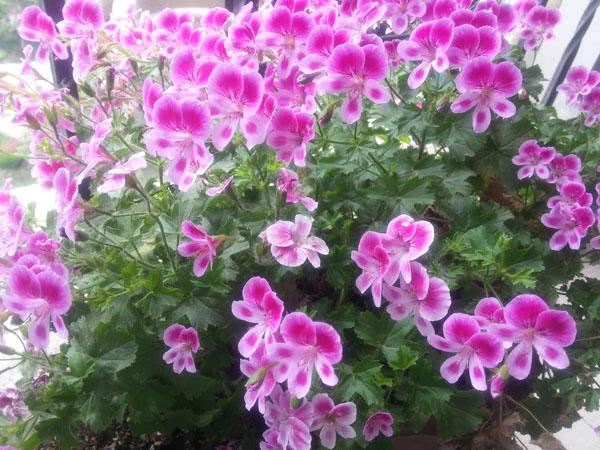
I have a pot of pink Angel's Eye, and it is gorgeous when in bloom, delighting the eye and lifting the spirit. The way it blooms makes me feel the beauty of life. Friends and relatives who saw it liked it too, and took some cuttings from me. This autumn, I decided to practice my hand and try propagating Angel's Eye myself. To be honest, after growing flowers for several years, I had never actually tried taking cuttings before, not even of the most ordinary plants. Only later did I learn that Angel's Eye is one of the pelargonium varieties that is hard to root. Below is a summary of my cutting experience:
1. Cutting season: autumn is best, with temperatures between 13-25°C. If rooted in autumn, you can enjoy the flowers the following Red May. You can also take cuttings in winter, but rooting is slow when it is cold.
2. Cutting medium: I chose imported peat plus perlite; perlite can make up as much as 40%, and some people even use pure perlite for cuttings.
3. Containers used: I used cheap and good clear disposable plastic cups. Note: do not punch holes in the bottom. The advantage of using cups is that one cutting goes into one cup, so there is no cross-infection. If it has rooted, you can observe it. Once you see roots extending to the wall of the cup, there are already quite a few roots inside, which means it has definitely rooted. As for when to transplant, whenever you like, there is no need to be rigid about it. When transplanting, simply cut away the cup and move the whole medium into the pot, planting it directly, without damaging the roots, and it is convenient too.
4. Choosing cuttings: generally choose the tender tip shoots of the current year, use a sterilized sharp knife or scissors to cut the shoots into 5 or 6 cm cuttings, and remove a few leaves at the bottom. However, in my experiment, a sturdy middle section without a growing tip rooted in 15-20 days, while the tender tip shoot took more than a month to root. This also shows that when choosing cuttings, sturdy shoots of the current year are the first choice.
5. Regarding how many leaves to leave on the cutting, I will say a bit more, because some flower friends think cuttings should keep few leaves, only two or three. I think this is debatable. In my view, taking cuttings is essentially a process of material production and material conversion. That is to say, root growth cannot do without leaves; leaves produce materials through photosynthesis, and the materials flow and are converted downward, forming roots. Therefore, provided that water is supplied abundantly, you can leave more leaves, and this way rooting is faster. My experiment has already proven this point. (If it is not water propagation, leaving fewer leaves is reasonable.)
6. Treating the cut: the cut end of the cutting is best placed near the node, cut at an angle with a sharp knife, and after cutting, dip it briefly in potassium permanganate aqueous solution to disinfect, then dip it in a little rooting powder.
7. How much water to add: since I drew on the sand water propagation method and improved it into my own peat water propagation method, in fact my cutting bed, that is, the peat, does not have that much water. The potassium permanganate aqueous solution I used only slightly covered the peat. This is because if there is too much water, the cuttings cannot stand upright, which is determined by the different properties of peat and sand.
8. Regarding sunlight: my approach is to first put the cuttings in a shady place for three days after propagation. After three days, let them get direct sun. Sunlight is the best sterilizer and preservative, and sun exposure also helps rooting.
9. Regarding ventilation: do not cover the cuttings; keep good ventilation. Everyone has already reached a consensus on this point.
The above points are my summary of experience in propagating Angel's Eye from cuttings, shared here for beginners' reference only. Because my level is limited, if there is anything inappropriate, I also welcome experienced growers to exchange views and offer criticism and corrections. Thank you!