Detailed Explanation of Key Techniques for Cultivating Large Single-Trunk Crape Myrtle Seedlings
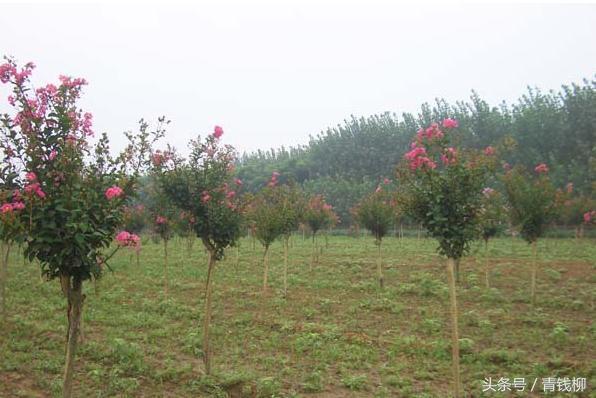
Cultivation Techniques for Large Single-Trunk Crape Myrtle Seedlings
Crape myrtle (Lagerstroemia indica) belongs to the genus Lagerstroemia in the family Lythraceae, also known as hundred-day red, mantanghong, itchy tree, and itchy flower. It is a shrub or small tree. The bark of crape myrtle is smooth, young branches are four-angled, leaves are alternate or opposite, and the flower colors are purplish-red or pink, bright and gorgeous, with a long flowering period from early July all the way to mid-October. It is a well-known ornamental tree and street tree for urban courtyards. Crape myrtle seedlings have extremely strong sprouting ability and well-developed lateral branches. When cultivating large single-trunk seedlings, they easily form a bush shape or curved trunk, failing to meet the requirements for landscaping tree species. For this reason, combined with many years of production practice in breeding single-trunk crape myrtle seedlings, a set of key techniques for cultivating large single-trunk crape myrtle seedlings has been summarized. The main cultivation techniques are summarized as follows.
1 Nursery site selection
Select a plot with convenient transportation, deep and fertile soil, good drainage and irrigation, sufficient sunlight, and soil pH of 6.5~7.2 as the cultivation nursery.
2 Land preparation and hole digging before seedling planting
Before the freeze, rotary till the entire nursery 1 time with a rotary tiller. Crape myrtle grows slowly, and cultivating large single-trunk seedlings is mainly focused on developing the trunk. To cultivate seedlings with a diameter at breast height of 5~7cm, holes should be dug at a spacing of 1m x 1m, with hole specifications of 50cm x 50cm x 50cm. Keep topsoil and subsoil separately piled. After the ground thaws in spring, backfill the topsoil first, then the subsoil. When the soil has been backfilled to about 25cm from the ground level, apply 10kg of fully decomposed farmyard manure + 0.5kg of phosphate fertilizer per hole, mix well with the soil, and fill back into the hole. The backfilled soil should be 15~20cm above the ground surface.
3 Seedling transplanting
The transplanting time is from late February to early-to-mid March. Use 1~2 year old cutting seedlings or seedling-grown plants. The planting depth should be such that the original nursery soil is level with the ground. Tamp down with backfilled soil and water thoroughly to settle the roots. Plant 667 plants per 667m2.
3.1 Watering after transplanting and timely topdressing
Regularly observe soil moisture. Generally, water 2~3 times before the rainy season from March to June. Before each watering, in mid-April, dig holes about 20cm deep on both sides of the trunk within the crown projection, and apply 0.1~0.2kg of urea per plant; from late May to early June, apply 0.1~0.2kg of urea per plant; from late July to mid-August is the fast-growing period of crape myrtle and also the flowering and fruiting period. Combined with intertillage and weeding, apply 0.2~0.3kg of nitrogen-phosphorus-potassium compound fertilizer per plant, which can promote the growth of crape myrtle and supplement the large amount of nutrients consumed by flowering and fruiting. The amount of fertilizer applied increases with the age of the tree.
3.2 Intertillage, weeding and deep plowing
After rain and after watering, intertillage and weeding must be carried out 1 time. Weeding and loosening the soil should be done simultaneously. Especially in July, on sunny days, remove ground weeds 1 time early. The depth is 10~15cm. From September to October, deep plow the entire nursery 1 time every other year. Within the tree disk, the depth is 5~10cm, and outside the tree disk, deep plowing is 20~30cm.
3.3 Timely pruning to ensure normal trunk growth
Crape myrtle has strong sprouting ability, well-developed lateral branches, and weak apical dominance. During the process of cultivating a single trunk, it most easily forms a bush or curved trunk, failing to meet the application specification requirements for courtyard landscaping and street trees. Therefore, reasonable pruning must be carried out. Years of practical experience have proven that the pruning period should be during the growing season, that is, from late June to mid-July. Some small seedlings of crape myrtle bloom in the same year as cuttings. From June to August is the fast-growing period of crape myrtle and also its flowering and fruiting period. When pruning in July, while cutting off branches and leaves, the inflorescences and fruits are also cut off, which can save the labor of cutting off inflorescences and fruits, concentrate the nutrients of the seedling, and help promote trunk thickening and height growth, thereby forming a straight trunk and a good crown shape.
Generally, pruning begins from the 2nd year after planting. For bushy crape myrtle seedlings, select and retain thick, upright branches to cultivate as the trunk, and cut off all the rest. After cutting off useless lateral branches, new tender buds will grow again below the cut. When the young buds grow to about 5cm, they should be removed in time. Bud removal is needed 2~3 times a year as needed. For crape myrtle seedlings whose trunks grow poorly or are curved, cut off the seedling stem at 5~10cm from the ground. After cutting, new branches will sprout again from the base below the cut. Be sure to select and retain 1 vigorous new shoot to cultivate as the trunk, and remove all other new shoots. When cutting off sprouted lateral branches at the base of the trunk, note that the cut should be close to the trunk and the cut should be smooth. For sprouts buried in the soil, be sure to dig away the soil at the base of the trunk before cutting off the sprouted branches, so as to avoid sprouting new branches again. For lateral branches growing on the trunk, according to the growth vigor of the crape myrtle seedling, cut off lateral branches on the trunk from bottom to top year by year, or shorten some lateral branches on the upper 1/3 of the trunk, maintaining the clear trunk height (referring to the height from the ground surface to the first branching point of the crown) at about 1/3 of the tree height. Thin out some lateral branches below the clear trunk height, shorten vigorously growing branches (generally mainly light pruning, cutting off 1/4~1/2 of the branch length), cut off small branches near the top of the main trunk leader to facilitate trunk cultivation, and cut off a small number of inflorescences and fruits. During management in the growing season, frequently check for sprouts growing on the clear trunk height and remove them as soon as they are seen. Gradually increase the clear trunk height year by year, always maintaining the clear trunk height at about 1/3 of the tree height. When the clear trunk height reaches the specification for landscaping tree species, about 1.5m or more, stop pruning for clear trunk height and focus on crown shape cultivation.
3.4 Pest and disease control
The main pests and diseases of crape myrtle include powdery mildew, brown spot, yellow slug moth, crape myrtle long-spotted aphid, and crape myrtle mealybug. After leaf fall in winter, promptly remove dead branches and fallen leaves and burn them in a centralized manner to eliminate overwintering sources of pests and diseases. Before sprouting, spray the entire nursery with 5°Be lime sulfur mixture or 50% carbendazim wettable powder 800 times solution, which can prevent the occurrence of powdery mildew and brown spot. During the growing season, use 2.5% kungfu emulsifiable concentrate 2500 times solution + 1.8% abamectin 2500 times solution, or alternately spray jiebis ha 2000 times solution, which can fully control the occurrence of yellow slug moth, crape myrtle long-spotted aphid, and crape myrtle mealybug.
3.5 Seedling delivery out of the nursery
Generally, after 5~6 years of cultivation, the diameter at breast height can reach 5~6cm, the plant height is 2.5m or more, the crown width is 1.6~2.5m, the clear trunk height is 1.5m or more, and the trunk is straight, the branching is reasonable, and the crown is symmetrical, meeting the standards of qualified seedlings. They can be delivered out of the nursery according to market demand.