Propagation Methods and Pest and Disease Control Techniques for Ornamental Peach Bonsai
Propagation and Pest and Disease Control Bonsai Techniques for Ornamental Peach
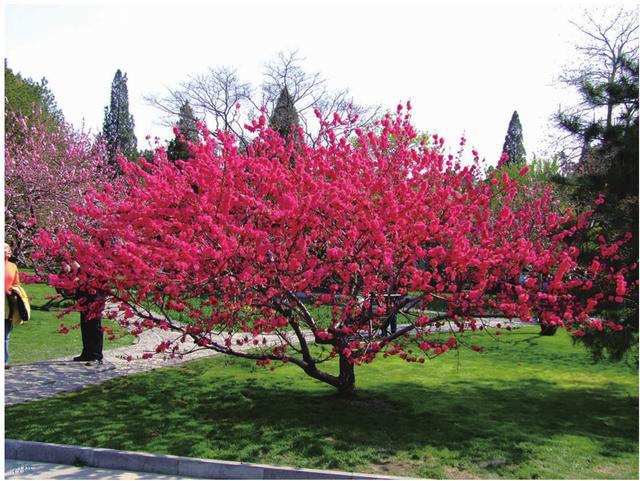
Ornamental peach refers to varieties grown for ornamental purposes. Compared with fruit peaches grown for food, they have the characteristics of larger flowers, more petals, graceful flower shapes, rich colors, and a longer flowering period. Except for a few varieties, ornamental peaches generally do not bear fruit; even if they do, the fruit is inedible, poor in color, and small. But their bright and brilliant flowers are a symbol of spring and an indispensable flowering plant for spring viewing.
Ornamental peaches can be planted as solitary specimens, in clumps, or in rows in courtyards, plazas, along roadsides, and near buildings. They can also be interplanted with willow trees to create a "red peach and green willow" landscape effect. They can also be grown as potted plants for viewing or made into bonsai. In addition, their cut branches can be used as cut flowers or for vase arrangements.
Variety Characteristics
Ornamental peach is a deciduous small tree or shrub in the genus Prunus of the Rosaceae family. Depending on the variety, the branches may spread outward, droop downward, or grow straight upward. The young branches are reddish-brown or greenish-brown; the buds have gray downy hairs; the leaves are elliptic-lanceolate with acuminate tips and fine serrated margins. Besides green, the leaf color can also be purplish-red. The flowers are solitary or in pairs in the leaf axils, opening simultaneously with the leaves or slightly earlier. Flower colors include white, pink, scarlet, deep red, and purple-red. Some varieties can even produce flowers of different colors on the same plant, and even a single flower may have spots or streaks of two different colors. The flower types can be divided into 5 categories:
Single-petal type: 5 petals, with a relatively flat and spreading flower shape;
Plum-blossom type: 20-25 petals, with a flower shape resembling plum blossoms;
China rose type: after the flower opens, the outer ring of petals turns outward while the inner ring wraps inward, like a small China rose;
Peony type: more than 40 petals, the entire flower resembling a flower ball, quite like a peony;
Chrysanthemum type: petals are slender and numerous, resembling a chrysanthemum in appearance.
The flowering period of ornamental peaches varies by region. In warmer regions such as Guangdong and Guangxi, they can bloom around the Spring Festival or even earlier, while in colder northern regions they do not bloom until April to May.
Among ornamental peaches, the most commonly cultivated and richest in varieties is the bitao (ornamental peach), including Sajin Bitao, Shouxing Bitao, Chuizhi Bitao, Honghua Bitao, Ziye Bitao, Baihua Bitao, Qianban Bitao, Liangse Bitao, Wucai Bitao, Renmian Tao, and others. There are also other types of ornamental peaches such as broom peach and mountain peach.
Propagation Methods
Ornamental peaches are mainly propagated by grafting. One-year-old seedlings of wild peach, mountain peach, or apricot can be used as rootstock, or one-year-old shoots sprouting from old peach tree stumps that have grown for many years can be used as rootstock. The scion should be branches or buds of superior ornamental peach varieties. To enhance ornamental value, different varieties of ornamental peach can be grafted onto a single plant so that it produces flowers of different colors and flower types.
1. Cleft grafting
Also called branch grafting, this is carried out before sprouting in spring. The scion should be vigorous, well-developed branches from the previous year. The rootstock should be about 1.2 cm thick. Cut off the branches above ground, split a small slit in the middle of the rootstock, and cut the lower end of the ornamental peach scion into a slanted surface with a sharp knife so that it fits into the slit of the rootstock. Then tie it firmly with plastic rope, cover it with a mound of soil, and protect it from wind and sunlight. It can resume growth in about one month.
2. Bud grafting
This is the most commonly used propagation method for peaches, carried out from May to August each year. The rootstock should be smooth and sturdy, about 1.5 cm in diameter. Buds from the middle section of well-developed current-year branches of superior peach varieties are used as scions. When selecting buds for grafting, choose relatively pointed leaf buds, because only such buds can successfully sprout branches after grafting and survive. Round, plump buds covered with more white silky hairs are flower buds and cannot be used. When grafting, first make cuts above and below the scion bud with a sharp knife, then make two vertical cuts on the back of the bud, and forcefully lift out a 0.3 cm thick piece of bark, called a "pattern." Then, according to the size of the "pattern," remove a bud piece from the sturdy bud area on the rootstock in the same way, and fit the bud piece from the scion onto it. Alternatively, cut the scion bud into a "T" shape and also make a "T"-shaped cut on the rootstock, insert the grafted bud into the cut, and make them fit together. Finally, tie it from top to bottom with hemp fiber or plastic rope, leaving only the leaf stalk and bud exposed. The tying should not be too tight to avoid damaging the bud piece. If the bud color remains unchanged after 10 days, it indicates that it has survived.
For successfully grafted plants, promptly remove new buds sprouting from the rootstock and cut off branches on the rootstock. For bud-grafted plants, when the grafted bud has sprouted about 10 cm, cut off the rootstock 1.5-2 cm above the grafted bud. These measures are all to prevent branches on the rootstock from dispersing nutrients and to promote the growth of the scion.
Cultivation and Management
Ornamental peach is native to China and distributed across the provinces of North China, Central China, and Southwest China. It has been introduced and cultivated in countries around the world. It prefers a warm, humid environment with ample sunlight and is cold-tolerant but afraid of waterlogging. It is suitable for growing in loose, fertile, well-drained sandy soil, and dislikes alkaline soil and heavy clay soil.
1. Field planting management
Field-planted ornamental peaches can be planted in sunny, well-ventilated locations. They can be planted on embankments, sunny slopes, lawns, roadside green belts, residential communities, and courtyards, but should not be planted under large-canopied trees to avoid affecting ventilation and light penetration, nor in low-lying waterlogged areas to avoid root rot caused by water accumulation.
(1) Transplanting: Ornamental peaches are transplanted with a soil ball in early spring or after leaf fall in autumn. For young trees, the soil ball may be omitted, but the roots should be coated with mud slurry. When transplanting large trees, a soil ball must be used to increase the survival rate. The planting hole should be dug slightly larger, and fully decomposed farmyard manure, cake fertilizer, etc. should be applied as base fertilizer. After planting, water thoroughly once. For peach trees with larger canopies, support frames should be used after planting to secure them, so that strong winds do not cause the plant to sway back and forth and adversely affect subsequent survival and growth.
(2) Watering: Field-planted ornamental peaches only need one thawing water in early spring and one freezing water in late autumn each year. In summer during high temperatures, if drought persists, appropriate watering is also needed. If dry hot wind weather occurs, water should also be sprayed around the plant's environment to increase air humidity. During the rainy season, pay attention to drainage and do not let the soil become waterlogged to avoid root rot. Ornamental peaches like dryness and fear moisture. Usually, attention should be paid to cultivating and loosening the soil to preserve moisture and eliminate weeds.
(3) Fertilizing: Ornamental peaches are generally fertilized once before and after flowering and once after autumn with fully decomposed organic fertilizer. When fertilizing, dig a trench about 35 cm from one side of the trunk, apply the fertilizer, cover with soil, and then water. The next year, dig a trench and fertilize on the other side of the trunk. In this way, alternate each year, and as the plant grows, gradually increase the distance from the trunk. If quick-acting phosphorus and potassium fertilizer is applied 1-2 times in June to July, it can promote the formation of flower buds.
(4) Pruning: For adult ornamental peaches, the main purpose of pruning is to control plant height, maintain a beautiful tree shape, inhibit apical dominance, promote the growth of lower branches and the formation of flower buds, and achieve balanced growth of the plant. The tree form of ornamental peach is mainly the natural open-center form. First, carry out a small pruning and shaping before flowering in spring, cutting off branches that affect the beauty of the tree shape so that it has a graceful form when flowering. After flowering, carry out a major pruning to control vigorous water shoots and maintain the perfection of the tree shape. When pruning, first appropriately shorten the side branches, then combine shaping by cutting off diseased and pest-infested branches, inner canopy branches, dead branches, water shoots, and crossing branches, so that the canopy is full and rounded and always maintains good ventilation and light penetration. Shorten the branches that have flowered, leaving only 2-3 buds at the base. When these branches grow to about 30 cm, promptly pinch the tips. In summer, when branches grow too vigorously, also promptly pinch the tips to promote plump axillary buds and the formation of more flowering branches, which is favorable for flower bud differentiation.
2. Potted management
For potted ornamental peaches, it is advisable to choose varieties such as Shouxing Bitao with short plants, shorter internodes, compact canopies, and graceful forms. Pot them after leaf fall in autumn or before flowering in spring. The potting soil can be a mixture of 1 part leaf mold, 1 part garden soil, and 1 part river sand, mixed with a small amount of decomposed cake fertilizer, bone meal, or superphosphate as base fertilizer. Usually, do not water too much. "Do not water until dry; when watering, water thoroughly" is the best choice. In autumn, control water and fertilizer even more to prevent the sprouting of autumn shoots and promote the lignification of current-year branches, which is beneficial for safe overwintering. In winter, move them to a cold room or overwinter outdoors in a wind-protected, sunny place, and keep watering to the principle of watering when dry. Repot once every spring. When repotting, cut off dead roots, rotten roots, and overly dense roots, and replant with new culture soil.
Pruning of potted ornamental peaches is basically the same as that of field-planted ornamental peaches. When pruning, pay attention to controlling plant height and making the distribution of branches reasonable in order to create a beautiful tree shape.
Flowering Period Control
In the north, the natural flowering period of ornamental peaches is March to April. If needed, potted ornamental peaches can also be forced to bloom so that they flower at New Year's Day or the Spring Festival. The method is: after the ornamental peach loses its leaves, place it in a low-temperature environment of about 7°C. Move it indoors 40-45 days before the Spring Festival, first giving a room temperature of 5-10°C, then gradually raising the temperature to 20-25°C. Pay attention to sprinkling water on the flowering branches every day to prevent the branches from drying out and wilting, and to promote the flower buds to open. If the flower buds split and show color ahead of time, promptly move them to a low-temperature room at about 15°C. In this way, the flowering time of the plant can be effectively delayed.
Pest and Disease Control
Ornamental peaches have relatively weak disease resistance. The main diseases that easily occur include brown spot disease, leaf curl disease, and trunk gummosis, all caused by fungal infection. They can be controlled by spraying 600-700 times diluted chlorothalonil or carbendazim solution. When spraying, be careful to spray both the front and back sides of the leaves.
The insect pests of ornamental peaches include aphids, scale insects, red spiders, stinging caterpillars (commonly known as "yang la zi"), and leaf roller moths. They can be killed with relevant pesticides, but note that dimethoate should not be used on ornamental peaches, otherwise it will cause phytotoxicity, resulting in yellowing and falling leaves. For pests such as longhorn beetles that bore into trunks, comprehensive control methods should be used: use light traps to kill adults; cut off infested branches; inject 50-100 times diluted trichlorfon solution into the insect holes, or use medicated mud or poison sticks to block the insect holes for control.