Aucuba japonica planted with rockery stones as an ornamental hedge; a few specimens dotted around the courtyard offer year-round interest
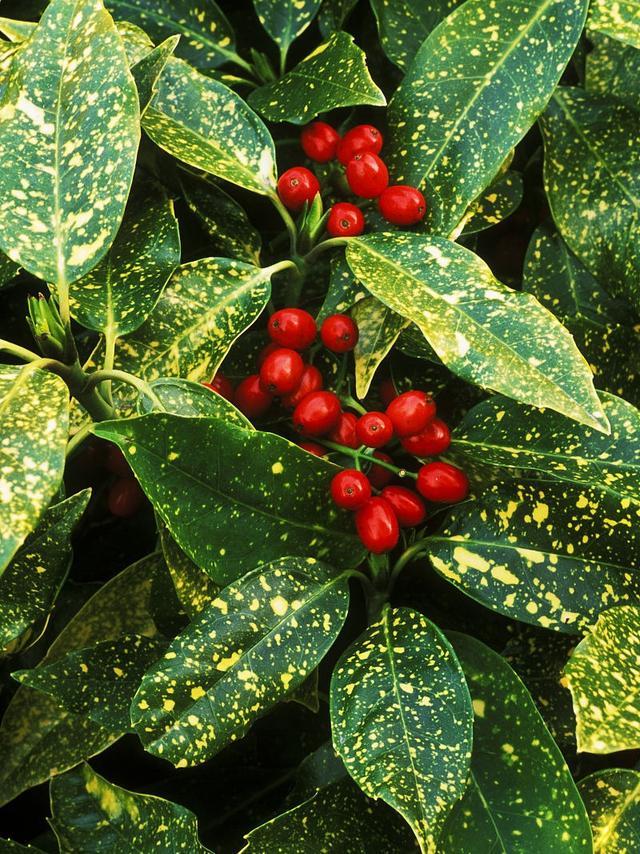
Aucuba japonica
Aucuba japonica (Aucuba chinensis Benth.) is an evergreen shrub of the dogwood family, with green branchlets covered in soft hairs, and older branches bearing white lenticels.
Leaves opposite, thinly leathery, long elliptic to obovate-lanceolate, 10-20 cm long, with a tail-like point at the tip, cut-shaped at the base, entire or with sparse teeth on the middle and upper part, leaf surface with stiff hairs, petiole about 3 cm long, flowers purple, arranged in racemes, drupe berry-like, dark red when ripe.
Fruit ripening period from November to February of the following year.
Morphological characteristics
Aucuba japonica (nominate subspecies) Aucuba chinensis Benth. subsp. chinensis is an evergreen small tree or shrub, 3-6 (-12) m tall;
Branchlets stout, dichotomously branched, green, smooth; lenticels white, long elliptic or elliptic, relatively sparse;
Leaf scars large, conspicuous.
Winter buds spherical, scales in 4 pairs, decussate, the outer whorl shorter, ovate, the rest broadly elliptic, the outer side of the apex of the inner two whorls covered with soft hairs.
Leaves leathery, elliptic or broadly elliptic, rarely obovate-elliptic, 10-20 cm long, 3.5-8 cm wide, apex acute or obtuse, base broadly cuneate or cuneate, rarely asymmetrical on both sides, margin slightly revolute, often with 5-8 pairs of serrations or glandular teeth, sometimes coarsely serrate;
Leaf upper surface dark green, lower surface light green, midrib slightly prominent above, protruding below, lateral veins 6-8 (-10) pairs, rarely intersecting the midrib at nearly a right angle;
Petiole 2-4 cm long, stout, smooth.
Panicles terminal, peduncle covered with soft hairs, male inflorescence more than 5 cm long;
Male flowers green (February), purplish red (Flora of Hainan); calyx apex with 4 teeth, glabrous or sparsely pubescent;
Petals 4, oblong or ovate, 3-4 mm long, 2-2.5 mm wide, outer side sparsely hairy or glabrous, apex with a short pointed tip; stamens 4, about 3 mm long, inserted on the outside of the disk, anthers yellow, 2-locular;
Disk fleshy, slightly 4-angled;
Pedicel about 3 mm long, covered with soft hairs;
Bract 1, lanceolate, 3 mm long, outer side sparsely pubescent.
Female inflorescence shorter than male inflorescence, about 4-5 cm long, calyx and petals similar to male flowers, ovary cylindrical, style stout, stigma capitate, slightly oblique;
Disk fleshy, slightly 4-lobed; with 2 small bracteoles below the flower, lanceolate, about 4-6 mm long, margin ciliate;
Articulate below the flower, covered with soft hairs.
Young fruit green, bright red when mature, cylindrical or ovate, 1.4-1.8 cm long, 8-10 (12) mm in diameter, sepals, style and stigma all persistent at the upper end of the drupe.
Flowering period January-February; fruit ripening period extends to February of the following year, often coexisting on the branches with one- and two-year-old infructescences.
Aucuba japonica (nominate variety) Aucuba chinensis Benth. subsp. chinensis var. chinensis
This variety has leathery, elliptic leaves, rarely obovate-elliptic, 3-8 cm wide. It is easily distinguished from narrow-leaved aucuba (variety).
Growing environment
Often grows in evergreen broad-leaved forests below 1000 m altitude.
Prefers warm and humid environments, strongly shade-tolerant, not drought-tolerant, not cold-tolerant, requires fertile, moist, well-drained soil; it is a shade-tolerant shrub, afraid of strong sunlight exposure in summer, not tolerant of high temperatures.
Distribution range
Distributed in China's middle and upper reaches of the Yangtze River in Hubei and Sichuan, and in Fujian, Yunnan, Guangxi, Guangdong, Taiwan, China, Hainan and other regions. According to literature records, it is also distributed in Vietnam.
Propagation methods
1. Placement: Aucuba japonica is shade-tolerant, but it is best placed in a location with bright light.
2. Temperature: Aucuba japonica likes warmth and is not very cold-tolerant; it fears high temperatures in summer. When the temperature exceeds 24°C, water should be sprayed on the leaves promptly, or the plant should be placed on wet stones to increase air humidity.
3. Watering: Aucuba japonica needs a large amount of water throughout the year; keep the potting soil moist.
4. Fertilizing: Apply standard liquid fertilizer once a month to Aucuba japonica.
5. Cultivation and repotting: Aucuba japonica is best planted in loose, well-drained loam. The root system is not very developed, so repotting every year is not necessary. If repotting is needed, it can be done in spring.
6. Propagation: Aucuba japonica is commonly propagated by cuttings, preferably in spring. Select branches 10-15 cm long, insert them into small pots, cover with plastic film, and maintain normal room temperature.
Cultivation techniques
Aucuba japonica is a dioecious plant; to produce many seeds, male and female plants must be planted together.
When repotting in spring, pay attention to pruning the roots and above-ground parts. Transplanting is best done in spring or the rainy season.
In summer, with high temperatures and strong light, keep the soil moist and provide shade. Fertilize once a month, and apply additional phosphorus and potassium fertilizer 1-2 times in autumn.
Aucuba japonica grows vigorously and is easy to manage.
For cultivation, a mixed soil of peat soil (2 parts) and coarse sand (1 part) can be used. Apply a small amount of base fertilizer before planting, apply liquid fertilizer once every 3-4 weeks during the growing period, keep the potting soil moist, and place it in semi-shade, avoiding direct strong light.
In winter, keep the greenhouse temperature above 10°C and reduce watering. It is rarely affected by pests and diseases.
Propagation can be done by sowing and cuttings; for varieties that are difficult to root from cuttings, grafting can be done using seedlings as rootstock.
The best time is during the plum rain season in May-June; select current-year semi-lignified branches 15 cm long, keep 2 leaves, and the survival rate is over 95%.
Pest and disease control
Aucuba japonica is a shade-loving plant and cannot tolerate strong sunlight. The scorching sun in midsummer often severely burns its young leaves, causing them to curl, turn yellow, or become scorched, seriously affecting the plant's growth. Certain pathogens then take advantage of this and further cause infectious diseases; at present, fungal fruiting bodies can be seen in some diseased spots.
Rhododendron is a semi-shade-loving plant, and the cause of its leaf scorch disease is similar to the above; young leaves are more severely affected, and this disease causes a large amount of abnormal leaf drop in the plant.
The main hazards are anthracnose and brown spot disease; when cultivated indoors, there are also red spider mite and scale insect hazards.
Control methods:
(1) Because midsummer often brings sudden strong wind and rain, existing diseased leaves and fallen leaves on the ground must be promptly removed and destroyed on site, to avoid existing pathogens using wind and rain to expand the scope of infection and damage;
(2) Strengthen management, enhance tree growth vigor, and improve plant disease resistance;
(3) Spray chemicals to inhibit disease development and spread: chlorothalonil 800-fold solution, 3000-4000-fold solution, sprayed once every 7-10 days.
Main value
This species is an excellent plant for both foliage and fruit display. In South China, it can also be planted as an ornamental hedge, or combined with rockery stones; a few specimens dotted in courtyards and yards can be enjoyed in all four seasons.
The leaves are also a fine feed for dairy cows.