How to behead a Haworthia cooperi? Get the method right and you can't lose
Previously, our most common method was to behead with a scalpel, simple and convenient; it's just that this beheading method has a drawback: plants with plump columns and compact leaves are very easily cut on the leaves, as shown below:
For expensive varieties that routinely cost hundreds or thousands, it's quite a shame to cut even a few leaves. Today, Uncle will introduce a method for beheading Haworthia cooperi without damaging the leaves!
1 Material preparation
Generally speaking. The materials needed for beheading are very simple; besides the plant itself, it's usually just for disinfection, and carbendazim is generally used. In some "harsh" environments (of course, not truly harsh), for example humid environments or high-temperature environments, you can also choose thiophanate-methyl, because thiophanate-methyl is essentially an enhanced version of carbendazim.
2 Method
Here I use the "wire twisting method," which needs the fewest things and is also the easiest to pick up. In the figure below, two lines are wrapped around the base of the plant like putting on a necklace, then the ends of the lines wrapped around the plant are pulled in the opposite direction, a bit like tying a scarf
3 "Twisting"
It's time. At this point, one finger of each hand should wrap the two line ends around the fingers, then pull forcefully toward both ends. Note that during the pulling process, if the root loosens, you should use your remaining fingers to press down on the plant to prevent it from "jumping" out of the soil. Also keep an eye on the base of the leaves to see whether the base of the leaves is damaged, to prevent crushing or pressure injury.
As for the line, on the premise of ensuring strength, of course the thinner the better! Fishing line is a very good choice!
The plant after strangling:
4 Disinfection
As mentioned above, thiophanate-methyl can also be used, though here I'll demonstrate with carbendazim. After cutting off, remove the leaves that have fallen from the base and use them for leaf propagation; for specific leaf propagation tutorials, please refer to the leaf propagation tutorials written by other experts.
Be careful when taking the base, and check whether the plant has separated from the base, otherwise the stem tissue may be damaged. Then evenly sprinkle carbendazim on the root growth point of the plant and the budding point of the base.
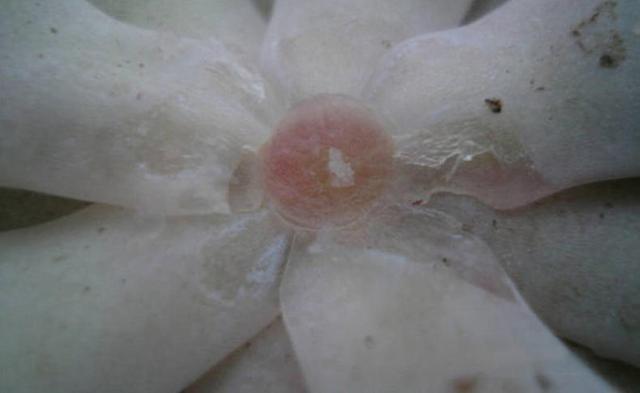
Below I'll show you a Haworthia truncata sprouting after beheading. Haworthia retusa comes out roughly like this too, and later you'll be able to see the difference between them
Also, wishing everyone success with beheading!!