When buying succulents in spring, choose varieties carefully; a single misstep and they die within a few months
Spring is the happiest time for succulent growing, not only because the succulents look their best, but also because you can buy buy buy to your heart's content, since they root into the pot quickly anyway. But while you are buying buy buy, don't forget the summer that is just around the corner. Every summer, there is always a group of people who step over the corpses of succulents to sum up valuable experience for us, and what we should do is stand on the shoulders of these people, rather than stepping with our own feet on the corpses of the fleshy plants...
If you don't want this summer to be too miserable, please don't rush to place your order and buy buy buy; finish reading this article first, and we might as well avoid those varieties that the veterans all feel are not so easy to get through the summer.
Echeveria 'Little Red Riding Hood', Echeveria derenbergii (known in English as Pachyphytum 'Orpet' or Echeveria derenbergii), and Echeveria 'Yudie' (Echeveria 'Pachyphytum') are called the "must die in summer" trio, famously known in the succulent world as the black rot big three. Once summer arrives, you can always see bad news coming from succulent growers everywhere: "My Little Red Riding Hood / Jingye / Yudie died again."
Echeveria 'Little Red Riding Hood'
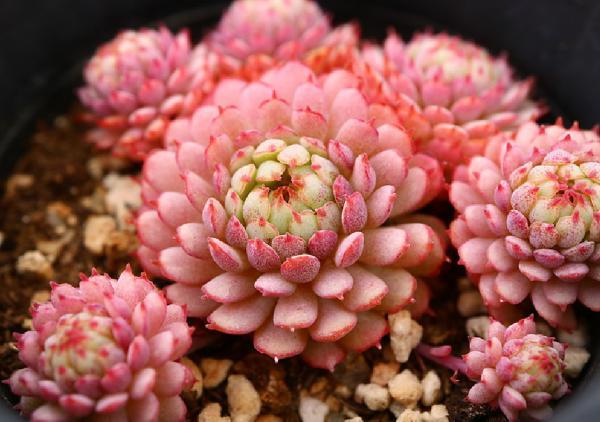
A small variety that easily forms clusters, and is quite difficult to cultivate in summer. The small leaves of Echeveria 'Little Red Riding Hood' are arranged tightly in a rosette, the leaves are slightly flattened ovate, and there are protruding thin wings on both sides of the leaf tip. It likes cool, dry, and sunny environments and well-drained sandy soil, and is not tolerant of water and moisture. It has very high requirements for ventilation. Summer care is very difficult, and it is the succulent plant most prone to problems.
Echeveria 'Yudie' (Echeveria 'Pachyphytum')
Leaves alternate, borne in a rosette on a shortened stem, obovate-spatulate, light green, fleshy, with a white powder coating on the surface. Yudie is still a relatively beautiful succulent, but it is prone to black rot in summer, a succulent quite prone to black rot. Way of dying: black rot from the roots, rapidly spreading to the top; side shoots can be saved.
Echeveria derenbergii
It is a rather mini Echeveria, very small in size, and easily forms clusters; when sunlight is sufficient, the leaf tips turn red, very cute. But Jingye also has some difficulty getting through summer; in summer high temperatures and strong sunlight it goes dormant, afraid of heat and afraid of humidity, and if not controlled well, only the pot will be left. Way of dying: turning to water (melting), black rot from the roots.
Sedum clavatum (Laoru)
A succulent plant of the Crassulaceae family, Sedum genus, it is a perennial subshrub with relatively many branches, usually producing new shoots from the lower part of the stem, and relatively easily forming clusters. The common death state in summer is turning to water, and blackening starting from the top; even after beheading, its stem will still turn to water and soften within a short time, and it cannot revive again.
Cotyledon tomentosa (Bear's Paw)
A succulent plant of the Crassulaceae family, Cotyledon genus; its leaves have light-colored fine hairs, and the front ends of the leaves have many small short points, with a shape as cute as a little bear's paw. Bear's Paw is prone to death during summer high temperatures, and the common death state in summer is leaf drop and shriveled stems.
The Fuzuniang (Cotyledon orbiculata varieties, "blessing ladies")
Succulent plants of the Crassulaceae family, Cotyledon genus; the leaves are pointed, slender and long, club-shaped and opposite, and they produce yellow-red flowers, with dark red or brownish red at the leaf tips and leaf margins. Since they are of the same genus as Bear's Paw, the Fuzuniang are likewise very afraid of heat, and the common death state in summer is also easy leaf drop, with the stems becoming shriveled and then dying.
Graptopetalum 'Blackberry' (Blackberry)
A succulent plant of the Crassulaceae family, Graptopetalum genus; their leaves are smooth, slender, club-shaped, and arranged tightly around the stem in a lotus shape, which is similar to the Echeveria genus, but because their leaf shapes are very different, they also look different in style. The common death state of Blackberry succulents in summer is black rot appearing from the bottom of the stem.
Echeveria 'Romeo'
In a sunny environment, the whole plant turns bright purplish red, very beautiful, and the plant shape is relatively large. Because high temperatures cause it to go dormant, problems can arise if it is not controlled well. Way of dying: rotten core, leaves rapidly falling apart, and there is not even time to behead it.
Graptosedum 'Jelly Otome Kokoro' (Jelly Maiden's Heart)
Way of dying: turning to water, leaf drop, stems going soft. Note: ordinary Otome Kokoro does not do this, further proving that they are two varieties.
Graptopetalum 'Blue Bean' (Blue Bean)
A succulent plant of the Crassulaceae family, Graptopetalum genus; the leaves are delicate and oblong, usually blue, with an obvious layer of white powder, and the leaf tips are slightly pointed and slightly red. Once it colors up, the leaf color may even become slightly pink and slightly orange, and because of this Blue Bean has always been highly praised among succulent lovers. The common death state of Blue Bean succulents in summer is: stems going soft and black rot.
Graptopetalum 'Green Bean' (Green Bean)
A succulent plant of the Crassulaceae family, Echeveria genus, a small to medium-sized variety; when Green Bean colors up, the leaves are thick and fleshy, the leaf tips are orange-red, and the leaf color can also take on orange, very charming. Way of dying: the same as Blue Bean.
Sedum 'Baby Fingers' (Baby Fingers)
A succulent plant of the Crassulaceae family, Sedum genus; when it colors up, the leaf color can be pink-purple, the leaves are plump and round, arranged tightly in a radial pattern, chubby and cute like a baby's fingers. In the stuffy, hot, and humid summer environment, it easily drops leaves, and the common death state is: slowly going soft starting from the roots; if discovered in time, it can absolutely be saved by beheading. However, Baby Fingers itself grows very slowly, and often after beheading, regrowth requires a long wait.
The above only lists some common varieties that everyone finds relatively difficult to get through summer, and it is certainly not comprehensive enough; you are welcome to add more in the comments section.