Recommended succulents that easily fill a pot: don't miss these varieties this spring
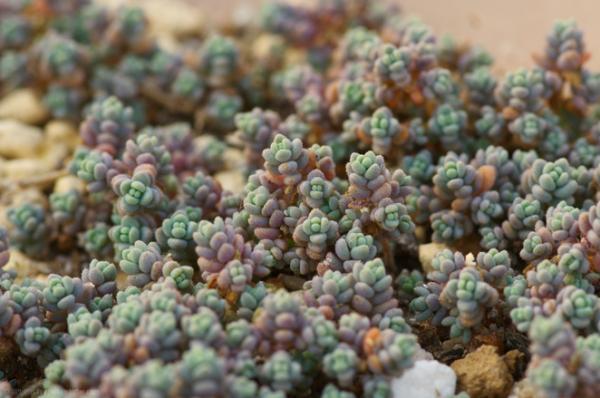
Among the many joys of growing succulents, there is one called "pot-bursting." When we face a large, vigorous cluster of succulents, very few people can resist it!
If you, like the editor, are a fan of pot-bursting succulents, you must not miss these varieties this spring:
1. Sedum dasyphyllum & Sedum dasyphyllum 'Major' & Sedum dasyphyllum 'Lilac Mound'
Sedum dasyphyllum is one of the easiest succulents to fill a pot. Although it belongs to the pot-covering grass series, when planted alone it also very easily develops color and fills the pot. In good condition, Sedum dasyphyllum shows a mix of red and blue colors, and its plump little leaves make it look very cute. Sedum dasyphyllum can be propagated by leaf cuttings, or by beheading and dividing offsets. When propagated by leaf cuttings, it fills the pot even more easily.
2. Graptopetalum mendozae & Graptopetalum mendozae 'Maruba'
Because it is easy to propagate and easy to fill a pot, Graptopetalum mendozae has become a beautiful succulent that almost every succulent grower owns. The pale pink color it develops in good condition also fascinates many people. Propagating Graptopetalum mendozae is also very simple: just pick healthy leaves and place them on the soil, and they will quickly take root and sprout. If enough leaves are picked, a pot-bursting effect can be achieved in a short time.
3. Orostachys boehmeri & Echeveria 'White Lotus'
Orostachys boehmeri is also a very cute succulent that easily fills a pot. This Orostachys species can be propagated by dividing offsets: cut off an offset about the size of a coin, lay it flat or insert it into the soil, and it will quickly take root. So if you want a pot-bursting Orostachys boehmeri, you have to harden your heart and keep trimming the offsets. The Echeveria 'White Lotus' propagates somewhat more slowly than Orostachys boehmeri, but it also easily fills a pot. One more thing to note is that Orostachys boehmeri dies after flowering, so remember to cut off the flower stalk when it blooms.
4. Sedum japonicum 'Tokyo Sun' & Sedum japonicum 'Tokyo Sun' Maruba
Sedum japonicum 'Tokyo Sun' is also a great succulent that easily fills a pot, an outstanding member of the pot-covering grass group. It has tenacious vitality and can grow rapidly until it fills the pot. Its low price and golden-yellow color are also loved by most succulent growers. Sedum japonicum 'Tokyo Sun' Maruba, like Sedum japonicum 'Tokyo Sun', very easily fills a pot, and both are propagated by division: cut off robust branches and insert them into the soil, and they will quickly propagate and grow.
5. Sedum rubrotinctum (variegated) & Sedum rubrotinctum 'Red Berry'
Both Sedum rubrotinctum and Sedum rubrotinctum 'Red Berry' can fill a pot in a short time, and both are propagated by leaf cuttings. These two succulents have a high success rate with leaf cuttings and are very easy to grow, and they are also very beautiful when they develop color. If you usually control watering well and increase sunlight, they will show extremely rich colors. However, for Sedum rubrotinctum 'Red Berry', Paopao more recommends beheading propagation, as this will produce many offsets that look very beautiful.
6. Sedum album & Sedum album 'Major'
Also a classic pot-covering grass series, easy to propagate. Whether you behead it or just leave it alone, it will form a large clump. A pot-bursting tool!
7. Sedum 'Little Ball Rose' & Sedum 'Little Ball Rose' variegated
A succulent that has barely escaped the pot-covering grass class. Although the plant is not large, when it develops color it looks like little roses, and growing a pot of it into a clump still gives a great sense of achievement. Its variegated variety, Sedum 'Little Ball Rose', is also extremely easy to propagate, just like Sedum 'Little Ball Rose'. Both can be propagated by cutting off robust stems and taking cuttings.
8. Sedum 'Little Wild Rose'
Sedum 'Little Wild Rose' is also a great succulent that easily fills a pot. After being grown for a period of time, it will produce many offsets. It is generally propagated by dividing offsets, but Paopao's experiments have shown that it can also be propagated by leaf cuttings. If you want Sedum 'Little Wild Rose' to develop color, you must control watering. If watered too much, the whole plant will turn to mush or grow into a very unconventional-looking form, with a huge contrast.
9. Graptosedum 'Bronze'
Graptosedum 'Bronze' can be said to be one of the easiest succulents to propagate. Its year-round purple leaves are also deeply loved by many succulent growers. It is worth mentioning that Graptosedum 'Bronze' is relatively easy to grow into an old stem, and after growing into an old stem its shape is also very graceful and varied. It is mostly propagated by leaf cuttings: healthy leaves can be laid in a flower pot for leaf cuttings, and they can quickly grow into a pot-bursting, cute clump of succulents.
10. Graptopetalum 'Triel Gem'
Commonly known as Xiaoyu, wild plants have been found in some areas of southern China (for example, succulent growers have discovered them in Kunming). The color varies greatly between seasons. It can be propagated by beheading and division or by leaf cuttings. Although it is a small succulent, its growth rate is not slow. A small plant can quickly grow into a pot-bursting cute succulent.
There are many succulents that easily fill a pot; the above are just a few listed at random.
However, some flower lovers cannot help but ask. It is said that these varieties fill the pot after being grown for a while without warning, but why, after I have grown them at home for so long, has the "filling the pot without warning" thing never happened even once?
To sum up, the main reasons are as follows:
1. You only planted one
Some varieties of succulents can indeed fill a pot even if only one is planted. However, to realize the dream of a single plant filling a pot, you may need to wait many extra years. So the simplest way is to take cuttings to fill a whole pot from the very beginning. That way, as long as time passes, you can harvest the joy of a pot-bursting plant!
2. Don't deliberately pursue natural clumping; act when it is time to act
Pot-covering grass type succulents need frequent pruning, and the more you prune them, the more luxuriantly they grow. Don't be polite at all; just pick up the scissors and snip away.
3. Replant in stages and batches
Succulents like Graptosedum 'Bronze' and Sedum rubrotinctum prefer to grow upward. Whether they form natural clumps or sprout after beheading, they do not produce many offsets. To keep the whole pot lush, the best way is to regularly pull off some leaves and throw them into the flower pot, letting these leaves grow naturally in the pot and fill the gaps in the pot. By pulling off leaves and replanting, you can achieve a super-lush, pot-bursting plant.
4. Fill the pot by beheading
For example, plant 5-6 Echeveria derenbergii in one flower pot. During vigorous growth, behead 4 of them, and stagger the beheading times by 1 month, so that the new offsets will gradually achieve the pot-bursting result.