Variety Introduction to the Succulent Plant 'Little Red Dress'
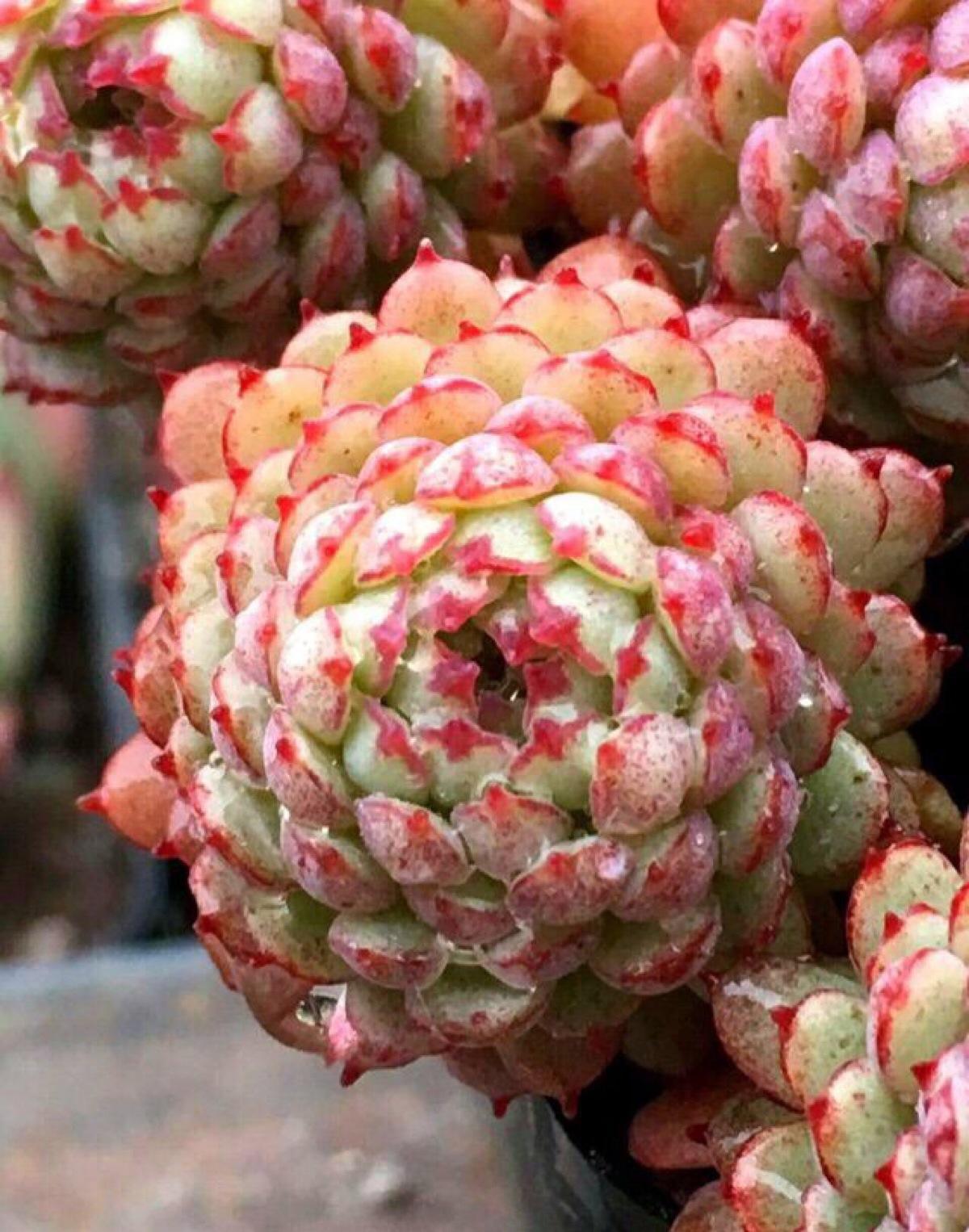
'Little Red Dress' is a succulent plant in the Crassulaceae family, Echeveria genus. It is a small variety that readily forms clusters, and is relatively difficult to cultivate in summer. The small leaves of 'Little Red Dress' are tightly arranged in a rosette, the leaves are slightly flattened ovate, with protruding thin wings on both sides of the leaf tip. Under strong light, the leaf margins and leaf tips take on a beautiful red color.
'Little Red Dress' prefers a cool, dry environment with plenty of sunlight and well-drained sandy soil, and is not tolerant of waterlogging. It has very high requirements for ventilation. It is very difficult to care for in summer.
Little Red Dress
Light:
The stronger the light and the greater the temperature difference between day and night, the brighter the leaf color and the more compact the plant shape. When the temperature is suitable, outdoor maintenance can make the leaves more colorful. If the soil light is insufficient or the light lasts too long, the entire plant turns pale green, the leaves are loosely arranged, which seriously affects the ornamental value, and it may even be killed by the plant's photosynthesis. In summer, it needs to be placed in a slightly cloudy, diffused-light area to avoid sunburn.
Water content:
Because the plant has a high internal water content, under high temperature and humid conditions, 'Little Red Dress' very easily turns black and rots (especially in summer). Do not water too much. To avoid water accumulating in the roots, it is best to choose a pot with a drainage hole at the bottom, as well as red pottery with good breathability in the south.
Reference water amount: at least about 10 days, watering once a day. According to the climate differences of different regions and seasons, the watering frequency can be increased or decreased. In summer or the rainy season, it is better to suspend watering.
Little Red Dress
Soil:
It should be cultivated in sandy soil that is well-drained and has good breathability, which facilitates the removal of excess water and the growth of the plant's root system; the ratio of leaf mold soil (or peat soil), sandy soil and vegetable garden soil can be prepared at 1/3 (the proportion of soil or peat soil).
An appropriate amount of vermiculite, perlite, orchid stone, Kiryu sand, akadama soil and kanuma soil can also be added to the soil. Repot once every 1-2 years in spring, and the necrotic old roots can be cut off.
Temperature:
In winter and summer, when it is too high (above 35°C) or too low (below 5°C), the plant's growth should be appropriately slowed or stopped to delay the growth rate, and the watering frequency should be resumed at a suitable temperature.
Cultivation techniques:
Normally, dry leaves should be removed in time to avoid the accumulation of bacteria. The plant's top growth point can be cut off to keep the plant shape beautiful. The cut top can take root in moist sandy soil, and after drying it becomes a new plant. The stem and branches at the base can sprout more side shoots.
Little Red Dress
Pests and diseases:
The main pest of 'Little Red Dress' is scale insects. In the early stage, the pests are commonly found in the roots or on the plant's leaves. The results show that after the pests appear, they need to be immediately isolated from other plants, and their roots of that size should be cut off, and the affected area can be sprayed or the plant's roots can be treated (for example, fungicides such as chlorothalonil and carbendazim have no insecticidal effect). It may take several cycles to completely kill the insects. For control measures, a small amount of carbofuran can be mixed into the soil, or soil insecticides can be used.
The main disease is the plant's black rot (that is, part of the plant turns black and rots, mostly at the roots), mainly in summer, usually due to poor ventilation and a high-humidity, high-temperature environment, but sometimes it may be caused by scale insects. Once discovered, it needs to be quickly isolated from other plants, and in the initial stage the rotted part can be cut off. Several fungicides (chlorothalonil, carbendazim, etc.) can be applied to the cut. After the cut dries, the roots can re-root in loose sand. If the black rot has already spread to the plant's growth point, it can be considered dead. Discard it as early as possible to prevent infection. For prevention, a mixture of chlorothalonil, carbendazim and other fungicides can be mixed into the soil.