Creating a Garden on a Hot, Dry, Sealed Balcony: A Lazy Person's Guide to Growing Flowers
Continuing from last time, I have one balcony and two large bay windows. The balcony faces south and is fully sealed and connected to the interior, which means that in smog-prone Beijing, I can barely open the windows. If you are like me, then congratulations, we have a natural plant oven! Whether it is winter or summer, the balcony temperature stays above 25°C, and at midday in summer it can reach around 35°C. In such a terrible environment, I still planted some plants, and these plants actually grew well and produced stunning flowers! Best of all, they barely need any care.
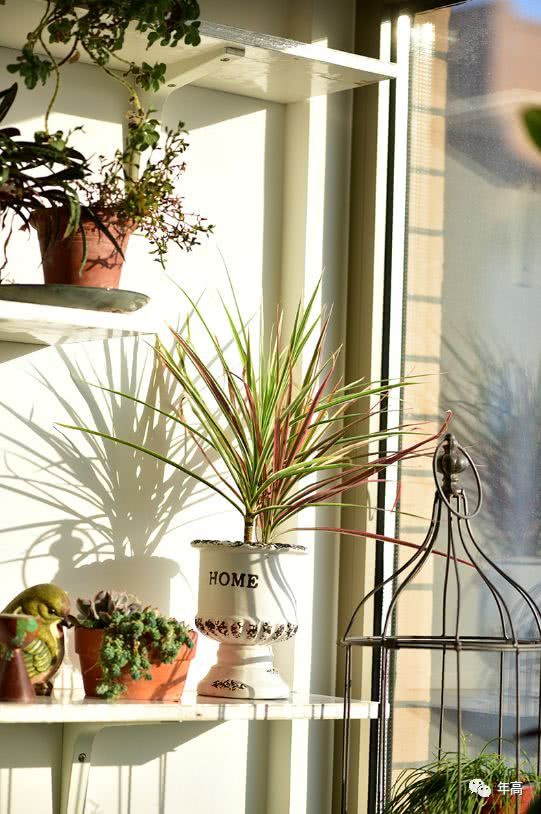
First, a photo of a corner of the hot, dry little balcony. The plants are mainly on the wall-mounted shelves.
Wall-mounted garden
From the photo above, you can see there are not many plants in bloom here, yet it still looks pretty good. This is the first magic weapon of a hot, dry balcony: foliage plants.
Because the harsh environment of a hot, dry balcony (heat, poor ventilation, and drought caused by a lazy person not watering) makes ordinary flowering annuals hard to keep alive, I chose to focus on the leaves. Let the colors become lively too. Because this wall-mounted garden has a pure white frame, arranging it with a fresh theme looks much better. Choosing some white and blue decorative pots or small trinkets made of wood or tin to accent it can make the space richer in color and content.
↓
The wall-mounted garden at the very beginning was also mainly green, with a white birdcage decoration, red ceramic pots for succulents, and a few little bird ornaments, so it still looked quite clean.
The original wall-mounted garden
↓
After amaryllis finishes blooming, it naturally has to be moved to the growing area to grow. Just changing the arrangement a little gives it a fresh feel. Here I swapped in a large wrought-iron birdcage for trailing plants. It happened to be winter at the time, so I also added a few cyclamen for accents. The remaining dracaena, African false hosta, Cuban oregano, and so on were all the original ones.
Just changing the decorations and plants a little makes it feel like a brand-new wall-mounted garden
Take note: foliage plants are the magic weapon of a hot, dry balcony. Look at this silver-veined shrimp plant; even without flowers it is still striking
These three are common peperomias from the flower market, very short and cute, and the key is that they have color
Even for pothos, you have to choose this white-variegated kind to make the colors pop a little
?The first recommendation is the plant in the photo below with its arms and legs sprawled everywhere: dragon tree. Dragon tree is a plant in the Asparagaceae family and loves hot, dry environments. I bought a small one, only 3 yuan per pot (2 plants in total), and put the original pot into a decorative pot with a layer of peat moss + perlite mixed soil at the bottom, so its roots can grow out through the bottom of the pot and keep going. In a place with ample light and high enough temperatures, dragon tree grows rapidly, and its leaves can keep showing multicolored hues. Now, the main stem of mine has already grown 10 cm tall, and in maybe another half year I will have to move it out and grow it as a floor plant.
In an environment with ample sunlight and high enough temperatures, the leaves of dragon tree can keep showing multicolored hues
After that, I will grow it in this direction. It grows so fast that in my lifetime it could become a tree (online image)
?The second recommendation is my favorite, the night-blooming cereus. Night-blooming cereus is a cactus-family plant, so of course it is very used to dry and hot environments. Every summer, after soaking up enough sunlight, the night-blooming cereus will present you with a whole bunch of ethereal large flowers at night, and by the way give you a pot of soup ingredients for the next day. What a bargain!
The pure white, beautiful large flowers
When several night-blooming cereus flowers open all at once, it is truly exciting
Pick a handful of night-blooming cereus flowers, and the next day you can make night-blooming cereus soup. Nutritious and delicious
But as a responsible person, I have to tell you that night-blooming cereus grows extremely large and needs to take up a lot of space. In a city where land is as precious as gold, growing such a giant is obviously quite luxurious. What's more, if you do not fertilize, you will not see flowers at all. Don't worry, I still have a perfect substitute: ?Epiphyllum anguliger?.
Epiphyllum anguliger is very small, about the size of a normal potted plant, but its growth rate is astonishing. I inserted four leaves, and in less than a year it started blooming a whole bunch of flowers. The flowers are small, but the advantage is that they are delicate and have a strong fragrance.
A propagated Epiphyllum anguliger grows very fast
Very ethereal
The little fairy herself
It blooms during the day. Look, it can bloom this many (online image)
?The third recommendation is dracaena. The yellowish-green plant in the far right corner of the photo below is it! I no longer remember how many years this pot of dracaena has lived in my home. It has always stayed alive. Last summer I barely paid it any attention, and all its leaves dropped. In winter I remembered to water it, and now it has grown a full pot again. It is also a plant in the Asparagaceae family, so it likewise likes high temperatures and long sunlight hours. However, it is also very shade-tolerant. If any friends have homes where they cannot get sunlight, growing it is definitely not wrong.
The wall-mounted balcony in early spring, with a pot of blooming primrose placed as the focal point. The touch of yellow-green on the far right is dracaena
I do not know how long ago I bought it. This photo was still taken with an old camera
It also looks good as a single pot
It also looks good as a supporting player in a mixed pot
Dracaena can also grow very large. This is its flower
?Let me also recommend a trailing plant, Rhipsalis. It is also a cactus-family plant and is super drought-tolerant and heat-tolerant. Because this is a wall-mounted garden, appropriately placing some plants that can grow downward looks very good. I have grown ivy (not very heat-tolerant; now I put it under the fiddle-leaf fig, where it has grown into a patch, but when wall-mounted it easily curls its leaves and gets red spider mites), string of pearls (this one is good, but after looking at it for a long time you get aesthetic fatigue), Schizophragma (very not heat-tolerant, dead), and this Rhipsalis. A small pot quickly trails very long, needs no care, grows very well, and may even bloom unexpectedly.
Ivy. It looks very nice, but it fears heat and will get red spider mites
How it looked when I just bought it. The flower market sells large pots for more than 200 yuan, while small ones only cost 15
It quickly grew into a green waterfall
How it looks in bloom (online image)
?The last recommendations are succulents, which many people grow, and grass balls, which few people grow. There is no need to say much about the benefits of succulents: they fill out a pot, need no care, have varied forms, and look good in mixed pots. The downside is that inside a sealed balcony they almost never change color and grow relatively weak. But no matter how weak, as long as they maintain their condition they still look good. As for cactus balls, they are not attractive most of the time, but when they bloom they are stunning. It is worth growing one.
Succulents are always cute
If you barely water them, they stop growing
Schick's grass ball 'Madame Edward' is about to bloom. Does it look like it is sticking out a little arm?
That little arm opens such a huge flower!
Super gorgeous
Besides the plants above, there are also some plants suitable for a hot, dry balcony, except that they need a little more care from us humans. For example, jasmine. Jasmine is also very heat-tolerant and drought-tolerant, but jasmine needs timely watering and cannot be left dry for too long. It is also best to double-pot it so the roots do not get too much sun. My jasmine is placed like this on a stool on the lowest level, and this year it has already rebloomed. Various prayer plants are also heat-tolerant and tough, but they require a bit more ventilation, otherwise they easily get red spider mites. I originally planted them too densely in a mixed pot, then later separated them all, and now they are in a slightly shadier spot and growing very well. Oncidium is heat-tolerant and can still bloom, but it needs its growing medium changed and timely watering, and if you are not careful it will rot its roots. Geraniums, petunias, and other flowering annuals can actually also be grown, but they easily get pests such as whiteflies and scale insects, and so on. If you choose them, you need to pay attention to pest prevention, fertilizing, and so on.
This is also an oncidium placed on the hot, dry balcony. It can rebloom every year, which is also puzzling
Jasmine. It needs timely watering
So, I think the ones truly worth recommending, the ones that really will not die, are the ones above. I hope this can save you. Next time I will write about how difficult it is to grow flowers at home.