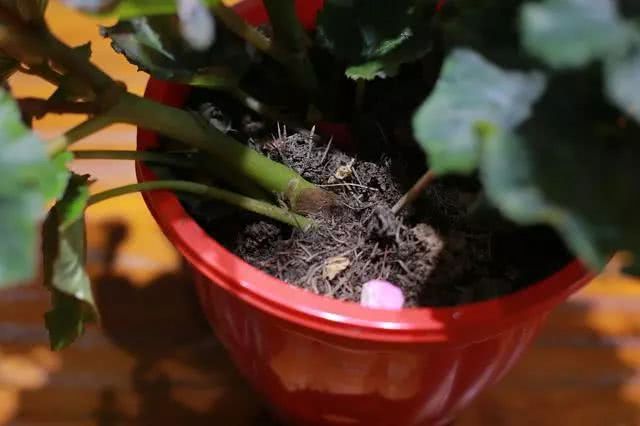
Always failing at growing Rieger begonias? Master this watering trick and enjoy blooms for over half the year Flowers & Gardening Jan 1, 1970 0 views Rieger begonias are beautiful but hard to grow. Basically, after a month or so they start dropping flowers, and after another month or so the roots and stems rot and they die. Posts online all blame root rot and black rot on too much water. They say to water less and not water until the soil is dry. As a veteran flower grower... Rieger begonias are beautiful but hard to grow. Basically, after a month or so they start dropping flowers, and after another month or so the roots and stems rot and they die.Posts online all blame root rot and black rot on too much water. They say to water less and not water until the soil is dry.As a veteran flower grower, I'm pretty good at controlling water. But they still rot, rot, rot... This year, I heard about a very unusual method that is said to solve the problem of Rieger begonia root rot.1.Experimental method ————To do this experiment, I specifically bought 2 Rieger begonias in full bloom. From the same shop, the same batch, both were three-plant mixed pots, and both were growing well.The one with yellow flowers was given the constant bottom-watering method (keeping water in the tray), and the one with all-red flowers was given the not-water-until-dry method.Both were kept in front of the south-facing floor-to-ceiling glass window in my office (around noon the light intensity is about 20,000 Lux. Day-night temperature is about 10-20 degrees. Air humidity is around 38%. The original pot medium is mainly pine needle soil. No fertilizer. Not understanding these does not affect reading the rest) 2.Experimental comparison————After half a month, the comparison was already obvious. The bottom-watered one was clearly growing better than the not-water-until-dry one. After another half month, the one without bottom watering had already developed black rot and root rot. The bottom-watered one was still blooming nicely, and its leaves were growing very well too.There was still one left that had not rotted, so I potted it separately in a small pot and also used the constant bottom-watering method to water it. Half a year later, the one that had been constantly bottom-watered was growing even better, and the small one that had been repotted also grew bigger and bloomed, because it had been switched to the constant bottom-watering method.Analysis: constant bottom watering not only ensures the moisture of the potting soil. The water evaporating from the pot also increases the humidity of the air around the plant. Rieger begonias are generally produced in greenhouses, where the humidity is about 60-70%, while at home it is generally less than 40%. Insufficient humidity is very likely the real reason Rieger begonias die easily.Let me add one more thing: the suitable temperature for Rieger begonias is 15-25 degrees. When the temperature exceeds 28 degrees, they enter dormancy. During dormancy, the water requirement is very low, so constant bottom watering may no longer be suitable.Tips:1. Do not water from the surface of the pot2. Use the bottom-watering method, and always keep water in the pot3. Rieger begonias fear high temperatures in summer. Whether this method gets them through summer remains to be verifiedThanks for reading. I'm Yang Ge from the flower-growing channel "You Mu You Hua", bringing you reliable flower-growing knowledge. Welcome to follow.