How to grow peace lilies: this is how you raise beautiful ornamental peace lilies
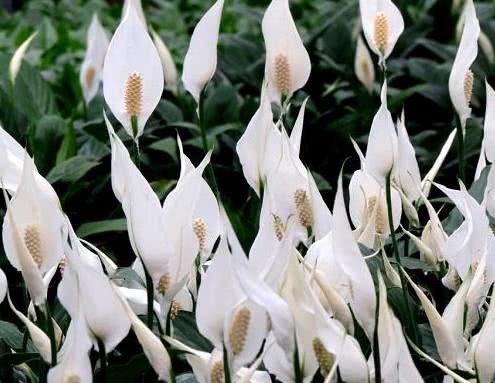
The water-changing interval differs from season to season. In hot weather, such as summer, it needs to be done about once a week. When the temperature is low, such as in winter, once every ten to fifteen days is fine. Note that before changing the water you need to clean the roots, then cut off the mucus, the aged roots and the rotted roots, and scrub off the moss and the like attached to the container. The amount of water also needs attention: it is best to keep it covering one-half to two-thirds of the roots. In addition, after changing the water,
you can also add some nutrient solution to it. To grow peace lilies well, watering is the most important thing. For the watering method of peace lilies, master the principle of "water when dry, stop when wet"; each watering must soak through, and avoid half watering (not soaking through). Peace lilies are not tolerant of waterlogging; if watered too much, it will cause the roots to rot and die. Peace lilies are also rather poor in drought tolerance. If the leaves are found to be wilting, water them promptly, otherwise they will also dry up and die.
The characteristic of peace lilies is that they tolerate neither high temperatures nor cold, so the first thing in growing peace lilies is to control the ambient temperature well. The temperature most suitable for its growth is 20~28°C. Being kept long-term in an environment above 30°C will cause slow growth, dull leaf color and so on. Therefore, cooling well in summer and keeping warm well in winter are key points in growing peace lilies. Soil. The soil requirement for peace lilies is loose soil with good drainage and good aeration,
and peace lilies should not use clay. In addition, if it is potting soil, you can generally use leaf mold and peat soil mixed with a small amount of perlite to prepare the substrate; when planting peace lilies you can also add a small amount of organic fertilizer as a base fertilizer. Potting. Peace lilies are planted by division. When planting peace lilies, you need to insert them back into the pot, then place them in a semi-shady spot and wait for them to take root. When potting peace lilies, note that the cut part must be one connected to the stem,
then apply wood charcoal ash to the wound, which can prevent the peace lily from rotting after being inserted into the soil. Once the roots of the peace lily return to normal, normal management can be carried out. Light. The light conditions for peace lilies are very important for their growth. In early spring and winter, peace lilies both need fairly good light, but when the light becomes stronger, you must pay attention to shading the peace lily. If the peace lily is planted in a hidden place,
you must not directly put the peace lily in the sun to bake, as this is not good for the growth and development of the peace lily. During the growing process of peace lilies, if you water too much, or give fertilizer too frequently, it will cause the root system of the peace lily to rot, and the leaves are also prone to turning yellow, or even withering. Generally, peace lilies are watered only after the potting soil is completely dry. In addition, when watering peace lilies, note that you should start watering from the bottom; sometimes watering from the top looks as if it is completely wet,
but the root area has no water, which will cause the peace lily to be too dry. Peace lilies are fairly shade-tolerant; as long as there is about 60% scattered light, their growth needs can be met, so they can be kept year-round indoors in a spot with bright scattered light. In summer, 60%~70% of the sunlight can be shaded off; direct strong light is taboo, otherwise the leaves will turn yellow, and in severe cases sunscald will occur. In winter in the north, greenhouse cultivation can go without shading or with little shading. If the light is too dark for a long time, it is not easy for them to bloom. Potted peace lilies require loose soil,
good drainage and aeration, and heavy clay soil must not be used. Generally, leaf mold and peat soil mixed with a small amount of perlite can be used to prepare the substrate; when planting, add a small amount of organic fertilizer as a base fertilizer. Because of its fast growth rate, it needs a relatively large amount of fertilizer, so during the growing season liquid fertilizer must be applied once every 1 to 2 weeks; at the same time, supply sufficient water and keep the potting soil moist often. During high-temperature periods, water should also be sprayed on the leaves and the ground to increase air humidity. If the surrounding environment is too dry, new leaves will become smaller and yellow, and in severe cases wither, yellow and fall off.