Succulent Plants, My Love, I Want to Tell You
Follow
Follow the Encyclopedia · Meet Beauty (WeChat ID: duoroubaike)
The text begins:
Thanks to the author [Luo Qiong] for theoriginal submissionsharing
Submission date: April 18, 2018
Edited and compiled by: Encyclopedia Jun
Location: Fengshun County, Meizhou, Guangdong
Perhaps it is an innate bond with plants. Those graceful, lush flowers and grasses always bring me joy and emotion. But getting to know succulent plants was something that happened only in recent years. Before 2016, I only had a smattering of understanding about succulents. Once, after seeing detailed pictures and introductions of succulents online, I fell in love with these adorable little sprites, and could not stop.
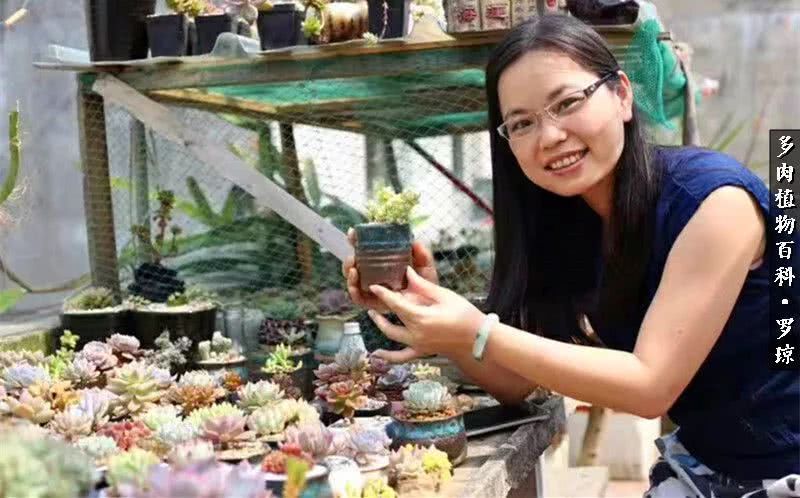
I am Luo Qiong (online name Rufeng), a literature enthusiast and a member of the Guangdong Writers Association.
After moving several times, one plant that was tenacious, easy to grow, shaped like a lotus, and pinkish-blue in leaf color always accompanied me. People called it jewel flower, stone lotus, or snow lotus. Only later did I learn that it was the famous old classic "star" among succulents: Graptopetalum paraguayense. Unfortunately, at the time, in my ignorance, I disliked its crooked shape, bare branches, and space-taking habit, so I would occasionally behead it and casually throw away the old stems that succulent lovers pursued so eagerly. Even now, thinking back, I feel as if my intestines are twisting with regret. Only later did I understand that the aloe, cactus, jade plant, and Bryophyllum in my home, and commonly seen in daily life, all belong to the category of succulent plants.
The golden fingers and jade plant that have accompanied me for many years
In the spring of 2016, through Moments, I learned that two friends were growing succulents. Also, because of work, I got to know a local veteran succulent enthusiast. That was Xiao Yao, a post-90s artsy pretty girl. The first time I visited her dormitory and saw the balcony packed full of potted succulents, that shock and amazement were simply beyond words. Later, later, I fell step by step into the endless cycle of succulents, gritty soil, flower pots, fertilizer, medicine, tools, and so on. Amid all kinds of buying, buying, buying and the alternation of death and rebirth, I passed through spring, summer, autumn, and winter, and my spare time was willingly and joyfully occupied by succulents. Because of succulents, I met many friends. We often arranged to chat and admire succulents, exchange varieties, and share experience. From this I gained cultivation techniques such as soil mixing, beheading, and leaf propagation, and learned knowledge such as succulent rot, etiolation, variegation, and fasciation, and even more, it was the mutual encouragement and common progress among succulent friends in a small city. That was a kind of warm and joyful deep friendship.
A gathering of succulent friends in a small city
On days at home, almost every morning, every noon, every dusk, and even every evening, my figure on the balcony was sometimes busy with planting until my back ached; sometimes observing changes and organizing flower pots, carefully understanding their growth states; sometimes watering and killing pests, giving them the warmest care; and sometimes taking photos and admiring them, remembering the most beautiful moments through images or sending them to like-minded succulent friends to share. The happiness and satisfaction were indescribable.
Black Prince grown into a jelly color
Succulent plants, the charm that makes me and many others unable to pick them up and put them down, lies not only in their varied shapes, colorful hues, and the trait of changing with the seasons or environment, but what I love even more is their sometimes tenacious and unruly nature, able to thrive anywhere and in any environment, and sometimes their delicate and sensitive nature, dying from black rot and rot in the blink of an eye once infected by bacteria. I feel the world of succulents is just like life. You can dream and yearn, but you never know what will happen in the future or even the next moment. So, while the years are quiet and good, cherish and enjoy them well.
Pachyveria 'Clavifolia', an immortal name, an immortal face
Sharing sessions with succulent friends always make people happy. Here is a little summary I put together to share with everyone.
1. Form.
Succulent plants come in a thousand postures: plump and round ones like peach eggs and string of pearls; furry ones like Echeveria pulvinata and bear's paw; crystal-clear ones like Haworthia cooperi and bulbine; ones like waterfall droplets such as million hearts and string of tears; Lithops like little pebbles; ones growing like pagodas such as Crassula 'Pagoda Village' and Crassula pyramidalis; air plants that can grow without soil and water; ones growing like lotuses such as Echeveria elegans; cacti and cactus balls covered in spines; and still others that look like deer antlers, springs, or fingers.
Sunny succulents, beloved in every corner
2. Color.
Succulents have all kinds of colors: red, orange, yellow, green, cyan, blue, purple... Red ones include red ruby and Echeveria 'Red Tip'; orange ones include Orange Monroe and California Sunset; yellow ones include Sedum adolphi and golden sedum; green ones include green tea and green flame; cyan ones include blue-green Echeveria and blue phoenix; blue ones include blue echeveria and blue beans; purple ones include purple pearl and purple joy; white ones include white phoenix, white bird, and white peony; black ones include Aeonium 'Zwartkop' and Black Prince; pink ones include pink vine and snow angel; brown ones include black rabbit ears, large cluster, and Bryophyllum tubiflorum; silver ones include silver fingers and silver moon; spotted and striped ones include Kalanchoe rhombopilosa, purple musashi, and striped Haworthia; in addition there are rainbow colors, jelly colors, transparent colors, rouge colors, jasper colors, emerald colors, and so on.
Red ruby, this color is still fairly satisfactory
3. Names.
The naming of succulent plants is fantastically diverse. Some carry a strong immortal aura, such as Guanghan Palace, snow lotus, bright mirror, Pachyveria 'Clavifolia', ice jade, Lingbo Fairy, Guanyin lotus, thousand Buddha hands, and fairy cups. Some are named after fruits or foods, such as grape, blue apple, lemon, ice berry, cream yellow peach, red berry, and green tea. Those named after the four seasons include spring sprout, spring top, summer story longevity, autumn beauty, autumn banquet, and winter beauty. Those named from English translations include David, Allen, Maria, and Marcus. Names completely unrelated to the plants include crispy duck, little man festival, Sun Wukong, red ghost city, tengu dance, quick knife tangled hemp, and Daruma Fukuniang. Of course, more succulent plants have elegant and poetic names, such as Miracle of Spring, Ruogeshi, blue surprise, California Sunset, pink beauty, Ji Xing beauty, dance of elegance, string of hearts, first love, and quiet night.
The small and exquisite thousand Buddha hands has slender leaves
4. Scent.
Many succulent plants can give off faint fruit fragrances such as apple and strawberry, and some smell of cream or mint, such as Cuban oregano, lily lily, ice berry, and spring top.
5. State.
Depending on different varieties and different growing environments, succulent plants can present different states such as flowering, variegation, popping heads, fasciation, monstrose growth, etiolation, and stunted seedlings.
The flowers of Echeveria elegans, too beautiful to take in all at once
The flowers of Daruma Fukuniang look like little hanging bells