Lupine flowers make people think of their mother's words every night, with tears glistening in their eyes.
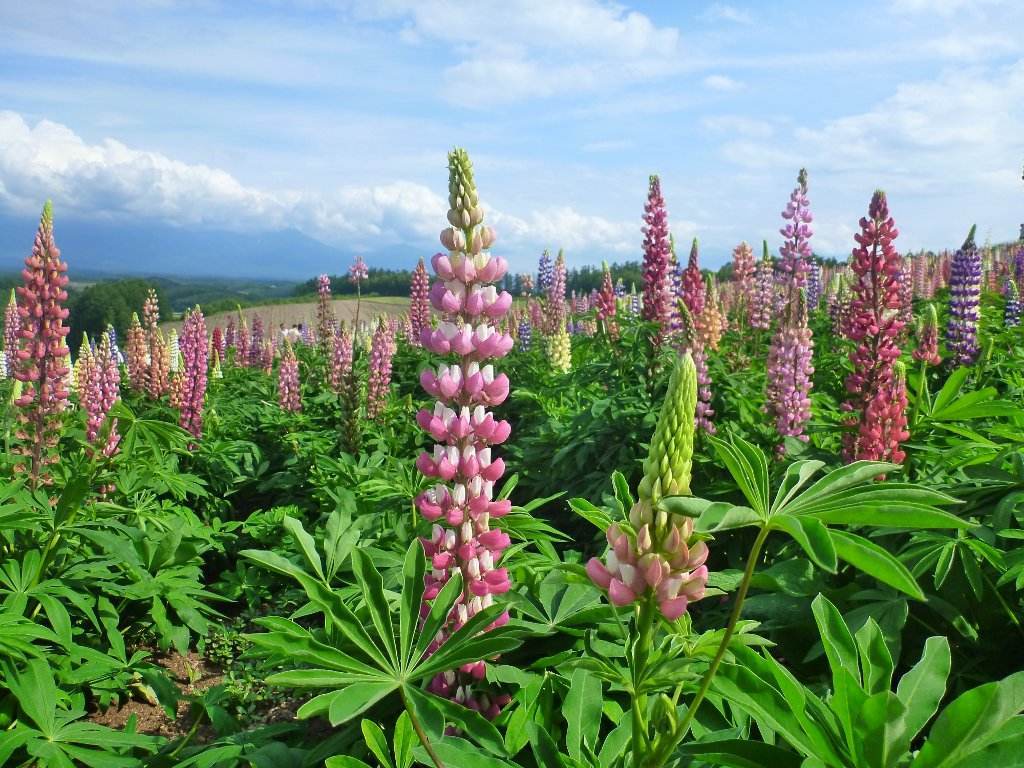
Lupine, also called "lupin," is a plant in the order Rosales, family Fabaceae, genus Lupinus. The stems are ascending or upright, branching from the base, and the entire plant is covered with brown or rusty stiff hairs. The raceme is terminal and relatively short; the fruiting axis thickens but still does not exceed the compound leaves in length. The flowering period is March to May, and the fruiting period is April to July.
Like many leguminous plants, lupine has root nodules that can fix nitrogen from the air into the soil; its seeds are rich in nutrients, especially protein. During the Japanese occupation period, the Japanese introduced lupine to Taiwan, China for use as green manure. Because the Japanese cultivated yellow lupine the most in their homeland, the most widely cultivated lupine in Taiwan, China today is also yellow lupine. Tea farmers in the mountainous areas of Taiwan, China plant "lupine" near tea plants as green manure when growing tea. Lupine can also be used for garden ornamental purposes.
Lupine
1. Potted ornamental use:
The emergence of dwarf varieties with symmetrical plants and lush leaves has broadened the market promotion scope of lupine, giving it the opportunity to enter ordinary households. Coupled with the special meaning it carries, it is believed that people will love it even more.
2. Use in flower arranging:
Rich plant materials have always been important materials for floral masters' creations. As lupine cultivation continues to increase, its value as a cut flower is gradually being noticed and discovered by people, achieving cut flower cultivation and production.
3. Landscape use:
Lupine's special plant form and rich inflorescence colors make it a relatively rare configuration material in garden plant landscaping. Used as a flower border background and for clump planting and mass planting along forest edges and riverbanks, it gives people a visual enjoyment that is exotic and distinctive, and this is increasingly accepted and praised by professionals.
Lupine
Plant culture:
The flower of Saint Eugene, bishop of Carthage in the 5th century
Since ancient times, Christianity has had the custom of linking saints with specific flowers. This follows from the church's practice, when commemorating saints, of often decorating altars with blooming flowers! In the Catholic monasteries of the Middle Ages, various flowers were planted almost like in a gardening center. Over time, the church paired the 366 days' saints with different flowers, forming the so-called flower calendar. At that time, most monasteries were located in Southern Europe, and Southern Europe has a Mediterranean climate, which is extremely suitable for growing flowers and plants. Lupine was chosen to honor the bishop of Carthage in the 5th century -- Saint Eugene -- as his flower. It is an annual herbaceous plant in the Fabaceae family, native to the Mediterranean. Lupine mostly grows in sandy soil where other plants cannot survive.
Lupine
Meaning of the scientific name:
"Lupin" means "bitter" in Greek. The seeds of lupine are extremely bitter when held in the mouth, making people frown, and they seem to look very painful. Therefore, its flower meaning is "bitterness." People born under the blessing of this flower are always considered unable to say anything pleasant, like to speak the truth bluntly, and do not know how to read the situation. This straightforward personality is best changed, otherwise one will suffer silent losses. The flower meanings of lupine: maternal love, happiness, greed, bitterness, sorrow, fantasy.
There is also a saying that the name "lupine flower" comes from Hakka, and "lupine flower" comes from the Hakka phrase "roadside flower," because in Hakka, "lupine flower" and "roadside flower" are homophones. The famous TV drama "Lupine Flower" was adapted from Zhong Zhaozheng's social realist novel. Zhong Zhaozheng was a Hakka from Taiwan, China, and the lupine flower is regarded by the Hakka people of Taiwan, China as the "mother's flower."