Night-Blooming Magnolia: Nalan Xingde's Last Five-Character Regulated Verse
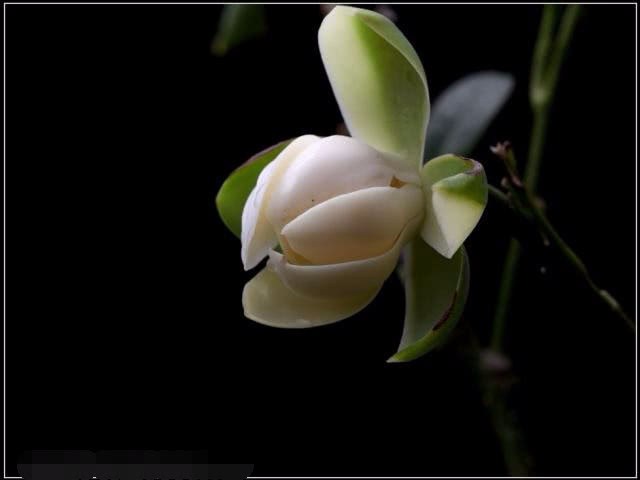
Night-Blooming Magnolia, also known as Night-Fragrant Magnolia, is native to southern China. It prefers warm, humid, semi-shaded conditions, tolerates shade, and fears scorching sun. It requires fertile, loose, well-drained, slightly acidic soil, and winter temperatures should not fall below 5°C. It is an evergreen shrub, 1-2 m tall.
Plant: Evergreen shrub or small tree, 2-4 m tall, all parts hairless; bark gray, branchlets green, smooth, slightly angular and glossy.
Leaves: Leathery, elliptic, narrowly elliptic, or obovate-elliptic, 7-14 (-28) cm long, 2-4.5 (-9) cm wide, apex long-acuminate, base cuneate, dark green and glossy above, slightly wavy, margins slightly recurved, lateral veins 8-10 per side, areoles sparse; petiole 5-10 mm long; stipular scar reaching apex of petiole.
Flowers: Pedicel recurved downward, with 3-4 bract scars. Flowers globose, 3-4 cm in diameter, tepals 9, fleshy, obovate, concave on inner surface, outer 3 greenish with 5 longitudinal veins, about 2 cm long, inner two whorls pure white, 3-4 cm long, about 4 cm wide; stamens 4-6 mm long, anthers about 3 mm long, connective extending into a short mucro; filaments white, about 2 mm long; gynoecium green, ovoid, 1.5-2 cm long; carpels about 10, narrowly ovoid, 5-6 mm long, with 1 longitudinal groove on dorsal side extending to base of style, stigma short, apex truncate after falling;
Fruit: Aggregate fruit about 3 cm long; follicles nearly woody; seeds ovoid, about 1 cm high, inner seed coat brown, with lateral pore at apex on ventral side, ventral groove inconspicuous, base pointed.
Flowering and fruiting period: Flowering in summer, in Guangzhou flowering almost continuously throughout the year, fruiting in autumn.
Night-Blooming Magnolia
Night-Blooming Magnolia is native to China. It prefers warm, humid, and sunny conditions, is highly adaptable to climate and soil, tolerates shade, and likes fertilizer. It prefers warm, humid, semi-shaded environments. It favors well-drained, fertile, slightly acidic sandy soil, and while it avoids calcareous soil, it also tolerates poor soil and dry climates. The flowers open for a short time, each lasting only 1-2 days, often opening in the early morning and closing at night, hence the name Night-Blooming Magnolia. The fragrance is delicate and becomes stronger at night. The optimal temperature for flowering is 22-25°C; below 20°C flowering is delayed.
Night-Blooming Magnolia
This species has deep green, gracefully spreading branches and leaves, and pure white flowers whose fragrance is even richer at night. It is a famous garden ornamental tree long cultivated in South China. The flowers can be used to extract essence, and are also added to tea leaves as a fumigant. The root bark is used medicinally to dissipate blood stasis and remove dampness, treating rheumatism and traumatic injuries, and the flowers treat strangury, turbidity, and leukorrhea.
It is usually planted in gardens or used as a street tree. The wood is resistant to water and moisture and can be used to make furniture; the bark contains tannins, and the fibers can be used to make artificial cypress; the seeds can be pressed for oil; the bark and flowers have medicinal uses, with effects of calming the mind, promoting blood circulation, and relieving pain; it has strong resistance to toxic gases such as sulfur dioxide and chlorine.
Night-Blooming Magnolia
"Night-Blooming Magnolia"
Before the steps, a pair of night-blooming magnolias, branches and leaves spread with flourishing flowers. Sparse and dense together through sunshine and rain, curling and unfurling according to light and dark.
Shadows with the bamboo blind, fragrance mingled with agarwood arises. Facing this can dispel anger, then move to welcome the small pillar.
In the twelfth month of the twenty-third year of the Kangxi reign (1684), not long after Nalan Xingde accompanied the emperor on the southern tour, he fell ill. The death of Wu Zhaoqian, his friend despite the age gap, made him lament, "Alas, O Heaven, why did you give him such talent yet stint his fortune?" The resignation and southward return of his good friend Yan Shengsun further left him disconsolate. On the twenty-third day of the fifth month of the twenty-fourth year, Nalan Xingde gathered with Zhu Yizun and other literary friends beneath the night-blooming magnolia tree in his own garden and composed the five-character regulated verse "Night-Blooming Magnolia."