What kind of succulent plant is Sedum spectabile?
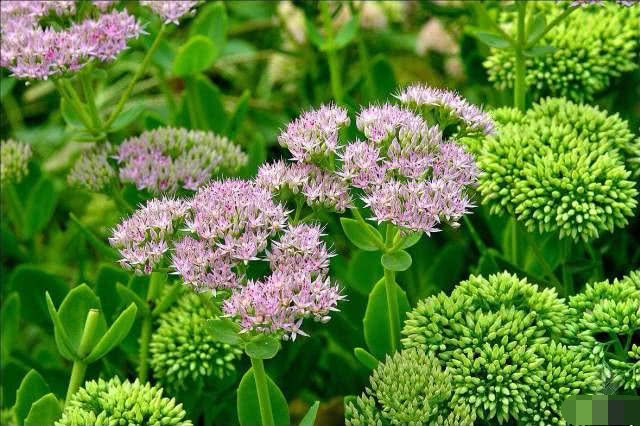
Sedum spectabile, also known as showy stonecrop, Sedum spectabile, large-leaved stonecrop, eight-treasure, blood-activating sanqi, opposite-leaved stonecrop, white-flowered scorpion grass. Latin name: Sedum spectabile. A perennial succulent herbaceous plant of the Crassulaceae family, Sedum genus, with thick underground stems, clustered, stout and upright above-ground stems, and the whole plant slightly covered with a white powder, appearing grayish-green. It is distributed in Northeast China and Korea. Commonly cultivated varieties also include white, purple-red, and rose-red forms. Flowering period, July to October. It is almost the most brilliantly colored species in the Crassulaceae family.
Sedum spectabile
Perennial herbaceous plant, with carrot-shaped tuberous roots. Stems upright, stem height 60-70 cm, unbranched. The whole plant is greenish-white, leaves opposite or in whorls of 3-4, oblong to ovate-oblong, 8-10 cm long, 2-3.5 cm wide, apex acute, obtuse, base gradually narrowed, margin sparsely serrate, nearly sessile. Corymbose cymes borne at the top of the stem, flowers densely arranged, about 1 cm in diameter, pedicels slightly shorter or of equal length; sepals 5, ovate, 1.5 mm long; petals 5, white or pink, broadly lanceolate, 5-6 mm long, acuminate; stamens 10, equal in length to the petals or slightly shorter, anthers purple; scales 5, oblong-cuneate, 1 mm long, apex slightly emarginate; carpels 5, upright, nearly free at the base. Flowering period August to September.
Sedum spectabile
It grows on hillside grasslands or ditch edges at an altitude of 450-1800 m. It prefers strong light and a dry, well-ventilated environment, and also tolerates light shade; it can withstand low temperatures of -20°C; it is not choosy about soil, requires good drainage, tolerates poor and arid conditions, and dislikes waterlogging. The plant is robust and easy to manage. It is cold-resistant, and can overwinter in the open ground in both East China and North China, with the above-ground parts withering in winter.
It prefers strong light and a dry, well-ventilated environment, and can withstand low temperatures of -20°C; it likes well-drained soil, tolerates poor and arid conditions, and dislikes waterlogging. The plant is robust and easy to manage.
Sedum spectabile
In gardens, it is often used together with other flowers to arrange flowerbeds, flower borders, or planted in masses as a slope-protecting groundcover plant. It can be shaped into circles, squares, cloud scrolls, arcs, fan shapes, and other forms, and can also be used as a groundcover plant to fill the gap left when summer flowers lose their ornamental value after withering in autumn. It is a good material for arranging flowerbeds and flower borders and for accenting lawns and rock gardens.
The whole plant is used medicinally, and it can be collected throughout the year. It dispels wind and promotes diuresis, activates blood and disperses stasis, stops bleeding and relieves pain, and is used for laryngitis, urticaria, hematemesis, infantile erysipelas, and mastitis; externally it is used to treat boils and swellings, traumatic injuries, corns, burns and scalds, poisonous insect and venomous snake bites, herpes zoster, and athlete's foot.