How do you choose the right soil for planting succulents?
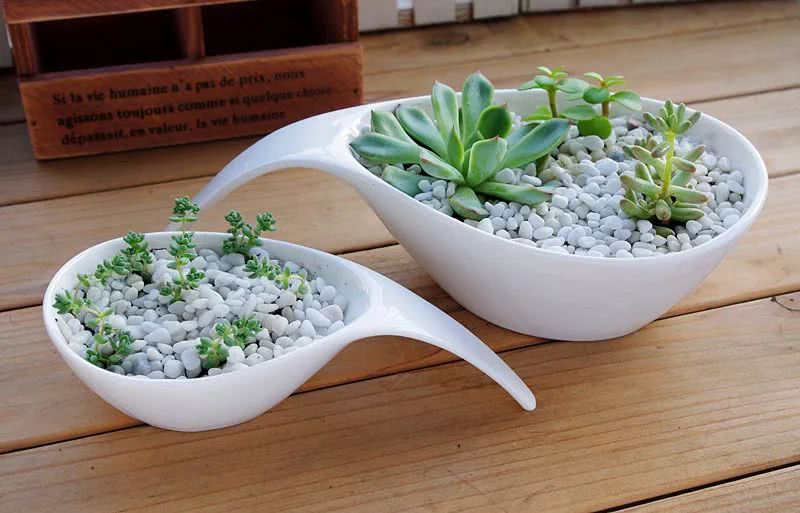
Most succulents grow in tropical desert regions, where the soil is poor (mostly gravel and coarse sand) with only a small amount of soil and organic matter. This kind of soil is extremely breathable, so when planting we should try our best to use growing media close to their original habitat. Here is an introduction to the growing media available on the market:
1. Orchid stone
Orchid stone, also called pumice, Kanuma stone or floatstone, is a growing medium with a porous structure, a certain water-holding capacity and excellent breathability.
2. Vermiculite
Vermiculite is made by processing mica at high temperature. It has good breathability and is sterile; but it turns to powder very easily, and once powdery its breathability becomes extremely poor. It is recommended for temporary use when sowing seeds; for planting it is best not to use it.
3. Perlite
Perlite is also artificially processed. It has good breathability and is sterile; it also turns to powder very easily, and it floats up when watering, which is unsightly.
4. Coco coir
Coco coir is processed from coconut husks. It has good breathability and is slightly acidic, which is somewhat beneficial for regions in the north where the water is alkaline. But when planting succulents you need to remove the fine powder in it.
5. Peat humus soil
Peat humus soil is formed by the accumulation, decay and carbonization of organic matter. It has good breathability, is neutral, and contains a certain amount of nutrients, making it a very good growing medium. But when planting succulents you need to remove the fine powder in it.
6. Peat moss soil
Peat moss soil is formed by further carbonization of peat humus soil. It has good breathability, is neutral, and has no nutrients, making it a very good growing medium. But when planting succulents you need to remove the fine powder in it.
7. Akadama soil
Akadama soil is formed by the accumulation of volcanic ash. It has a porous structure and is an excellent growing medium for breathability. It contains a certain amount of phosphorus and potassium fertilizer.
8. Charcoal
Charcoal is made by burning wood. It has a porous structure, no nutrients, and a strong ability to inhibit bacteria and absorb harmful substances.
9. Carbonized husks
Carbonized husks are made from the outer shells of rice grains carbonized at high temperature. They contain a certain amount of phosphorus and potassium fertilizer, have good breathability, and a strong ability to inhibit bacteria and absorb harmful substances. But they also turn to powder very easily.
10. Sand
There are many kinds of sand. What we mean here is weathered sand from the mountains and coarse-grained (particle size above 1MM) gravel sand. These sands have good breathability, and some contain trace elements such as quartz, iron and magnesium that are beneficial for plant absorption.
The growing media mentioned above should be selected and combined when used, and fine particles below 1MM should be removed. Mix those of the same particle size at a ratio of inorganic matter to organic matter of 7:3. In this way it can come as close as possible to the plant's physiological needs. Some other growing media can also be used, such as honeycomb coal ash, Xiantu soil, and the manure of various herbivorous animals, all of which you can make use of.
LOVE. Soilless Farm
Soilless FarmShengguoju Mall
Discover the beauty of growing flowers