Silent Poetry, Three-Dimensional Painting - Bonsai Art Stamps
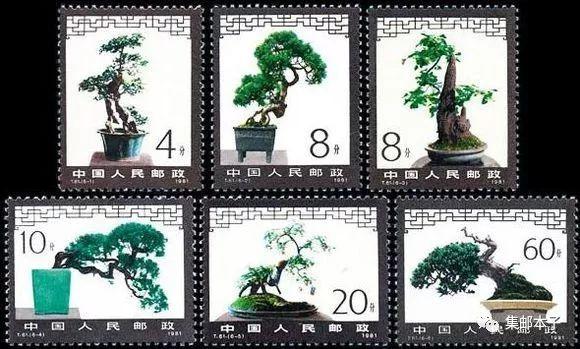
Bonsai art is a traditional Chinese decorative craft. Using the artistic technique of "a thousand miles within a foot" and "shrinking a dragon into a rain-maker," it cultivates trees, rocks and other natural scenery in small pots, hence the name "bonsai." Bonsai is a miniature of natural scenery formed by cultivating certain flowers and trees in pots and then arranging appropriate water and stones, for display and ornamentation, mostly placed on indoor tables or in garden pavilions. Chinese bonsai art has many schools, each with its own distinctive style, and can be divided into tree-stump bonsai, mainly featuring trees, and landscape bonsai, mainly featuring rocks. Tree-stump bonsai, or zhuangjing for short, generally refers to bonsai that showcase the bearing, color and charm of the roots, trunks, leaves, flowers and fruits of ornamental plants. Plants with beautiful posture, small leaves, long lifespan and easy shaping are mostly selected. According to their growth characteristics, through pruning, branch training, wiring, grafting and other processing and cultivation, their growth and development are controlled over the long term, giving them unique artistic shapes. Landscape bonsai is also called water-and-stone bonsai. After artistic treatment such as carving and erosion, rocks are arranged in elegant shallow pots, decorated with pavilions, boats and bridges, and planted with small trees and moss, forming beautiful natural landscape scenes. Bonsai art originates from nature, yet rises above nature. With well-balanced density, appropriate complexity and simplicity, it brings the colorful natural scenery into the indoor spaces of people's daily lives, creating abundant vitality and delightful charm, making people feel relaxed and happy, with rich poetic and pictorial appeal. It is praised by people as "silent poetry, three-dimensional painting."
(6-1) "Chinese Elm." The design shows a bonsai made from Chinese elm. The branches and trunk are upright, naturally rustic, delicate and elegant. Chinese elm is also called "bark-shedding elm" and "small-leaf elm." A deciduous tree. It is distributed in the Yellow River basin of China and areas to the south. It likes sunlight, tolerates drought and barren soil, and grows relatively slowly, reaching up to 25 m in height. The leaves are narrowly elliptical with single serrations. It blooms in autumn. The wood is solid and is used for shipbuilding, vehicles, farm tools, etc.; the bark can be used as raw material for wax paper and artificial cotton, and can also be made into ropes; the root bark and young leaves can be used as medicine.
(6-2) "Chinese Juniper." The design shows a bonsai made from Chinese juniper. The branches and trunk are coiled and twisted, vigorous and powerful; the branches and leaves are spread out, full of vitality. Chinese juniper is also called "gui." An evergreen tree. The crown is conical. It is native to China, centered on the Yellow River basin and the Yangtze River basin, and is widely distributed. When young it is relatively shade-tolerant, has no strict soil requirements, and can live for several hundred years, reaching up to 20 m in height; those propagated by cuttings grow quickly. The wood is light yellowish-brown to reddish-brown, fine, solid, aromatic and rot-resistant, and is used for construction and for making furniture, handicrafts, drawing boards, pencil shafts, etc.; the branches and leaves are used as medicine; the roots, trunks, branches and leaves can yield volatile oil; the seeds can yield lubricating oil. Chinese juniper is also a landscaping tree.
(6-3) "Ginkgo." The design shows a bonsai made from ginkgo. The old trunk is rustic and elegant, while the new branches burst with vitality. Ginkgo is also called "white fruit tree" and "grandfather-grandson tree." A deciduous tree. The leaves are fan-shaped, spirally scattered on long shoots and clustered on short shoots. The seeds are drupe-like, elliptical or obovate; the outer seed coat is fleshy, with a white bloom, and turns pale yellow or orange-yellow when ripe. The seed kernel is used as food, but eating too much causes poisoning; the outer seed coat can yield tannin extract; the wood is pale yellow, fine and light-soft, and is used for construction, furniture, carving and other handicrafts. It is also a landscaping tree. In traditional Chinese medicine, the seeds are used as medicine; their nature is neutral, their taste bitter and astringent, and they are slightly toxic.
(6-4) "Chinese Juniper." The design shows a bonsai made from Chinese juniper (also called "gui" or "yuanbai"). The pot is square, tall and deep, and the branches and trunk extend sideways and slant outward, like hanging upside down from a cliff, full of remarkable perilous natural charm.
(6-5) is "Oil Persimmon." The design shows a bonsai made from oil persimmon. The roots are exposed and attached to the curious stones in the pot, with a unique shape and a delicate, elegant charm. Oil persimmon is a deciduous tree with grayish-white bark. It blooms in early summer. The fruit is golden yellow. It grows wild in China's Zhejiang, Hunan, Sichuan, Yunnan and other provinces. The fruit is specially used to extract an astringent juice called "persimmon lacquer," which can dye fishing nets and coat umbrellas and rain hats, etc.
(6-6) is "Cuibai." The design shows a bonsai made from Cuibai. It stands tall and upright, gracefully slender, with a crown like a canopy. It has a bold and free-spirited charm. Cuibai generally refers to ordinary cypress trees. An evergreen tree. Cypress can be used to create shelterbelts. The wood is hard in texture and can be used as a building material.
Source: Stamp Collecting Tieba
Author: Xiaobai You