A Detailed Guide to Making and Caring for Juniper Bonsai
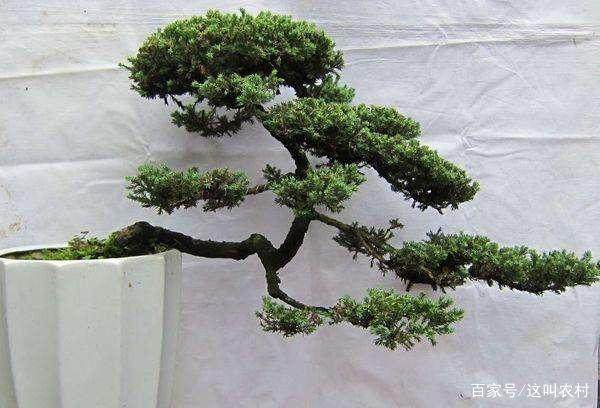
Juniper bonsai, also known by the name Sabina vulgaris, is a tall juniper, an evergreen dwarf Pu bush. The twigs are slender and smooth, densely covered with short and prickly branchlets; the plant usually has no upright trunk; the young bark is smooth, and the old bark is rough. Juniper has characteristics such as tolerance to light, tolerance to shade, resistance to cold and resistance to drought. It is a very good choice for humid conditions and demanding soils, as shown by the small juniper bonsai Sabina vulgaris.
1. Data selection
There are 2 main types of bonsai data.
(1) Cuttings, layering or grafting are the main methods of controlling artificial growth.
(2) Buy 2-3 year old plants on the bonsai market, or buy plants of the current year and junipers, and then restrict them according to their appearance.
2. Bonsai
Juniper is suitable for the cliff type (Jilan Huayao), slanting trunk style, curved trunk style and straight trunk style. In the production of juniper bonsai, the panning mainly depends on the panning. The panes can be made with wire and brown silk. After the bonsai outline is completed, cut off or cut off the base. Summer and autumn are the concentrated seasons for juniper. Assuming storage, pruning and shaping, the sap flows out and affects their swelling, so they should be flattened, pruned and shaped in summer or early spring. Generally, about 2 years are needed to build on Lunar New Year's Eve. If the whip is assembled too early, the branches will bounce back to their original shape. After disassembly, it will destroy the branches, affect development, and leave ruins, but it is not beautiful or elegant.
3. Bonsai care
(1) In spring, summer and autumn, when the sun is not strong, juniper can be grown in humid places. In summer, early autumn, when the sunlight is intense and the temperature is high, juniper bonsai should be placed in half shade and half shade. In Beijing, it should be moved indoors in summer. In the early winter in the south, it can seep into the water. Even if the pot is buried, the sun can safely pass through the winter. Kyrgyzstan flower Yao
(2) The water is very humid in the air. In this season, water is often poured into the pot, but there is no water in the pot. Under very hot climate conditions, in addition to the water pot, it should also be sprinkled on the ground and sprinkled on the branches, so that the local humid weather will have a certain degree of humidity. In winter, there should be less water.
(3) At the beginning of this season (except for summer heat), chemical fertilizer is diluted with inorganic liquid fertilizer for about 30 days. Do not fertilize in winter.