Bonsai Tree Root Replacement Technique: Clever Use of the Threading Method to Promote Root Growth
A bonsai specimen can never be perfect by nature; you can only make up for its innate shortcomings through certain techniques acquired over time. For example, missing roots on the surface rootage is an all-too-common flaw. There are many ways to remedy it, and today we will look at a real example to see how the threading method works.
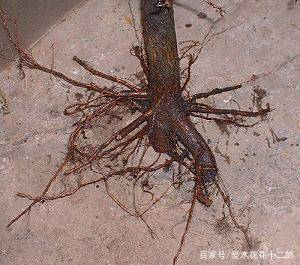
This is a field-collected European hawthorn (Crataegus). Collected stumps all share a common trait: a very thick, very long taproot that grows straight down to anchor the tree in the ground, from which many lateral roots then grow. The lateral roots serve to absorb water and minerals. In bonsai styling, the taproot is of no use to us and is usually cut off in one go; what we need are the lateral roots. Ideally, the lateral roots should form a full ring of roots spreading in all directions, but naturally grown roots are often far from satisfactory. This hawthorn is a case in point.
After being collected from the field, it was grown on for three years. It has one particularly thick root, with too much empty space beside it, making it look very unbalanced. In this situation, you either cut the root off and let it send out new roots, but that carries some risk. This root is also not suitable for scoring and breaking. So the bonsai artist decided to graft a small root onto this root.
First, it was potted up
Then a small sapling was found
Next, an electric drill was found, and a hole was drilled at a suitable spot
Just like this
Then the sapling was threaded through the hole
Let the brown root section come into contact with the tree's root
Bury the root properly
Then let this sapling grow wildly
The more lush, the better
Once it has grown to a certain thickness, you can cut off the branch side, and this is the result you get. Not bad, is it?