What are the maintenance and management methods for landscape bonsai?
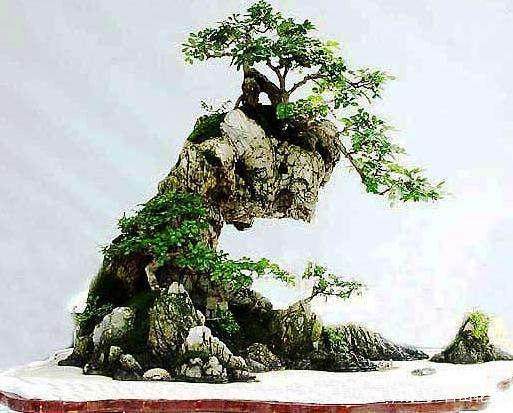
How do you maintain and manage a landscape bonsai?
Without scientific management, even the finest landscape bonsai will come to nothing, so the care of a landscape bonsai is crucial and mainly includes the following aspects.
1. Keeping the pot surface clean
Externally grown landscape bonsai, whether before being moved indoors for display and embellishment or before entering an exhibition, must undergo a major overhaul and thorough cleaning; the picture shows a landscape bonsai with a clean pot surface. In daily maintenance and management, do not keep water in the pot; even when watering, any water that flows into the pot must be wiped dry immediately, to prevent green algae from growing and affecting the cleanliness of the pot. To prevent water from accumulating after rain or during watering maintenance, place a fine yarn end at the edge of the pot with one end in the pot and the other hanging outside the pot, so that water drips out on its own through siphon action. If conditions permit, during the maintenance period use terrazzo pots, coarse pots or damaged pots, and transfer the bonsai into a good pot when it is time for display; these are the basic methods for keeping the pot surface clean. In daily maintenance, do not wash directly with water, to prevent soil loss and contamination of the pot surface. Dead branches, fallen leaves and contaminating debris on the trees, rocks and in the pot must be removed promptly; otherwise yellow and mixed colors will seep into the pot and cannot be removed, affecting the clean appearance of the pot surface. Place and move the rocks gently; do not bump or wear the pot surface. Once green moss or other grime appears in the pot, scrub it with scouring powder or a scouring pad, and if necessary remove it with a copper wire brush or steel wool ball; you can also carefully sand it with fine-grade wet-and-dry abrasive paper, then fine-grind with borax powder, and finally polish it bright with polishing wax (if necessary, wash it clean with oxalic acid, etc.); in this way an old pot can be made to look new.
2. Keeping the rock body and tree body clean
Some rock types are dense in texture with a smooth, glossy surface; to preserve their natural color, they can be maintained daily with polishing wax, applying the wax evenly to the rock surface with an oil painting brush and then brushing it bright, so the rock can "stay forever young". Ordinarily you can take the opportunity when sprinkling water to spray appropriately, to remove dust from the rock body and tree body. By paying attention to wax (oil) care and water care, the rock will be free of dirt and debris, moist and lovely, always maintaining exquisite color and texture, while the trees, moss and grass will keep their lush, healthy beauty.
3. Repairing the rocks
If a landscape bonsai is accidentally damaged when being moved, over time the rock will naturally weather, peel and separate, causing the trees to grow poorly or even die. Besides repairing damage, the loss of the mountain foot and accompanying peaks, and changes in the pot, are all closely related to repair. Timely and proper repair can extend the "lifespan" of a landscape bonsai and reduce losses. Ordinarily use it reasonably (for example, be careful when moving, transporting, placing and storing it) and manage it meticulously (maintain it), always ensuring the best appearance of the landscape bonsai.
4. Keeping the plants growing luxuriantly
It is most pleasing when the plants on the rocks stay vibrant and lush with branches and leaves through all four seasons. But plants growing on rocks face unfavorable environmental conditions that seriously affect normal growth, so daily care must start from several aspects: watering, fertilizing, pruning, shading and cold protection.
Shallow-mouthed pots in which plants are generally grown hold very little water, and in hot summer the water evaporates quickly, so the pot must be watered promptly; besides filling the pot with water, you also need to use a fine-spout watering can to pour water from the top of the rock downward, so the rock can absorb its fill of water as quickly as possible, which benefits the growth of the plant roots; through watering, you can also wash away dust on the surface of the rock and plants and keep them clean. Besides frequent watering, you can also use a watering can to spray water on the rock and plants, which works very well too.
Plants grown on rocks have less soil and poorer growing conditions, and cannot be repotted with fresh soil often, so to give them enough nutrients for growth they must be fertilized frequently.
The fertilizer is best a decomposed dilute liquid fertilizer, which can be mixed with more water; a thin, weak fertilizer is beneficial to the growth of plants on rocks. If it is a soft rock material, you can directly apply the thin decomposed liquid fertilizer in the pot and let the rock slowly absorb it upward. If it is a hard rock material, you must slowly pour it around the plant roots with a small ladle and let it seep into the soil. Fertilizing should be done with thin fertilizer applied frequently, and fertilizing in the spring and summer growing seasons is best.
For plants grown on rocks, it is usually better to use ones that are already grown into shape with a full, vigorous tree form; the picture shows a landscape bonsai with luxuriant branches and leaves. But because there is little soil on the rocks and nutrients are limited, to keep the whole rock composition harmonious and beautiful, pruning must be done frequently. For deciduous tree species you can cut off some overly long and overly luxuriant branches and leaves, such as Chinese elm (Ulmus parvifolia), Chinese sweet plum (Sageretia thea) and snowbush (Serissa japonica). For pines and cypresses, since they grow slowly, you can control their growth by pinching buds and removing shoot tips. For five-needle pine (Pinus parviflora), when the new buds extend each spring you can simply pinch off one third of the bud tip with your fingers; there is no need to prune.
For deciduous plants, besides pruning the leggy branches, you can also ordinarily remove some old leaves to let new leaves sprout, making the leaf shape smaller and more worth appreciating.
Under strong sunlight in summer, the rock material is very easily damaged and falls off. Strong sunlight is also unfavorable to plant growth; lacking soil and water, the plants cannot withstand strong light. In summer and early autumn, the landscape bonsai should be placed in a shady spot or under a shade awning. But at the same time, provided watering is sufficient, you can sprinkle water on the ground several times a day to maintain a certain humidity.
In the northern regions of our country, because winter temperatures drop below zero degrees, the landscape bonsai must be moved indoors; the rocks and water in the pot must not be allowed to freeze into ice. In the southern regions, winter temperatures are usually above zero degrees, so the rocks and water in the pot will not freeze, and it can be kept outdoors in a wind-sheltered spot to overwinter.
5. Pruning the trees
As the saying goes: "Three parts creating, seven parts maintaining." For a perfect landscape bonsai, completing the styling is only a temporary stage; you must still concentrate on pruning the trees to control their form, control their height, maintain a good tree posture and tree vigor, enhance resistance, prolong life and improve ornamental value. In short, pruning is to improve the artistic effect of the tree stumps among the rocks and merge them into one with the landscape. Only through careful and reasonable pruning can you maintain an elegant style, regulate the growth, make up for shortcomings in the styling, and increase the flowering rate, fruit-setting rate, leafing rate, etc. Before each pruning, carefully analyze the relationship between tree and rock, how to prune, and what purpose is to be achieved, and be able to foresee the effect; once clear, cut boldly.
Different varieties of trees have their best pruning periods, so you must understand the habits of the trees; some need to be pruned several times a year (including bud removal and leaf picking). Prune promptly; generally, when you find something unsatisfactory, prune and adjust immediately, consistently ensuring the perfection of the tree's outer form and its harmony with the rocks. When pruning, apart from certain compositional needs, you should generally make the cut smooth and leave no stub; if necessary, shave and chisel with a knife to achieve a perfect effect. Pruning the trees in the pot can be said to be a long process; it is by no means something that can be "fixed once and for all" in a moment; each pruning only represents the completion of that stage, and the next time pruning must be done again. Even for an old stump that has been on the rock for many years, once pruning stops, the whole thing will become a chaotic mess.