What does my mother's approach to bonsai look like in her son's eyes?
"Life is not just the drudgery before your eyes; there are also poetry and distant fields. You came into this world bare-handed, and for the sake of finding that sea, you hold nothing back."
- Gao Xiaosong
Text and photos by Chen Xi
"The Cangshan Mountains need no ink to be a painting for a thousand autumns; the Erhai Lake has no strings yet is a zither for ten thousand ages." Cangshan, named for the verdant green of its mountain hues, is the main peak at the southern end of the Yunling mountain range, made up of nineteen peaks running from north to south. Its summits are capped with snow year-round and it is majestic in bearing, famed for its "snow, clouds, springs and rocks," and is one of the four scenes of Dali's "wind, flowers, snow and moon."
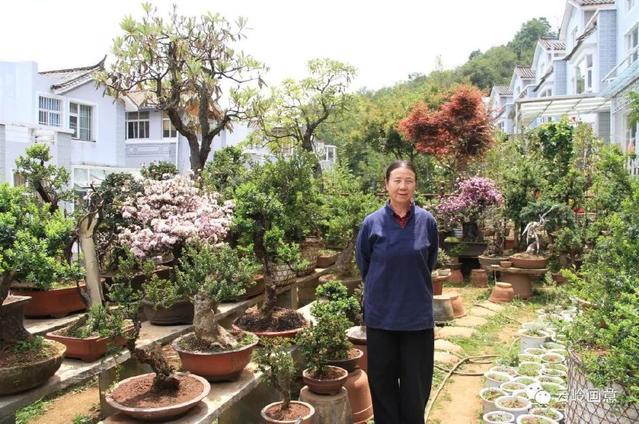
Sitting at the foot of Cangshan, "Diancang Garden," with mountains near and water far, its ink tones blending into one another, gives us a beauty that is understated, restrained, tranquil and profound. Standing in the garden, one feels that a restless heart is instantly set at ease. Although "Diancang Garden" covers only 120 sq m, more than 200 bonsai of varied forms and sizes - azaleas, boxwood, fragrant wood, cotoneaster, papaya, alpine juniper, ebony, Chinese persimmon and more - proclaim the owner's more than 20 years of persistent pursuit. The owner of this "Diancang Garden" is my mother - Ms. Ma Yanhua of Dali University.
Ms. Ma Yanhua (first from right) exchanging creative insights with Mr. Wang Xuanmin, a Chinese bonsai art master, at the "Bonsai and Viewing Stone Culture and Art Exhibition" celebrating the 60th anniversary of the founding of Dali Bai Autonomous Prefecture (Photo: Yunzi)
In late spring, the bonsai in the garden are full of vitality, and the oldest among them has been in a pot for nearly twenty years; it could be said that they have accompanied and witnessed my growing up. My love for and dedication to bonsai are mainly due to my mother's influence; her perseverance and devotion to bonsai deeply inspire me, and she is my first teacher on the path of bonsai.
My mother works at Dali University and is now retired. She is an executive director of the fifth council of the Yunnan Provincial Bonsai and Viewing Stone Association and vice president of the Dali Prefecture Bonsai Association. Friends in Dali and in bonsai circles all affectionately call her Teacher Ma. My mother is devoted to the art of bonsai, and whenever she has time she tends her beloved bonsai in the garden. Especially during the periods when I was away studying in Nanjing, there was not a single task - weeding, fertilizing, spraying, pruning, shaping - that she did not do herself. My mother is enthusiastic about bonsai activities; whenever there is an event, especially a bonsai event in the Dali area, she is always running around and out from early morning until late. After retirement, my mother is busier than when she was working.
Ms. Ma Yanhua (first from right) carefully checking exhibits at the "2016 26th China (Dali) Orchid Expo Bonsai Exhibition" (Photo: Yunzi)
In Yunnan and indeed across the national bonsai world, women in bonsai are very rare, and those well known to everyone can be counted on one's fingers. Working with bonsai means dealing with trees and soil all day long; a whole series of tasks - watering, fertilizing, repotting, pruning, pest control, weeding - is complicated and varied, exposed to wind and sun, and much of it is physical labor. Most critically, bonsai is by no means a matter of a single day or night; it requires sustained perseverance and a certain state of mind, and many men cannot keep it up, let alone women in bonsai. Therefore, every woman in bonsai deserves our respect.
There are many factors in why my mother has been able to keep walking on the path of bonsai. From the broader environment, it is the prosperity of the country and the rapid development of Yunnan bonsai in recent years, which have created a favorable environment for the development of bonsai; from the family perspective, although my father and I both wholeheartedly support her, the most crucial thing is still my mother's love and dedication from the bottom of her heart, and her unrelenting pursuit.
Ms. Ma Yanhua (first from right) exchanging creative insights with Mr. Lu Zhiwei, a Chinese bonsai art master, at the 2015 "China Kunming (Expo Cup) China Bonsai Fine Works Invitational Exhibition." First from right is Teacher Ma's husband, Mr. Chen Xiaojun (Photo: Yunzi)
When I was in sixth grade, my mother began taking me along to work on bonsai. At that time, neither my mother nor I knew much about bonsai; the only channel for learning was the few bonsai books we had. I still remember that back then, every weekend, my mother would take me to the flower and bird market in Dali to buy tree stumps, from winter to summer, never once stopping. Even if we did not buy stumps, we still had to go to the flower and bird market or to the homes of other bonsai-growing friends to look around and exchange experience.
The flower and bird market in Dali was relocated three times, and the price of tree stumps slowly rose from just a few yuan at first to hundreds and then thousands of yuan, but my mother's habit of taking me to buy and look at stumps on weekends never changed. Many of the bonsai materials we have at home now were accumulated during that period.
This azalea beside my mother was bought when I was in the second year of junior high school, and it has now been in a pot for 16 years. No matter where she is, as long as my mother sees a beautiful bonsai or an ancient tree in nature, she will stop and linger for a long time, which shows how obsessed she is with bonsai.
I still remember that the first bonsai we kept at home was an azalea. At that time, because of a lack of experience and skill, it withered and died after only a few years, which was a heavy blow to my mother. But my mother did not give up because of this; instead, she looked for the reasons together with me, exploring one by one from light, water and fertilizer to azalea varieties, and accumulating experience. After that we had a second azalea, then a third, a fourth... until we could handle azaleas with ease. Before I was in my third year of university, our family always lived in an apartment building, and the only place where bonsai could be kept was a balcony of 4 or 5 sq m. When the balcony could no longer hold them, they went into the living room, then to the open space downstairs, and finally they had to be fostered in a friend's yard.
Ms. Ma Yanhua (first from right) and Chen Xi, mother and son, with Chen Xi serving as deputy secretary-general of the Dali Prefecture Bonsai Association, showing their skills together on stage at the "2016 26th China (Dali) Orchid Expo Bonsai Exhibition" (Photo: Yunzi)
Later, when conditions improved, we had a small courtyard, but it too was soon filled with bonsai. As the number of bonsai grew, the workload multiplied; at first, watering all the bonsai once took only about 5 minutes, but now it takes 2 or 3 hours. For my mother, who is getting older, this is a great physical task, yet she has never stopped. The variety of bonsai at home has also become richer and richer, from azalea to boxwood, cotoneaster, and then fragrant wood, pine and cypress. Today, this little "Diancang Garden" is the favorite place for bonsai enthusiasts around Dali to visit; everyone gathers from time to time, sips tea, talks about insights, and discusses bonsai care and creative techniques.
Boxwood tree form in 2011
On the long road of bonsai, my mother has always been moving forward persistently through exploration. Every bonsai at home, no matter its size, is treated with the same care by my mother. Boxwood is recognized in bonsai circles as a variety that grows relatively slowly and is relatively difficult to shape. The earliest batch of boxwood material at home, when it first arrived, was just a bare stump with no branches and no buds, and the root system was very poor. Every branch started from a small bud (see the image above, boxwood tree form in 2011), and now it has gradually come to look verdant (see the image below, boxwood tree form in 2018). My mother often says that trees also have spirit; if you treat them well, they will grow lush branches and leaves, and one day they will grow into the shape you want. My mother's persistence has also let me see what the future of bonsai looks like.
Boxwood tree form in 2018
When I was little, my mother took me along to work on bonsai, and now I walk the path of bonsai side by side with my mother, exchanging ideas together, discussing bonsai care experience and shaping techniques, as well as new developments and new perspectives in bonsai.
The above is my mother's approach to bonsai as I see it. I hope more women bonsai enthusiasts will join the world of bonsai, and I wish Yunnan bonsai better and better, and Chinese bonsai ever more flourishing.