How to cultivate a trident maple bonsai? A detailed explanation of two classic styling techniques
Although the title refers to the cultivation of trident maple, this process is suitable for most deciduous tree species bonsai.
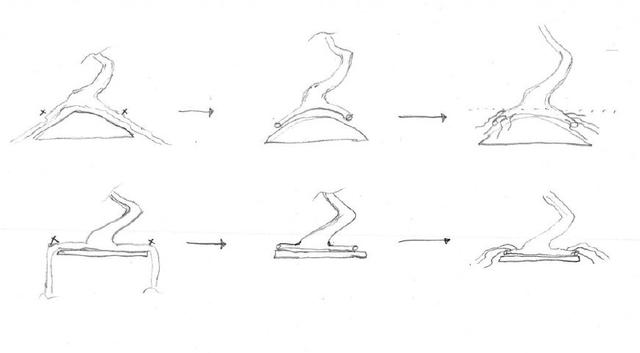
Let us first look at how to cultivate surface roots. If it is a seed-grown seedling, the bottom of the root needs to be trimmed flat first. If it is a cutting or layer-propagated seedling, then comb the root system flat. Then find a suitable-sized hard object (wooden board, stone) to place underneath, trim any overly long roots, and plant it in the ground, and you can get surface roots that spread out flat in all directions. If roots are missing in certain directions, you can use grafting to add roots. As shown in the picture below.
The grafted roots, after a long time, also look very natural.
Next, let us look at the first styling, which is a very common one for trident maple, a small-scale bonsai. During the seedling stage, the trunk needs to be shaped accordingly, not necessarily as shown in the picture. Then use sacrifice branches to grow the trunk thick, while the structural branches need to be grown out and pruned each year to maintain their shape. This process will be very long, and in between you may need to replace the nutrient branches. After the trunk has grown to a suitable size, you can remove the sacrifice branches and make fine adjustments to its overall shape. Through this, it can be completed in about 10 years.
The finished product is roughly like this
The second styling is the curved-trunk style for maples.
It also starts from a small seedling, using sacrifice branches to grow it thick and set the form, trimming the structural branches more, and finally forming a suitable apex. This process also takes about 10 years or so.