A Detailed Guide to the Basic Knowledge of Orchids for Beginners
Promote Chinese orchid culture, spread orchid knowledge
Ornamental orchids are usually divided into two major categories according to their cultivation history and national circumstances. One category has a relatively short cultivation history (about 200 years) and consists mainly of epiphytic orchids native to tropical and subtropical regions. Their flowers are large, brightly colored, and unscented, and they are more favored by Europeans and Americans. They are usually called "foreign orchids" or "modern orchids," such as Cattleya, Dendrobium, Phalaenopsis, Cymbidium hookerianum (Cymbidium), Paphiopedilum, and Oncidium. The other category has a long cultivation history (about 1,000 years or more) and consists mainly of terrestrial orchids distributed in subtropical and temperate regions. Their flowers are small, elegant in color, and delicately fragrant, and they are loved by the people of our country and the people of Japan. They are usually called "national orchids" or "Chinese orchids," and are also sometimes called "oriental orchids," such as Cymbidium goeringii, Cymbidium faberi, Cymbidium ensifolium, Cymbidium sinense, and Cymbidium kanran.
Chinese orchids have an elusive wafting fragrance that, together with their dignified flower appearance and elegant bearing, fully embodies a uniquely Eastern style. Not for their brilliant colors but for their pleasant delicate fragrance, they are deeply loved by the people of our country, who praise them as the "national fragrance," the "ancestor of fragrance," the "fragrance of kings," and "the finest fragrance under heaven."
More than 2,000 years ago, Confucius praised orchids in this way: "The iris and orchid grow in deep valleys, yet do not cease to be fragrant because no one is there." This expresses the proud character and resolute temperament of the orchid. Together with plum, bamboo, and chrysanthemum, it is ranked among the "Four Gentlemen."
There are more than 40 species of Cymbidium plants worldwide, and about 20 species in our country. Chinese orchids usually refer to several terrestrial orchids among the Cymbidium plants:
Cymbidium goeringii, blooming in spring: the flowering period is late March, with a single flower or occasionally two flowers borne in pairs on the scape; the scape is shorter than the leaves, and the flower is pale yellow-green and extremely fragrant. Varieties include Song Mei, Green Cloud, Long Zi, and others.
Cymbidium faberi, blooming in summer: the flowering period is April to May, the leaves are strongly upright, the scape is nearly as long as the leaves, and it bears 6-12 flowers. The flowers are pale yellow-green, and the fragrance is slightly inferior to that of Cymbidium goeringii. Varieties are also divided into plum-petal, lotus-petal, narcissus-petal, and other types.
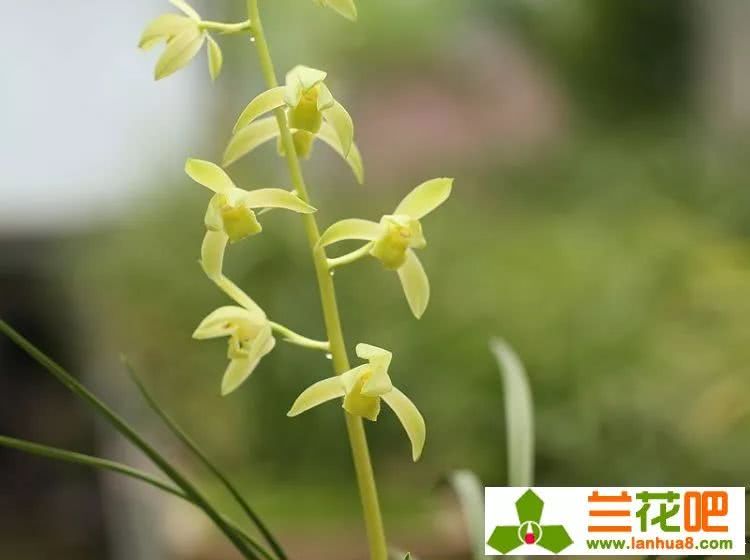
Cymbidium ensifolium, blooming in autumn: the flowering period is July to October, and some types bloom continuously from summer to autumn and are called four-season orchids. The scape is slightly shorter than the leaves and bears 4-7 flowers; the flowers are pale yellow-green and have a delicate fragrance.
Cymbidium sinense and Cymbidium kanran, blooming in winter: Cymbidium sinense, also called the year-reporting orchid, has a flowering period from January to March, with a few blooming in autumn. Its leaves are relatively broad and sword-shaped, and the scape rises above the leaves, bearing 7-20 flowers. The sepals and petals mostly have purple-brown markings. Cymbidium kanran also blooms from winter to early spring, but its leaves are relatively narrow and linear, and the scape is slender, upright, and slightly above the leaves, bearing 5-7 flowers, with the petals also relatively narrow.
The appreciation of Chinese orchids by the people of our country has gone through a process of development from smelling the fragrance, to viewing the flowers, to observing the leaves, and to appreciating "artistic variation." The traditional love of orchids among the people of our country was mainly based on smelling the fragrance. The ancients praised the fragrance of orchids most highly, calling it the "national fragrance," the "fragrance of kings," and "the finest fragrance under heaven." The fragrance of orchids differs from other fragrances: it is sometimes present and sometimes absent, now hidden and now visible, now near and now far, mysterious and unfathomable. An ancient poem says: "For two or three years I cultivated orchid buds by hand; as the days warmed and the winds softened, they opened one by one. Sitting long, I did not know the fragrance was in the room; when I pushed open the window, sometimes a butterfly flew in." This is a vivid description of orchid fragrance. Besides fragrance, the noble purity and elegant refinement of orchids, their refusal to compete in beauty with peach and plum, and their character of not changing color because of frost and snow are also deeply loved by the people of our country. In particular, the pure white "plain heart" is regarded as the foremost among all orchids, the so-called "bearing of a gentleman." Beyond smelling fragrance and observing color, there is also attention to petal type, requiring the flower shape to have spiritual charm. For example, the two lateral sepals of an orchid arranged in a horizontal line, the "single-character shoulder," has always been regarded as an excellent variety. If the lip is tightly pressed below the column and only slightly exposed without extending outward, it can be called a top-grade specimen.
Although orchids are fine, after all, the flowers bloom only for a time. Therefore, some people turned from viewing flowers to observing leaves, believing that "viewing flowers lasts a time, viewing leaves lasts the year." Orchid leaves are fresh green all year round, combining firmness and softness, with graceful posture; even when it is not the flowering season, they are a living work of art. A poem says: "Weeping dew scatters the light in confusion; holding the wind, the shadows slant of themselves. How can ordinary people understand this? Viewing leaves is better than viewing flowers." This shows that the beauty of orchid leaves has been highly praised.
In recent years, some people have developed a preference for the yellow-white stripes and spots that appear on the leaves of Chinese orchids, calling these stripes or spots "artistic variation." Orchids with "artistic variation" are called "art orchids," and their value is several times to several dozen times higher than those without "artistic variation." In recent years, attention has shifted from "leaf artistic variation" to "flower artistic variation," with high praise given to orchid flowers whose petals appear double or malformed.
At present, the appreciation trend for Chinese orchids has shifted again to the appreciation of form, the so-called "form artistic variation," namely the special formal beauty of dwarf varieties and unusual-leaf types. And from a single "flower artistic variation," "leaf artistic variation," or "form artistic variation," it has developed into comprehensive "supreme-grade" orchids combining dwarf type, unusual leaves, linear artistic variation, and unusual flowers, excelling in all four qualities. According to the public's habits of appreciation, orchid appreciation can be summarized as the "ten looks":
First, look at fragrance. The pure and not muddy is the finest.
Second, look at posture. A whole plant that is well proportioned, with flowers and leaves in harmony, is good.
Third, look at color. Among flower colors, pale green is best, deep green is next, those that are red when first opening and later turn green are next again, and red and purple are even lower. For leaf color, oily and glossy is best.
Fourth, look at the shoulders. The left and right lateral petals rising slightly are called "flying shoulders" and are the most precious; those extending horizontally and level, forming a "single-character shoulder," are superior varieties; the two lateral petals drooping after blooming are called "drooping shoulders" and rank next.
Fifth, look at the petals. "Petals" (actually the 3 sepals) shaped like lotus petals are top grade, those like plum petals are next, and those like narcissus petals are next again.
Sixth, look at the column. The column is best when smooth and clean, fleshy, thick, and concave inward into a hood-like shape.
Seventh, look at the tongue. The lip is best when proper, round, short, and large. The color on the tongue is called "moss," and unmatched color and white are best, with yellow next. The tongue often has red lines or block-like red spots, and those with vivid color are good. Spots are good when they form one dot, one patch, or are arranged in a character-"pin" shape.
Eighth, look at the nose. The nose should be small, and those appearing spirited are top grade.
Ninth, look at the sheath. Green sheaths are best, purple ones are next; those fine in texture, thin and hard are good, while thin and soft ones are called "rotten clothing" and are not desirable.
Tenth, look at the stalk. The stalk is the scape; green ones, with length proportionate to the flowers and leaves, slender and rising above the leaves, are good.
The above "ten looks" include all four aspects highly emphasized in judging orchids: qi, color, spirit, and charm.
Because orchids differ in species, their places of origin and ecological environments also differ, so they must be treated differently in cultivation. Propagation is mainly by division.
Orchid Bar, your good teacher on the road of growing orchids
If the orchid knowledge we publish has been helpful to you, we hope you can give it a like or click the upper right corner to share it with your friends! After following this official account, "Orchid Bar," you can have your orchid questions answered online. Send the number "8" to buy orchids, send "6" to sell orchids, and send "1" to sell orchids online with zero inventory on your behalf!