A flower with a very long blooming period, it can bloom from the first half of the year all the way into the second half.
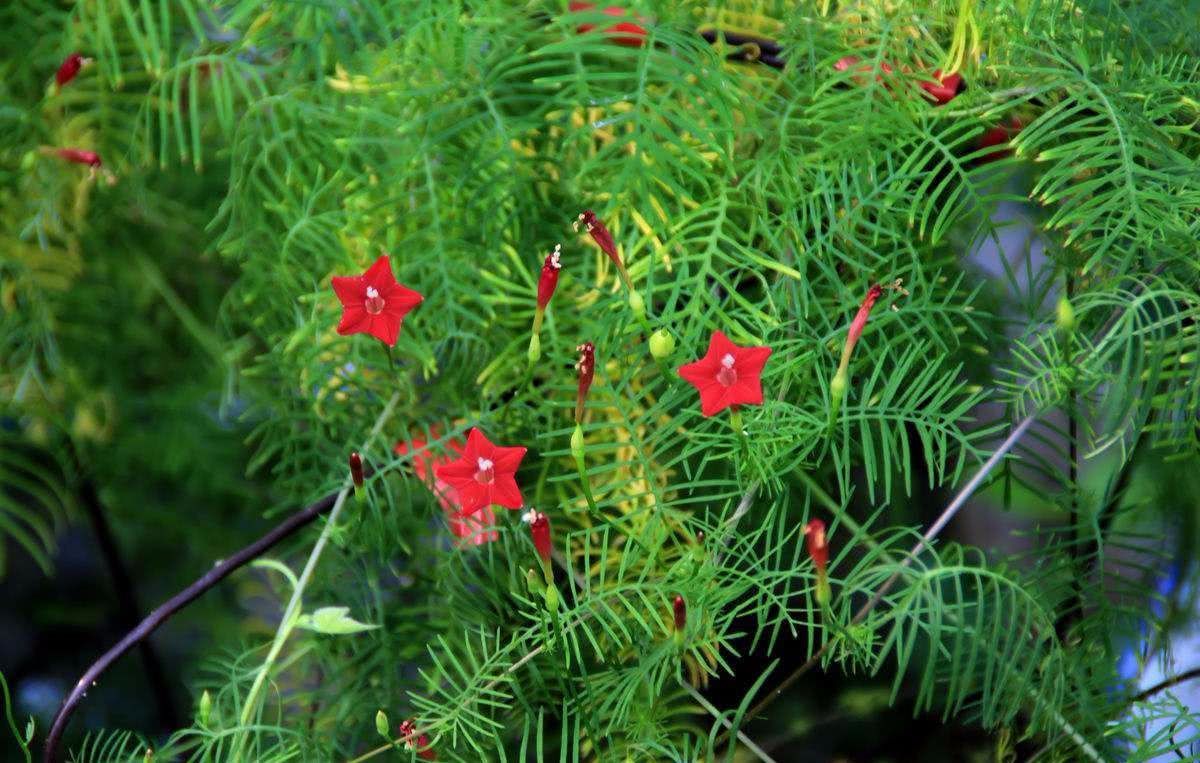
Cypress vine (Ipomoea quamoclit), native to Mexico, has a great many alternative names, including Mi Luo Song, You Long Cao, Niao Luo Song, five-pointed star flower, and lion grass. It is an annual herbaceous flowering plant in the Convolvulaceae family, with a long blooming period. In the south, the blooming period generally runs from April to November, and every day a fresh batch of flowers opens, though they open in the morning and wilt by the afternoon.
When green leaves cover the trellis, the cypress vine's corolla is deep red and vivid, and when in bloom it looks like little red five-pointed stars dotted among layer upon layer of emerald feathers (besides red, the flowers also come in white; if planted as a cross, red and white set each other off beautifully), shining brightly with a distinctive charm. Even when not in bloom, the cypress vine is like a cage of green mist, like being draped in green gauze, delicate and light, swaying in the wind, its lovely silhouette flitting gracefully, extremely endearing.
This kind of garden art is called "landscape scenery" (dijing), named alongside bonsai, and is yet another style.
The cypress vine's vines and leaves are slender and elegant, smooth and soft, with a very strong climbing habit. It is an excellent plant for arranging courtyard flower trellises, low walls and short fences, or greening a balcony, and of course it can also be grown in pots and displayed indoors. During the blooming season, although its flowers are small, they are scattered in twos and threes among the green leaves, lively and charming. The cypress vine is not only ornamental; the whole plant can also be used as medicine, and it has the effects of clearing heat and detoxifying, and reducing swelling. It has a good effect on treating feverish colds and sores, swellings and toxic conditions.