What natural conditions are needed for the formation of Lingnan bonsai?
Lingnan is roughly distributed across eastern Guangxi to eastern Guangdong and the border area of five provinces and regions including Hunan and Jiangxi. In the past, the Nanling Mountains acted like a natural barrier, hindering transport and economic links between the Lingnan region and the Central Plains, so that the economy and culture of the Lingnan region fell far behind those of the Central Plains, and northerners called it "the land of the barbarians." Only after Chancellor Zhang Jiuling of the Tang Dynasty cut the Meiguan Ancient Road through Dageng Ridge did the Lingnan region gradually undergo development. The "Book of Jin: Treatise on Geography, Part Two" called the Nanhai, Guilin and Xiang commanderies established in the Qin Dynasty the "three commanderies of Lingnan," clarifying the regional scope of Lingnan.
Lingnan lies with the Five Ridges to its north, the South China Sea to its south, Yunnan-Guizhou to its west and Fujian to its east; its range covered most of present-day Guangdong, Hainan and Guangxi as well as northern Vietnam. Only after the Song Dynasty did northern Vietnam separate from it. The Five Ridges does not refer specifically to five ridge names; it also includes the five passages that cross the Nanling Mountains. Lingnan is also called Lingwai and Lingbiao, which are terms based on different geographical positions: seen from the Central Plains it is called Lingwai, while seen from the Pearl River Delta it can be called Lingbiao.
In the Lingnan region, most of the area has a subtropical monsoon climate, where solar radiation is relatively abundant, sunshine duration is relatively long, and wind direction changes alternately with the seasons. Because the Tropic of Cancer runs through the middle of the Lingnan region, the main climatic features are high temperature and abundant rain. It is precisely under such climatic conditions that the vegetation of the Lingnan region grows luxuriantly, stays green through all four seasons, with a hundred flowers vying in beauty, and all kinds of fruits without interruption throughout the year; plant resources are extremely rich.
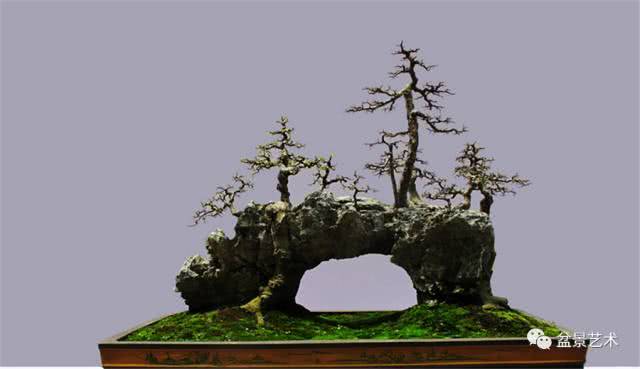
As a bonsai art, it is precisely such easily sprouting, fast-growing tree species, that is, tree species with extremely strong sprouting ability, that are needed as source material. Species such as orange jessamine (Murraya paniculata), Fujian tea (Carmona retusa), Japanese bush cherry (Sageretia thea), Chinese elm (Ulmus parvifolia), acacia and banyan gradually became the preferred tree species materials for Lingnan bonsai art, and these climatic features also provided the preparatory conditions for the emergence of "storing the trunk and cutting the branches," a creative technique unique to Lingnan tree-stump bonsai art. In addition, Lingnan is also rich in ornamental stones such as Yingde stone, sand-accumulated stone, reed-pipe stone, pumice, sea-mother stone, coral stone and stalactite, which become excellent materials for Lingnan landscape bonsai.