How can bonsai creation truly follow nature as its teacher?
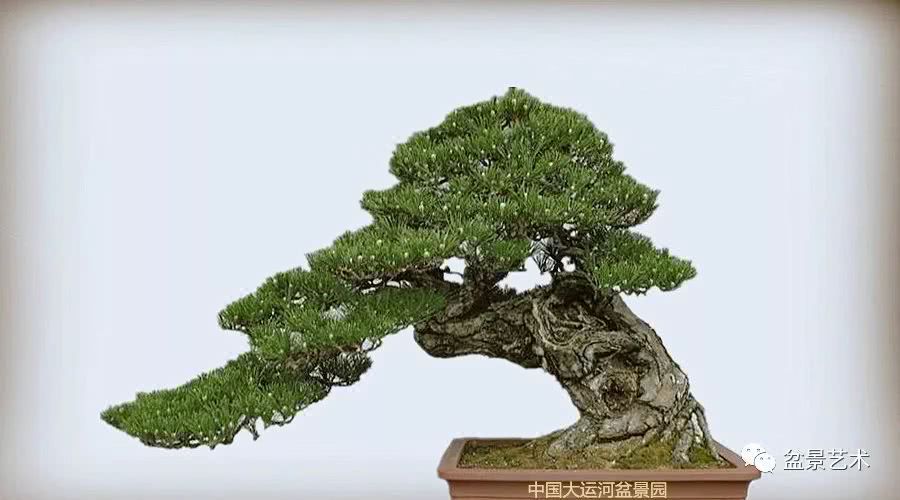
Nature as teacher, following creation: the so-called "nature" and "creation" encompass all things in the world.
Bonsai is precisely the artistic summary and artistic reproduction of famous mountains and rivers and ancient wondrous trees. In creating bonsai, the most important thing is to have hills and valleys, forests and springs in one's heart, and only then can there be "summary" and "reproduction". Learning from nature and taking creation as one's teacher is an important task in collecting materials and a prerequisite for creation. Of course, since it is creation, it is not a direct copy or transcription of natural scenery, not a mirror-like "miniature", but a combination of realism and romanticism. How can a thousand li of mountains all be wondrous? How can ten thousand li of waters all be beautiful? In bonsai creation, one must carefully observe and study mountains and waters and towering ancient trees, and earnestly carry out artistic processing through pruning, selection, rendering and exaggeration, so as to reproduce nature in a more concentrated and more typical way. Toward nature, poets, painters and artists of past dynasties have all endlessly praised and worshipped it, drawing nourishment from nature to enrich their own creations.
Bonsai practitioners must also spare no effort, climbing mountains and wading through waters, conducting in-depth research on mountains and trees, grasping their characteristics and mastering their laws. Mountains may be secluded, graceful, perilous, majestic or wondrous; trees may be vigorous and unrestrained, or elegant and flowing. One must concentrate fully and capture their characteristics. And for each characteristic, one must also pay attention to subtle differences, searching all wondrous peaks to draft the work in one's mind. In nature are deeply hidden inexhaustible and endlessly abundant materials for bonsai art, but we need to excavate them and collect materials in order to avoid rigidity and cliché, and thereby create works with new conceptions, beautiful composition, pleasant colors and artistic charm. Someone had this experience: "From Jiangling I ascended the Three Gorges and Kuimen, a long flow of more than three thousand li... whirlpools and returning currents, majestic waves and rushing rapids all lie within it... cliffs and precipices, steep banks and high winds, towering ridges and deep crags, secluded springs and beautiful valleys, tiger dens and dragon pools, wonders, dangers and steep heights, sudden rain and wild wind, all were experienced... truly what is called taking something from a bag." Many bonsai craftsmen have not had a high level of education, yet they can create fine works with considerable artistic conception and both spirit and form, precisely because they have worked hard in observing nature and in "traveling ten thousand li". Of course, emphasizing traveling ten thousand li and having hills and valleys in one's heart does not deny reading ten thousand books and storing poetry and books within, but rather one must clarify the root and source, and not treat learning from predecessors as the source. If the primary and secondary are reversed, the artistic source of bonsai will dry up.
How should one learn from nature, and what should one learn? To learn from nature is to grasp the characteristics, properties, expressions and postures of various things, and to grasp their regularity. All things in nature have a certain regularity. Trees have the laws of growth, development, flowering, fruiting, leaf fall and dormancy; mountains have the changing laws of spring, summer, autumn and winter, morning and evening, clear and rainy. As for plants, each has different botanical forms and biological characteristics, with wondrous postures and strange forms changing in a thousand ways, such as bamboo's vigorous joints and elegance, the pine's verdant firmness, the osmanthus's fragrant charm, the crabapple's charm, and so on in endless variety, each with its own characteristics. Take elegance and refinement: there are distinctions among ancient elegance, refined elegance and light elegance, and predecessors further divided elegance into five categories: "Plain and innocent, untouched by any trace of appearance, is high elegance; with method in composition, foundation in brushwork, reaching the utmost change yet never departing from the rules amid change, is classic elegance; sparse trees on the plain, cold sand at distant peaks, faint distant ridges, brimming autumn waters, with little brush and ink yet the more one plays with it the more inexhaustible it becomes, is subtle elegance; with tranquil spirit and calm qi, causing one to suddenly dispel restless and presumptuous qi, is harmonious elegance; able to gather the strengths of all former masters and form a bearing of one's own, yet not losing the qi of famous and noble scrolls, is great elegance." In short, the more meticulously one observes things, the more freely one can act in creation, "responding to things and giving them form", "following categories and applying colors", so that works reach "formal likeness" and "spiritual likeness" and possess a vivid and moving artistic conception.
The so-called formal likeness refers to the image in an artwork vividly reflecting the appearance of an objective thing; the so-called spiritual likeness refers to expressing the vivid and distinct expression, condition and unique individuality of a thing. Form is the foundation; without formal likeness, spiritual likeness cannot be discussed. But if one rigidly adheres to formal likeness and seeks the truth of external partial appearance, then one cannot highlight the object's spiritual temperament and individual characteristics. Here, spirit is the key; formal likeness is for conveying spirit, and form and spirit must both be present, neither can be lacking. Because bonsai art is limited by objective conditions such as materials and forms of expression, it is affected to a certain extent in realism; if one seeks strict formal likeness, one often instead loses truth, and moreover the ultimate aim of bonsai art is to express artistic conception and give vent to feeling. Only with both form and spirit can this aim be achieved. The aesthetic requirement of both form and spirit is "likeness that is not likeness". We emphasize that bonsai should conform to nature, but that does not mean becoming a model of natural scenery. Bonsai must "shrink a dragon into an inch" and "shrink the earth by a thousand li" from the scenery of nature, and achieve "one peak then roughly a thousand xun, one spoon then rivers and lakes ten thousand li"; therefore it must summarize, condense and concentrate, and it is impossible to be completely formally alike. Compared with the natural scenery being expressed, the scenery in bonsai, though not completely alike in form, is similar in spirit, and only when form is not completely alike can spiritual likeness be obtained; too much formal likeness instead loses spiritual charm.
In bonsai creation, to achieve both form and spirit, one must begin from every aspect. First, one must have a full understanding of the object to be expressed. In order to highlight spirit, when choosing the object to express, one should appropriately summarize and select the form, sometimes selecting only "a single scale and half a claw", that is, seeking simplicity amid complexity. In processing and making, for plants, mountain stones and so on, one must certainly apply skills according to the material, so as to make full use of its inherent form to express a kind of natural spiritual charm. In layout and selection of type, one must flexibly apply the relationship between form and spirit, seeking to achieve perfection of image, so that viewers are stirred emotionally, produce associations and resonate. This constitutes a profound artistic conception, and artistic conception is the blending of feeling and scene. Moreover, every blade of grass and every tree, every mountain and every water in the pot is infused with the creator's subjective feelings and condensed with the creator's thoughts and emotions, producing infinite associations from limited scenery. For example, if the stump and trunk are majestic, rugged and with gnarled roots, then shape it into a large-tree type or old banyan type; if the head and roots are smooth and the trunk leans to one side, shape it into a slanting drifting tree type; if the trunk is tall and upright piercing the sky, then shape it into a kapok tree type, and so on. The finished work is required to have a form conforming to nature, so that each form has its own individuality and characteristics, possessing both natural beauty and artistic beauty, achieving the creative aim of "originating from nature, yet higher than nature".