Balcony Planting Example: Create a Mini Balcony All to Yourself
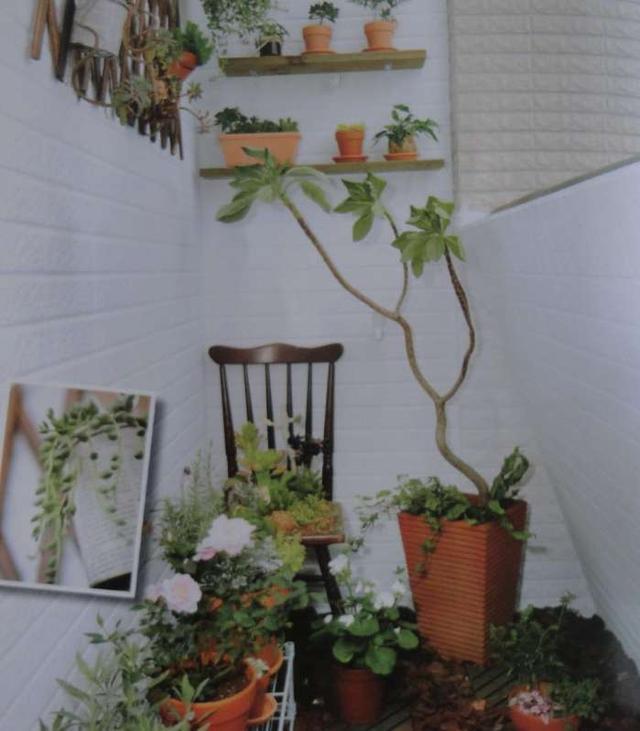
Details: Open balcony, 3 to 7 sq m, 5th floor, scattered light in the morning, direct light only in the afternoon, mainly foliage plants and succulents
If the balcony at home is only wide enough for one person to pass through, and the parapet forms a slanted, narrow layout, most people would give up on turning it into a garden. But after discussing it with the designer, the owner still succeeded in creating a small but beautiful balcony garden on the west-facing top floor of their home.
Arriving at the long, narrow balcony on the top floor, the scent of hinoki cypress greets you first, and what comes into view is a natural-style garden floored with wooden planks and hinoki wood shavings. To match the overall color scheme, the designer mostly used unglazed terracotta pots, bamboo fences and wooden boxes. To achieve the lush green effect the owner wanted, the designer also used quite a few potted plants, arranging them according to pot size and the height of their placement, and deliberately interspersed a few colorful flowering plants among the sea of green with leaves in varying shades, creating a rich, compact garden feel. If you look closely at where the different types of plants are placed, you will find that flowering plants, herbs and succulents are mostly in spots that receive direct sunlight, while the spaces in the corners and under the parapet hold foliage plants and ferns, breaking the limits of the layout through the nature of the plants themselves.
A glass bottle paired with perlite and an aluminum wire handle becomes a small water-grown accent on the shelf
A chair discarded because its seat was broken, wrapped in sphagnum moss, becomes a display platform for various succulents
The high wall surface receives sunlight for longer, making it suitable for placing succulents
The owner's Doberman, "Ou Huahua," also curiously admires the home's new balcony
Creative Focus One: Make Full Use of Wall Space to Expand It
On a balcony that is not large, the wall is one of the keys to spatial expression. Making good use of the wall can instantly make an empty balcony feel bigger and richer. The designer first painted all the walls white, since white can create a visual effect of enlarging a space, and then chose several types of fences and stands that can hang plants, adding more room for potted plants. If that is still not enough, wall shelves are also great material. Small shelves are perfect for creative potted plants, eye-catching and fresh.
Small potted plants placed on a swing-shaped flower stand have a lovely, innocent childlike charm
Reclaimed old wood nailed to the wall has many benefits, and the cracks and grain on the boards add even more rustic charm
Aluminum wire casually wrapped around a pot and fixed to the wall fence gives a relaxed, lived-in feel
Creative Focus Two: Combined Plantings Offer Endless Variety
Because the owner wanted the sense of a large amount of plants as a whole, and the space was limited, the rich, ever-changing nature of combined plantings was used to quietly arrange various group plantings of herbs, flowering plants and foliage plants in the garden. Paired with pots of different shapes, they set each other off even more, and this is also the key weapon for turning a small balcony into a garden!
Fill a wooden box with sphagnum moss and place moisture-loving plants such as giant taro and ferns inside, and you have a combined planting perfect for setting at the foot of the parapet
In combined plantings, besides the types of plants paired together, leaf shape and leaf color are also the best expressions of creativity
Creative Focus Three: Place Pots High and Low to Create Layering
The long, narrow balcony is the most common layout. In planning the space, to avoid monotony, you can use flower stands, tiered cabinets, chairs and other elements to create more than a single horizontal level. This not only gives a harmonious visual flow, but also makes it easier to care for the plants, leaving proper space between the pots so the plants grow better.
Without tiered stands, you can also use potted flowers of different sizes to create the same sense of layering