Japanese blood grass is an outstanding choice that ornamental grass enthusiasts should not miss.
A Fine Grass for Enthusiasts: Appreciation and Care of Japanese Blood Grass
Hua Mujun
In recent years, as people's living standards have risen, spending on bonsai and flowers has continued to increase, the market for flowers and bonsai has grown ever broader, and their classification has become increasingly detailed. According to the differing interests of flower and bonsai enthusiasts, their areas of pursuit vary as well: some grow orchids and cultivate cymbidiums, some meticulously train bonsai, some transplant flowers and trees, some search the fields for trees, and there are palm-sized potted plants, miniature bonsai, garden landscaping, and courtyard accents - each in its own category, each with its own charm. There are also those who strike out on their own path, introducing foreign horticultural varieties, greatly enriching the domestic flower market.
Among the introduced plants and flowers, many varieties have attractive forms, brilliant flower colors, exceptionally long blooming periods, drifting fragrances, and other such characteristics, drawing flower and bonsai enthusiasts alike to generously open their wallets. As promoters of flower culture, we will introduce a number of foreign flower varieties one after another for our readers' enjoyment.
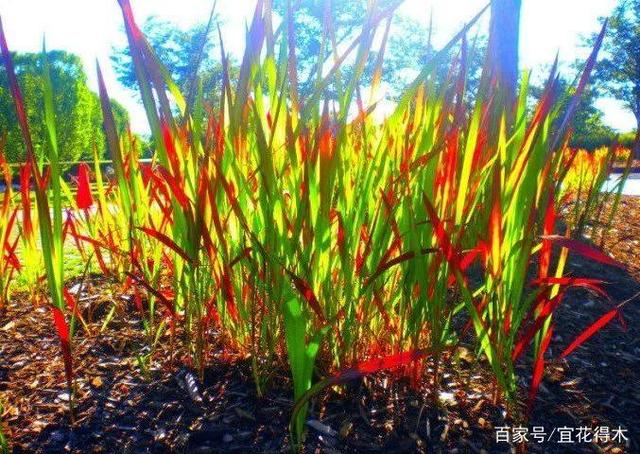
Today we introduce Japanese blood grass, a garden potted variety introduced from Japan in recent years. Its leaves stand upright like swords, growing in dense clumps, with eye-catching color. The base of the leaf is green, shifting from pale green in spring to golden yellow in winter, full of variation, while the leaf tips remain blood-red year-round - most delightful, and highly ornamental.
Three or five blood grass seedlings stand tall and tenacious, like blood-dripping broken swords pointing toward the sky; a clump of Japanese blood grass has an excellent overall effect, and viewed from afar, it is like a streak of colorful clouds in the blue sky. Carefully arranged in a flower pot, ingeniously interspersed with ornamental stones, whether as an accent or planted densely, within a small space it shows great craftsmanship.
There is not much information about Japanese blood grass, and some encyclopedias contain errors in their entries, so we introduce its morphological characteristics as follows: Japanese blood grass, scientific name Imperata cylindrical "Rubra", also called Japanese blood grass, is a perennial herb of the grass family, Imperata genus. The plant height is 30-60 cm, the leaves are clustered and sword-shaped, the leaf color is initially green and gradually turns blood-red; the panicle is a spike-like inflorescence with silvery-white spikelets, blooming in late summer, and it goes dormant in winter. Japanese blood grass is heat-tolerant and moisture-loving, prefers warmth and fears waterlogging, is native to Japan, and is now cultivated in many large cities, mostly sold as potted plants in the flower market.
Japanese blood grass has an elegant, flowing form, a graceful plant shape, and striking, beautiful color, full of natural wild charm. In addition, it propagates quickly, has strong growth adaptability, is simple and easy to plant, and requires only rough care and management, so it is widely used in garden landscaping. Because potted Japanese blood grass becomes shorter in stature, clean, elegant, and lovely, and can be planted alone or used in combination with scenery, it has gradually gained people's affection in recent years. As for cultivation and care methods, we briefly introduce them as follows:
[Soil] Japanese blood grass likes warm, cool, and humid environments, and dislikes waterlogging. It has strong adaptability to soil and tolerates poor soil; substrates that are slightly acidic or slightly alkaline are both fine for healthy growth. For soil preparation, a mix of loose, breathable humus soil and sandy soil can be used for cultivation. For palm-sized potted plants and miniature bonsai, if conditions permit, akadama soil or peat soil can be used for cultivation, clean and hygienic, beautiful and elegant.
[Light and Temperature] Japanese blood grass likes heat and sunlight, and is slightly cold-tolerant. In pots, it should be brought indoors for management in winter. In spring, autumn, and winter it can receive full sunlight, while in summer strong light requires shading. If kept in insufficient light or shade, the red color will fade and turn green, so sufficient light both benefits its growth and ensures its coloration.
[Watering] The watering principle for Japanese blood grass is "do not water until dry, and when watering, water thoroughly." When first planted, keep the soil on the dry side to help the roots take hold and adapt. For potted Japanese blood grass, water about once every three days in spring and autumn, once a day in summer, and appropriately reduce watering frequency in winter, generally once every one week to half a month. Ordinarily, you can spray water on the leaves to make them glossy and beautiful.
[Fertilizing] Japanese blood grass likes fertilizer and tolerates poor soil. In batch cultivation, fertilizer can be supplemented in all three seasons of spring, summer, and autumn, watering once about every ten days with cake fertilizer water at a light concentration, applying thin fertilizer frequently, so that Japanese blood grass grows vigorously. If it is a small potted plant and the potting soil substrate is organic soil such as akadama soil or peat soil, fertilize as little as possible, once a month, to avoid excessive rampant growth of Japanese blood grass that would affect the overall appearance of the potted plant.
[Pruning] Japanese blood grass needs pruning. In spring, it can be cut short overall to encourage new shoots to sprout. During the normal growing season, simply cut away diseased and withered leaves. Weeds at the bottom of the pot should be removed frequently to avoid affecting the growth of Japanese blood grass.
[Propagation] Japanese blood grass is propagated by division and by seed. Japanese blood grass has an extremely strong ability to self-propagate, even spreading excessively, and some varieties gradually lose their red color. Its seeds have a high germination rate and easily escape cultivation to become weeds, turning into an invasive species; now half the states in the United States have already banned its sale. Domestic sales are currently quite brisk, but care should be taken to protect the country's wild environment. When cultivating it, enthusiasts should not casually throw it into the wild, to avoid creating weeds and damaging the environment.
[Diseases] Apart from fungal infections caused by overly wet soil, Japanese blood grass rarely suffers from pests or diseases. Fungicides such as mancozeb and carbendazim can be used for control.
Japanese blood grass is a favorite of some grass enthusiasts, and its market attention is not yet very high. With the rise of palm-sized potted plants, its future market looks strong. However, flower and bonsai enthusiasts must be careful not to spread it casually. Japanese blood grass has strong wild reproductive capacity and grows rapidly; do not let your own preferences cause an exotic species to escape cultivation and bring harm to the environment.
As for the price of Japanese blood grass, there is now quite a lot of batch cultivation. At present, imported plants generally cost around a few yuan per pot, and market retail prices generally range from more than ten yuan to several tens of yuan. It can be foreseen that as sales increase, the price will become lower and lower.
(Some images are from the internet; if there is any infringement, contact us for deletion.)
2018-5-20 Yihua Demu