Potted avocado: healthy and beautifying, with techniques for northern mass cultivation
Hello everyone, I'm Ajie, a gardening enthusiast who loves growing plants from around the world. Today I'm bringing you avocado growing techniques.
Avocado, also known as alligator pear, laurel pear, butter pear or oil pear, is an evergreen tree of the genus Persea in the family Lauraceae. It is listed as one of the most nutritious fruits, with the reputation of "one avocado equals three eggs" and "the poor man's butter." Hence its fine names "nutritious fruit" and "forest butter," and it is regarded as a treasure among fruits by many developed countries. Avocado is rich in glyceric acid, protein and vitamins, moisturizing without being greasy, and is a natural antioxidant; it not only softens and moisturizes the skin but also shrinks enlarged pores. Avocado flesh has good affinity with human skin, is easily absorbed by the skin, and has strong absorption of ultraviolet rays. Combined with its richness in vitamin E and carotene, it thus has good skin care, sun protection and health benefits.
I have a potted avocado tree that I have been growing for eight or nine years now, and it is growing well. Because I live in the north where winters are cold, the one I chose back then was a cold-tolerant variety from Mexico, and a dwarf type as well. It is said that the Mexican variety series has strong cold tolerance, but to be safe, every winter I move it into a simple greenhouse, so that it can both avoid freezing and go dormant.
Avocado blooms in March. When it blooms, the flowers are very beautiful; the flower shape is somewhat similar to jujube flowers, but the flowers are larger than jujube flowers and have no fragrance. The fruit ripens from August to September. Avocado is a fleshy drupe; when ripe, the skin ranges from yellow-green, reddish-brown to brown, the fruit is 5 to 20 cm long and 3 to 14 cm in diameter, and after ripening the skin turns yellow-green, creamy yellow, brown or dark green; the flesh is slightly soft, and the flesh color is creamy white, pale yellow or creamy yellow, with an extremely fine texture; the flesh has an egg-yolk taste and is slightly sweet.
Potted avocado trees are very easy to care for, and one of the main reasons is that they have strong adaptability to soil. Water according to the principle of "water when dry, stop when wet," so that root rot will not occur. Avocado trees like light and prefer high temperatures and a relatively humid climate; if the above conditions are met, the tree will grow very fast. Fertilize frequently but with light fertilizer; you can apply organic fertilizer, such as cake fertilizer. Also note that each year you should apply some zinc-containing fertilizer to ensure a balanced composition of nutrients, because avocado trees are sometimes prone to zinc deficiency after flowering and fruiting. After my avocado tree sets fruit, it will still push out flower buds, bloom and bear fruit. Avocado trees basically do not attract insects and have no diseases, so there is no need to spray pesticides to kill insects. The avocados produced are also very clean, absolutely a "green" fruit.
Regarding avocado propagation, some gardening enthusiasts often like to plant the small seedling trees grown from avocado seeds in flower pots or in the ground, and they find that such seedling trees propagated from seed grow very fast, and they hope they will bloom and fruit soon. In fact, such seedling trees grown from seed not only enter the fruiting stage very late after growing up, or may not bloom or fruit for many years, but also have the characteristic of only blooming without fruiting after growing up. If they do bear fruit after being planted for several years, the fruit will also be very different from the fruit borne by the original mother tree.
Because seedling offspring vary greatly, the fruit is small and the quality is relatively poor. Therefore, people often use grafting as the main means of propagating avocados. But seedling trees grown from seed are used as rootstock. I planted avocado seeds (pits) in a flower pot, and after about 40 days I found that they had already rooted and sprouted. After two months in the flower pot, they had grown into seedling trees more than 20 cm tall. After such seedling trees are cultivated in flower pots for one year, in the spring of the second year they can be used as rootstock for grafting.
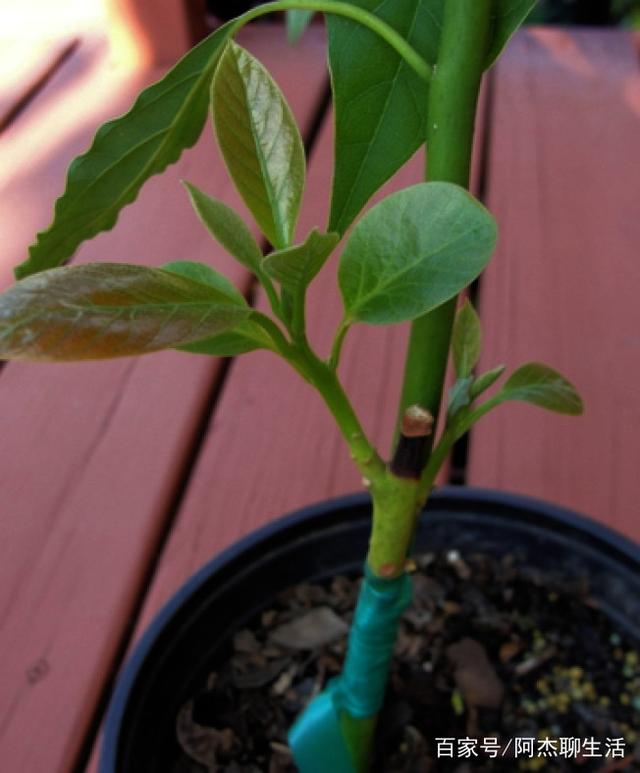
When grafting, cut a healthy scion from last year's growth from my potted avocado mother tree, with a diameter almost as thick as the rootstock grown from an avocado seed; on the rootstock, at a spot 5 to 6 cm near the root, use a knife to cut a flat surface of about 3 cm, then cut a similar flat surface on the scion as well, then press the flat surfaces of the scion and rootstock together, bind them tightly together with tape, and finally bend down the branches and leaves above the rootstock; this is done to provide nutrients and water to the scion. Generally after about 30 days you can see new buds growing on the scion. In this way you have propagated a very good small avocado sapling, and a fruit tree propagated by grafting will bloom in the second year after grafting and will soon bear fruit, and the avocados produced will be exactly the same as the fruit borne by the mother tree.