Get the proportions right, and your bonsai is more than half done.
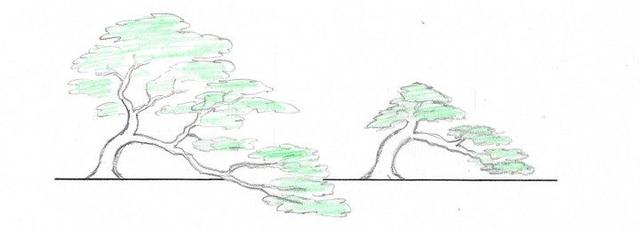
For the two potted trees in the picture below, which one do you think looks better? Most people, I believe, would choose the one on the right. It is more compact, and its proportions fit our sense of beauty better.
Making a bonsai means shaping the tree's various proportions so that they best match people's sense of beauty. Take the tree below, for example: it is very tall with very long branches, and if you let it grow freely, it will end up as nothing more than a landscaping tree. How do you turn it into a bonsai? You have to make it shorter and reduce its height-to-width ratio. If it is a deciduous tree, you can first cut off the long branches on the upper part. Of course, if you do not want to waste them, then do high-level air layering. But if it is a pine, it cannot be handled that way. After cutting off part of the trunk, it takes several years of branch growing and pruning to make it look like the one on the far right, and then it is a nice little piece.
There are also proportional requirements for the taper of the trunk. Tree stumps of three shapes, A, B and C. A is what we often call a pencil-straight stump, usually the part left behind after artificial felling. Such a stump is not entirely useless; with carving techniques it can also be made very beautiful. But if you do not carve it, then saw it off at a height about 1.5 times its diameter, let it sprout again, and then slowly train it. The B type of stump is also often encountered; it has a certain taper, but this kind of stump is deceptive and hard to handle, so you can only cultivate it slowly, and after it sprouts from the trunk, respond according to the situation. C is a very ideal bonsai stump, very suitable for making bonsai, but this kind of stump can only be produced by artificial cultivation.
There are also proportional requirements for the taper of the crown. A is clearly a rough piece still needing branch growing and pruning, B is already ruined and can only be started over from scratch, and C is the ideal crown; its proportions are just right.
For a tree shape like A in the picture below, the structure is loose and the proportions are out of balance. The only later operation is to shorten it, grow the branches again, and train it in the direction of D.
For a bonsai tree, if you control the overall proportions well, you are more than half successful. As for the remaining minor details, you only need to tidy the branches and leaves a little, and it can be a beautiful bonsai.