Will a pomegranate bonsai grow more slowly after being bent into shape?
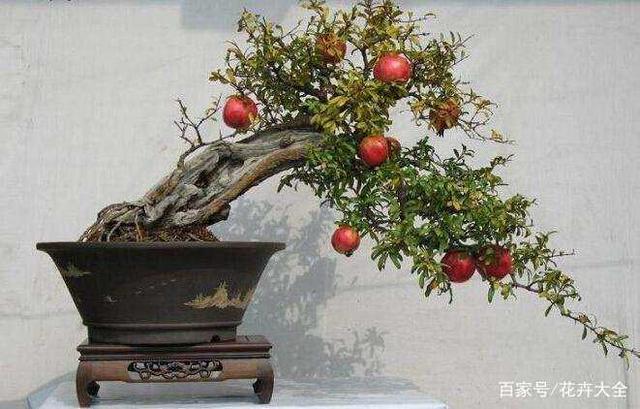
Isn't pomegranate something you eat? How can it also be a bonsai? When you saw the title, was your first reaction: could it be that I'm just ignorant? In fact, maybe we really are a bit ignorant. The pomegranates we usually eat really are quite big, but that doesn't mean there are no small pomegranates. It's just that small pomegranates have little juice and don't taste good, so they were never widely promoted, and many people simply don't know about them.
Actually, at my grandfather's house there's a small pomegranate tree. I've never seen him pick the pomegranates to eat; all year round it just sits on the balcony to be looked at. Still, I have to say, the small pomegranate tree really is quite pretty, with round, bright red fruits hanging on the tree, looking especially tempting. When a pomegranate tree is made into a bonsai, it also looks especially petite and small, and paired with a finely carved pot, it really does look lovely placed in the home.
However, some people, in pursuit of an aesthetic sense of design, will more or less prune and fiddle with the shape of the pomegranate tree, and some people just bend the pomegranate tree directly. After bending, although it really does look much better, some people then worry: after bending, will the pomegranate tree show stunted growth? Does it have a negative effect on it? Today I'll explain this for everyone.
1. Some inexperienced friends may not be clear on what bending a pomegranate bonsai into shape actually means. Let me explain first. The bending mentioned here is not simply using your fingers to crudely snap the branches of the pomegranate tree into a curve, but rather using some special ropes to weave and tie together the branches that need bending. Over time, the pomegranate tree will gradually grow into that fixed shape, and after being bound for several months, once you untie the ropes, you'll find that the pomegranate tree has been bent into shape.
2. If you want to bend a pomegranate bonsai into shape, is there anything to pay attention to? That would be the choice of rope: it's best to use a thinner hemp rope or nylon rope. Rope that is too hard will cut into the bark of the pomegranate tree, and the thinner the rope, the harder it becomes after being pulled taut, and the easier it is to snap the branches of the pomegranate tree. Besides, bending into shape is already not very good for the pomegranate tree's growth, so if you also break it because you didn't pay attention to the details, wouldn't that be the end of it?
3. Will a pomegranate bonsai show stunted growth after being bent into shape? The answer is definitely yes, because you haven't let it grow normally; the process of nutrient transport is no longer unobstructed, but instead encounters obstacles like a road with seven twists and eighteen turns. However, it won't stop growing entirely. To force a shape, the pomegranate tree has suffered quite a bit, so you'll need to use fertilizer to make up for it. It's best to loosen the rope every ten days to see whether it has set into shape, and once it has set, you must remove the rope promptly.