5 rose cutting tips: learn them and the flowers will bloom bigger and bigger
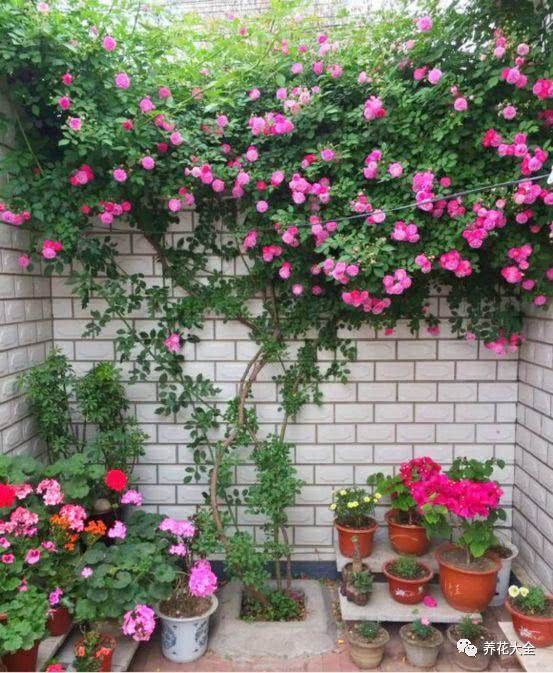
When it comes to the most romantic flower of early summer, the rose must be on the list. Today, Huahua is sharing a wave of beautiful scenes of roses blooming all over the garden!
How about it, isn't it beautiful? So do flower lovers know how to make roses cover an entire wall with blooms? Below, Huahua will introduce a few key tips to everyone!
Follow these 5 cutting steps and they will root in 1 month
The Complete Guide to Growing Flowers
Roses are generally propagated by cuttings, and May or October is the most suitable time:
1. Choose a young shoot about 13 cm long for the cutting, and keep 3~4 small leaves at the top;
2. Use scissors to cut the upper end flat, and make the lower cut slanting downward;
3. It is best to use a shallow pot for the cutting. Use humus soil mixed with sand and mud, and keep it moist;
4. Before cutting, disinfect with a 0.5% potassium permanganate solution, then rinse clean with clear water. The cutting depth should be about 5 cm;
5. After successful cutting, roots generally form in about 20 days, and at this point it needs to be potted up.
Take the rose out of the original pot and shake it gently to let the roots spread out;
Then prepare a slightly larger pot, and add the previously prepared loose humus soil to 2/3 full;
Place the rose inside, continue adding soil until slightly full, and water thoroughly once after 3 hours.
Do this in care and the flowers will bloom bigger and bigger
The Complete Guide to Growing Flowers
Soil
Roses are drought-tolerant and do not have high soil requirements. Generally, soft and fertile sandy gravel soil with some leaves and grass roots added for fertility is enough. Put some crushed stones at the bottom to increase aeration and drainage.
Watering
Roses like a slightly moist environment, and waterlogging that damages the roots must be avoided. In spring and autumn, water once every 15 days; in summer, water once every 10 days. Usually check the soil moisture more often. If it is slightly moist, there is no need to water; water again after it dries out.
Light
Roses like light and warmth. Generally place them on a south-facing balcony or by a south-facing window. If conditions allow, they can be placed outdoors to ensure sufficient light; otherwise they will bloom less and the flowering branches will be weak. But in the hot summer, shade them appropriately to avoid direct strong light.
Fertilizing
Roses quite like fertilizer. During the growing period, apply liquid nitrogen fertilizer once or twice a month, such as fermented fruit peel water or compound fertilizer, to promote the growth of branches and leaves;
During the flowering period in April and May, apply phosphorus and potassium fertilizer two or three times a month, such as monopotassium phosphate or fermented banana water, fish intestine water, etc., to promote flowering.
Pruning
Pruning is an essential part of the care process. Generally prune once before flower buds form, leave the main trunk long, keep 3~5 buds on the side branches, and cut off all other dead branches and weak branches. The overall density should be moderate.
Pest prevention
During care, if ventilation, light, moisture removal and air circulation are neglected, roses are very susceptible to powdery mildew, black spot, and other diseases, showing white powder, dark spots, and even yellowing and falling off.
When pests or diseases are found, immediately cut off diseased and weak branches, and spray the leaves with a 800-times dilution of triadimefon, once a week, for 3-4 consecutive times.
One extra step before flowering and the whole wall will burst into bloom
The Complete Guide to Growing Flowers
Roses mostly bloom from May to September, with pink and white being the majority. They cling and drape over fences or walls, adding a touch of elegance and romance to the small courtyard in summer for no reason at all.
So here comes the question: how do you train roses to climb a wall?
1. Choose a wall with good ventilation and light, cut off all flowering branches and top branches, keep 2~3 buds, and manually train the main branches horizontally toward the wall;
2. Stretch a few wires or vine trellis nets on the wall, fix the rose main trunk, and arrange the positions of the remaining branches according to the direction of extension, pruning reasonably. Of course, you can also directly fix the rose branches and trunk on a fence.
Flower lovers, have you learned all these little tips?
If you have also grown a courtyard full of beautiful roses,
Leave a comment below and share it with everyone.
?