This flower can fill your balcony with blooms in 3 months, and even with no one tending it, you'll have flowers to enjoy year after year
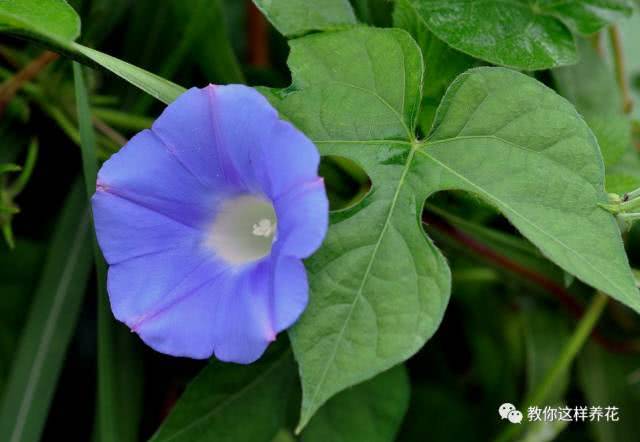
As the saying goes: "Admire chrysanthemums in autumn, tend plum blossoms in winter, plant crabapple in spring, and grow morning glory in summer." Among the many flowers and plants, morning glory surely earns its place. Morning glory also has another name, "Diligent Lady," because every day just after the rooster crows for the first time, the morning glory vines winding around the fence and trellis open one trumpet-shaped flower after another, so it is also called morning face. Morning glory has a fairly strong ability to self-seed; after the seeds mature, they fall on their own, and beside the withered stems they quickly sprout and grow more. Basically, they can come up on their own year after year. They are easy to grow, and the flower shapes are very attractive too.
Common varieties include the split-leaf morning glory, typically characterized by leaves with deep three-lobed divisions.
Round-leaf morning glory, with broad heart-shaped leaves
Large-flowered morning glory, with large leaves and long stalks, having three lobes, with the central lobe relatively large; it is widely cultivated in Japan, where it is called the morning face flower, and many horticultural varieties have been bred, with diverse flower shapes and rich, colorful blooms.
The central lobe is relatively long, which is a very obvious characteristic.
Varieties like this grape color, as well as the coffee-colored one, are relatively rare; many large-flowered morning glories have white edges.
Morning glory is generally sown in spring and blooms in summer and autumn. There are many varieties, and the flower colors include blue, crimson, peach red, purple, and so on, as well as mixed colors, with many variations along the petal edges. The seed capsule splits into several parts; collect them well and sow again the next year, and they will quickly grow and produce beautiful flowers.
Morning glory seeds have a relatively hard outer shell, so before sowing they must be soaked in water for 24 hours, then sown. Morning glory is sown by the spot-seeding method: place the seeds into the soil, cover with about 2 cm of soil, press lightly firm, water thoroughly, and under suitable conditions they sprout in 7 to 8 days.
Petunia likes dry conditions and fears dampness. During growth it needs sufficient water, especially in the hot summer season, when it should be watered every day. But it must not be waterlogged; long-term waterlogging often causes root rot, and the whole plant wilts and dies. If there is a lot of rain during the flowering period, the flowers fade, rot easily, and the petals tear easily.
Morning glory is extremely adaptable. It likes full sunlight and can also tolerate partial shade. Morning glory is not frost-tolerant; the suitable growing temperature is 13 to 18°C, and in winter the temperature should be 4 to 10°C. If it falls below 4°C, plant growth stops. In summer it can withstand high temperatures above 35°C.
Morning glory is a long-day plant and requires strong light conditions; whether potted or planted in the ground, it must be given sufficient light. With ample sunlight it grows vigorously, with lush leaves and abundant flowers; if light is insufficient, the branches and leaves tend to grow leggy, with fewer flowers or poor flower quality. If it can be given more than 12 hours of light per day, and the night temperature is above 10°C, it can bloom in all four seasons.
Many gardening enthusiasts often say they have seen wild morning glory, and then find from the pictures that it is bindweed. It looks very similar, but it is not the same kind of flower! Bindweed, this little wildflower, is actually very beautiful too! It can be used as medicine and has effects such as strengthening the spleen and boosting qi, promoting digestion, and relieving pain. But it is somewhat toxic, so eat it with caution.
The flowers of water spinach are also somewhat similar to morning glory; the little vegetable flowers are very beautiful too.
At first glance, don't they look quite similar?
The super tough morning glory~
Sowing and care are super simple!
If you like it, plant one~