Desert rose potted plant, a different kind of rose
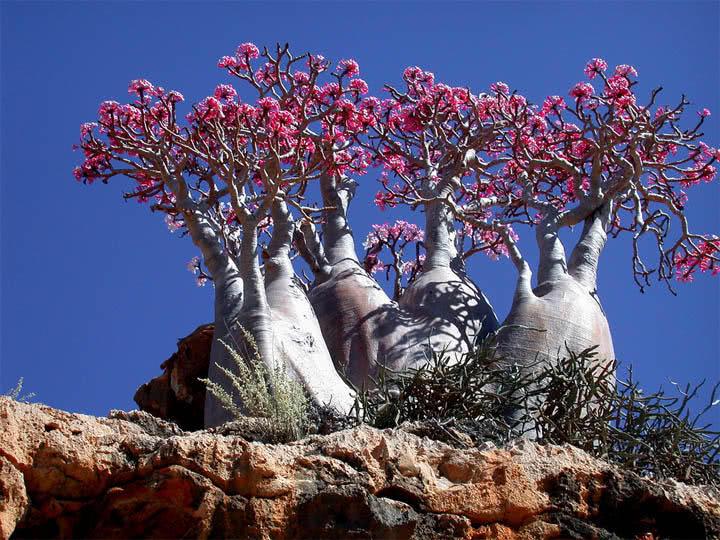
Desert rose, in fact it is not a rose that grows in desert regions, and it has no close relationship or resemblance to roses. Also known as: Adenium obesum, Apocynaceae, this is a plant of the Apocynaceae family. Adenium is a succulent plant, also called a succulent. It is a succulent shrub or small tree, up to 4.5m tall; the trunk is swollen. Leaves are simple and alternate, clustered at the branch tips, obovate to elliptic, up to 15cm long, entire, with a blunt apex and a short point, fleshy, nearly sessile. It likes high temperatures, dry conditions and a sunny environment, tolerates extreme heat but not cold, and is named desert rose because its place of origin is close to the desert and its flowers are red like roses; its place of origin is Kenya and Tanzania in Africa, and it is beautiful when in full bloom, often cultivated for ornament.
Succulent shrub or small tree, up to 4.5m tall; the trunk is swollen. Leaves are simple and alternate, clustered at the branch tips, obovate to elliptic, up to 15cm long, entire, with a blunt apex and a short point, fleshy, nearly sessile. The corolla is funnel-shaped, with short pubescence on the outside, 5-lobed, about 5cm in diameter, the outer edge red to pink, lighter in the middle, with wavy lobe edges; terminal corymbose inflorescences. The desert rose flower is shaped like a small trumpet, rose-red, very showy. The umbel-like inflorescences form clusters of three to five, brilliant as brocade, blooming continuously through all four seasons. It is named desert rose because its place of origin is close to the desert and its flowers are red like roses.
The desert rose has simple alternate leaves, obovate, with an acute apex, 8cm to 10cm long, 2cm to 4cm wide, leathery, glossy, dark green on the upper surface, grayish-green on the underside, entire. Racemose inflorescences, terminal, bearing more than 10 flowers, trumpet-shaped, 6cm to 8cm long; the corolla is 5-lobed, with rose-red, pink, white and bicolor forms, etc. May to December is the flowering period of the desert rose, and the flowers come in red, rose-red, pink, white and other colors. In the south, greenhouse cultivation makes it relatively easy to set seed. The seeds have white soft hairs that help them fly and disperse.
It is commonly propagated by cuttings, grafting and layering, and can also be grown from seed. For cuttings, summer is best; select 1-2 year old branches, with tip branches being best, cut them into 10cm lengths, let the cut surface dry, then insert them into a sand bed, and they root about 3-4 weeks after insertion. For grafting, use oleander as the rootstock, adopt the cleft grafting method in summer, and after surviving, the plant grows robustly and flowers easily. For layering, air layering is often used in summer; cut away 2/3 on a healthy branch, first fill with moss and then wrap with plastic film, roots form in about 25 days, and after 45 days cut it off and pot it. Sow in summer, with a germination temperature of 21°C.