Why do succulent leaves vary in size? Learn these and grow beautiful succulents
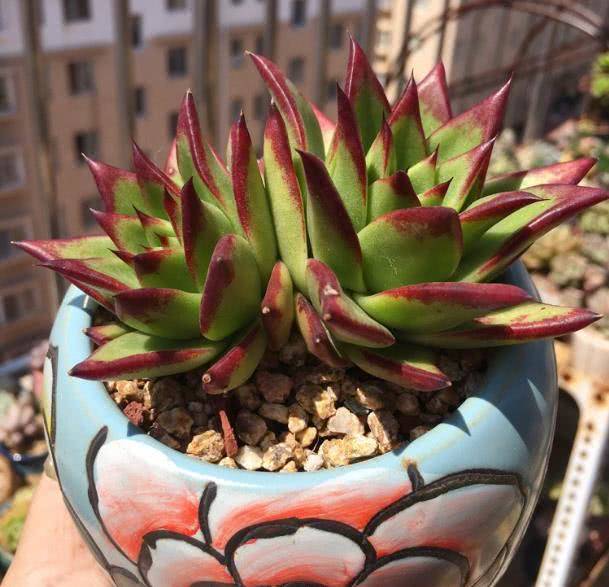
Some observant gardeners have noticed a phenomenon: on the same succulent plant, the leaves are not uniform in size - the old leaves are relatively small, while the newly grown leaves are relatively large. What is the reason for this? Spring is very suitable for growth, so the newly grown leaves are relatively large, while the old leaves that have been through hardships have already passed their development stage and remain in a small-leaf state. The reverse is also true: if the original growing environment was relatively good and the plant is moved to a poorer growing environment, it is also prone to producing increasingly smaller leaves.
When succulent leaves grow downward, which is what everyone quickly calls "wearing a skirt," the main reason is often too much water and too little light, causing the lower leaves to grow downward. With severe light deficiency, you can tell from how badly the plant is splayed out that it is very unhealthy. The most effective way to solve this problem is to control water and increase light. When a succulent is in a water-deficient state, its leaves tend to curl inward more easily, and under high light and water-deficient conditions, the lower leaves are also more easily consumed. If you do not believe it, this summer try an experiment with Sempervivum tectorum (hens and chicks): leave one outdoors with controlled water so its leaves frequently show a water-deficient state, and give another appropriate shade and water it appropriately when the soil is dry.
What is going on when succulent leaves split open? The problem of leaf splitting is related to our succulent-growing environment and methods. If the environment is unsuitable or the methods are improper, succulents will frequently develop split leaves. It is not easy to avoid leaf splitting. If you want to reduce this kind of problem, you need to find a way to maintain soil moisture and not let the soil become excessively dry. Do not wait until their leaves are shriveled before watering, and you will avoid the binge-eating style of leaf splitting.
Sometimes succulent leaves do not split open obviously, but are only slightly burst. Although such small wounds may not be obvious, after the succulent repairs the wound, it will show spots like those in the picture below, which also look very unattractive. In a humid environment, these small breaks on the leaves can also lead to further fungal infection, and in severe cases can even cause the entire succulent to develop black rot.
What should you do when a succulent becomes leggy? The treatment methods for leggy succulent leaves are as follows: let it get more sun. Plants carry out metabolism through photosynthesis, so it is recommended that you put it on a windowsill and let it stay in the sun. Succulents have very strong vitality, so you must mainly avoid overwatering. The one you are growing now is relatively small, so you should pay even more attention to the amount of water; if you water too much, the roots will rot, and naturally the plant will not grow well.
This is a gathering place for succulent lovers, sharing succulent care tips. You are welcome to follow and exchange ideas.