Bonsai Technique: The Brutal Trunk-Splitting Method to Fix Old Stock That Is Thick on Top and Thin at the Bottom
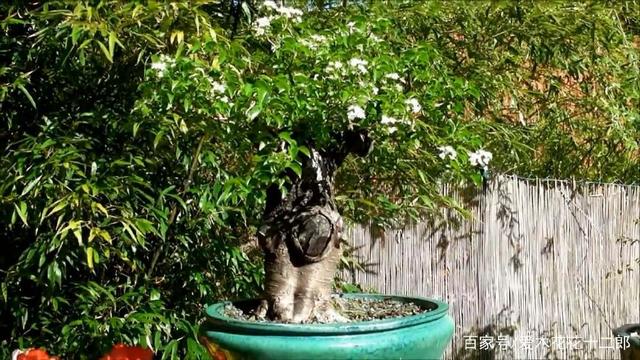
When working with bonsai, you inevitably run into stock that is good in every way except for one fatal flaw: the trunk is thick on top and thin at the bottom, which is absolutely unacceptable in bonsai. So is there any way to fix it?
The answer is yes. One option is to use a sacrifice branch to thicken the lower part; the other is to use the trunk-splitting method. The sacrifice branch is slower but the safest and most natural, though if there is no suitable branch, you will also need to graft on a replacement branch. The trunk-splitting method works quickly, but it leaves a permanent wound, though this wound can be repaired by other means.
The trunk-splitting method is actually very commonly used, and it can achieve rapid thickening of the trunk. That said, this method is quite brutal, but there is no way around it: great force produces miracles. Let us look at a very brutal trunk-splitting process.
This piece of stock is probably a trunk produced by high-level air layering. Because there were once several large branches in the middle section, it became swollen there, which makes it overall spindle-shaped, with a relatively thin base.
From this angle it is even more obvious. Today this young man is going to work on it.
First, prune the branches and foliage a bit. Because major surgery is coming shortly, removing some branches and leaves will help with post-operative recovery.
About half has been cut away.
Move it onto the operating table.
First, try the electric saw.
Mm, not bad, it can cut through.
A fairly deep groove was cut.
Just cutting a groove is not enough; something needs to be stuffed in to wedge it open.
So let us start with two cm. Then a two cm wedge is hammered in from this side.
Another one on the other side too.
Two cm is still not enough, so add another two cm.
Enough, enough, no more wedging, or it will become two trees.
How about that, bold enough for you?
Only a full view can show the effect. Has it been corrected now? It is no longer top-heavy, right?
Pot it up, and done.
This trunk-splitting method looks cruel, but for this tree it will not cause much harm, and after a short recovery period it can grow normally. In nature, due to all kinds of natural disasters and mishaps, tree trunks get damaged, and as long as there is no fungal infection, they can basically survive healthily. Those ancient trees that are several hundred years old are almost all covered in scars.