How to make a cliff chrysanthemum and the detailed steps
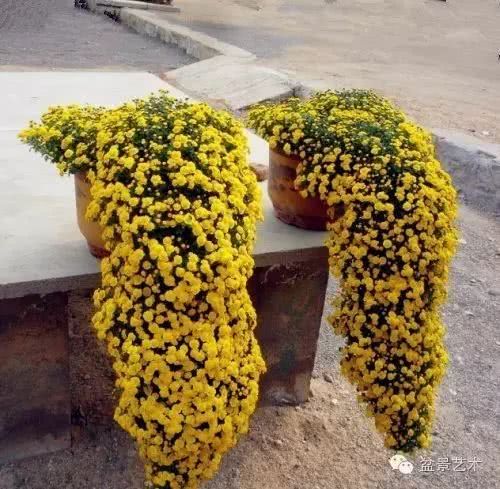
I. Choosing the variety for making a cliff chrysanthemum
Cliff chrysanthemums mostly use small chrysanthemums, but small-flowered, long-stemmed varieties from the large chrysanthemum group can also be used. Varieties are required to have many branches, slender stems, dense flowering, fast growth, vigorous growth, obvious apical dominance, and long, flexible internodes. The flower color depends on need; generally, those with bright colors are better.
II. Shaping the cliff chrysanthemum
Begin shaping when the chrysanthemum seedling is about 20cm tall.
Twisting
Choose a sunny midday, when the chrysanthemum stem is highly flexible. Gently twist the chrysanthemum stem so that its tip extends obliquely downward, and fix it at the base of the chrysanthemum stem with wire. After half a month, each axillary bud can sprout a side branch. When the branch is about 15cm long, use the thumbs and index fingers of both hands, at a point 5cm from the main branch on the side branch, to firmly pinch both sides of the leaf base (without damaging the leaf stalk), with the left hand inward and the right hand outward, twisting at the same time, until the inside of the internode is appropriately twisted and injured. At this point, do not let both hands fully leave the branch; alternately move to the next node above the branch, until reaching the tender part of the side branch, so that the vascular bundle's vessel tissue is slightly damaged and enters a semi-blocked state, promoting side branches and rapidly forming a framework. Afterward, the branches produced by the side branches are continuously pinched to fill out the plant shape.
Pinching
Try not to pinch the main branch; continuously twist and injure the upward-curving branch tips so that the tip naturally droops under its own weight; the basal shoots may be appropriately retained, and repeatedly pinched to fill out the tail; pinching the side branches should take care to make the distribution of branches and leaves across the whole plant dense and sparse in a well-balanced way. The final pinching should be done in three stages. First pinch the tail, after 10 days pinch the middle, and after another 10 days pinch the tip. This can solve the problem of the tip blooming first due to apical dominance, thereby making the whole plant's flowering period uniform.
III. Care
Place the chrysanthemum pot in a high place so that the chrysanthemum tip naturally extends obliquely downward. When the chrysanthemum roots emerge through the drainage holes, promptly repot into a pot one size larger. Spray a 0.3% urea and monopotassium phosphate liquid fertilizer once every 1 week, or apply decomposed liquid fertilizer, and stop when the flower buds show color, ensuring the chrysanthemum plant grows healthily and vigorously. 2 to 3 days after the final pinching, combined with foliar fertilizer spraying, spray 100ppm paclobutrazol (PP333), then spray once about every 10 days thereafter; if rain occurs within 3 days after spraying, spray again to supplement. Spray 3 times in total; the first dose is slightly larger, and afterward reduce as appropriate to about 50ppm. Although spraying paclobutrazol controls the trailing length to a certain extent, it makes the stems thick and the internodes short, the plant shape compact, the posture elegant, the leaf color dark green, and the flowering period uniform.