Detailed Explanation of the Production and Management Methods of Persimmon Bonsai
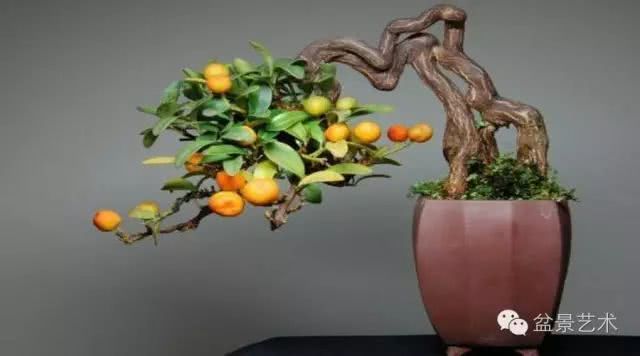
The persimmon tree is a deciduous tree of the genus Diospyros in the family Ebenaceae, with a height that can reach more than 10 m, and an open crown that is spherical or bluntly conical. The bark is dark gray, with relatively deep fissures, appearing blocky, and the branchlets are brown. The leaves are oblong, obovate, or broadly elliptical, somewhat leathery, dark green and glossy on the surface, and in some cultivars turn red in late autumn. The corolla is bell-shaped and yellowish white, solitary or several clustered in the leaf axils of new shoots. Depending on the cultivar, the fruit is oblate or spherical, often with four longitudinal grooves or constrictions, and its size ranges from 4 cm to 8 cm; when mature it is red, orange-red, orange-yellow, or bright yellow. The flowering period is from May to June, and the fruit ripening period is from September to November.
For making bonsai, persimmon trees can use seedlings of Diospyros lotus, wild persimmon, or oil persimmon as rootstock, and persimmon cultivars with high ornamental value such as Mopan persimmon, Huo persimmon, Shiliu persimmon, and Luofu persimmon as scions, grafted in spring by cleft grafting or cut grafting. It is also possible after leaf fall in autumn and before budbreak in spring to dig up in the wild Diospyros lotus stumps that have grown for many years and are ancient and vigorous; after they survive, after one year of "raising the stock," grafting is carried out in the spring of the second year. Because the roots of Diospyros lotus contain a relatively large amount of tannins, they are difficult to heal after injury, and after transplanting the tree vigor recovers slowly; therefore, when transplanting, the root system should be retained as much as possible, and attention should be paid to keeping it fresh and moist to ensure survival. For the first potting, it is advisable to use a clay pot of suitable size to promote root growth and speed up the rate of shaping.
Persimmon bonsai can be processed into many different forms according to the shape of the rootstock and the cultivar characteristics of the scion, such as single-trunk style, double-trunk style, slanting-trunk style, waterside style, and literati tree. Because its leaves are relatively large, the crown mostly adopts a natural style; its bright fruits hang among the green leaves and are very beautiful, while after leaf fall in winter the branches are like iron, giving another kind of character. The shaping method uses a combination of pruning and wiring, gradually cultivating them so that the thickness of the branches transitions naturally and the proportions are harmonious.
The persimmon tree is native to the vast areas of China from the Yellow River basin to south of the Yangtze River basin. It likes a sunny, warm, and humid environment, but is also tolerant of drought and cold, and grows better in deep, fertile soil with good drainage. Therefore, it is advisable to plant it in a relatively deep flower pot. During the growing period, it can be kept in a sunny, well-ventilated place for care. If the light is insufficient, the branches will not be sturdy, root growth will be poor, tree vigor will decline, flower buds will not fully differentiate, and flowering and fruit set will be sparse. Keep the potting soil moist but not waterlogged; both excessive drought and long-term waterlogging are unfavorable to the normal growth of the plant. Apply a fully decomposed dilute liquid fertilizer once every 15 to 20 days, and stop fertilizing after mid-September. However, from flowering to fruit set, water and fertilizer should be controlled to avoid excessive vegetative growth of the branches, so as to promote flower bud differentiation. After fruit set, resume watering and fertilizing, and appropriately increase the amount of phosphorus and potassium fertilizer until the fruit colors. For plants with weak growth and heavy fruit set, in July and August, spray the leaves once every 15 days or so with a solution of urea plus potassium dihydrogen phosphate to make the plant grow robustly. After the fruit is picked,
bury an appropriate amount of fully decomposed cake fertilizer powder in the pot. In winter, place it in a cold room with ample sunlight or outdoors in a wind-sheltered, sunny spot to overwinter, and the temperature should not be higher than 10°C to ensure the plant goes dormant, which is beneficial to growth in the coming year. Carry out one pruning and shaping in winter, cutting off weak branches and overlapping branches to increase ventilation and light penetration inside the crown, but excessive thinning of branches will cause the remaining branches to extend rapidly and produce bare trunks; while pruning back 2 to 3 nodes at the branch tips can promote fruit set on fruiting branches. Therefore, when pruning, the two should be combined to promote the formation of short branch groups and a compact crown. In summer, promptly thin out weak branches on the scaffold branches inside and outside the crown and sprouts at the pruning cuts. For vigorous new shoots, after the flowering period and before and after it, leave an appropriate length of branch section and then pinch the tips to promote the emergence of secondary shoots, so that they form flower buds in the same year and become fruit-bearing branches the next year. To promote flowering and preserve fruit, you can also perform double half-ring girdling on vigorously growing plants from late May to early June; carry out artificial pollination during full bloom; 10 to 15 days before flowering, thin out other flower buds on the fruiting branch base except for 2 to 3 upward ones; after physiological fruit drop, thin the fruit, generally leaving 2 to 3 fruiting branches per fruiting mother branch, and retaining 2 to 3 fruits per fruiting branch. After the fruit colors, some old leaves and branches that affect the appearance can be removed to maintain the beauty of the tree shape. Repot once every 2 to 3 years before budbreak in spring.