Appreciation of Plum Blossom Bonsai Styles and Introduction to Famous Varieties
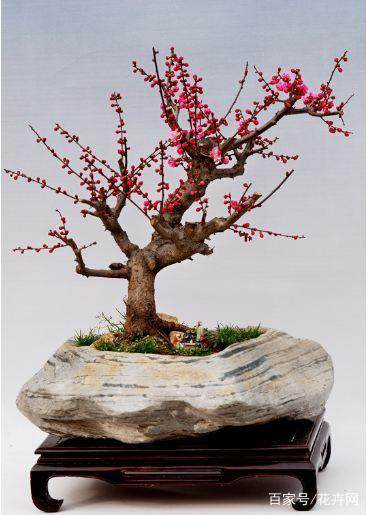
The ancients all loved plum blossoms, and poems praising them have flowed endlessly from ancient times to the present. Because it is one of the Three Friends of Winter, one of the Three Outstanding Spring Flowers, and one of the Four Gentlemen. Plum blossoms grow in almost every part of our country, so there are many places to admire them. However, many people do not truly understand them. Loving plum blossoms also means learning about them, and this is the appreciation and respect we should show toward them.
Although plum blossoms are very common, perhaps many people have still never seen one, and their knowledge of plum blossoms exists only in poems passed down through the ages. So let me start with an introduction to the styles of plum blossoms. We have always held high expectations for them, hoping they are vigorous and powerful yet elegant with ancient charm, hoping they are ever-changing yet remain natural. When grafted into bonsai, we must prune and shape them in certain ways to achieve an ornamental purpose.
We generally have three methods of shaping and pruning. They are the curved-trunk style, the slanting-trunk style, and the attached-wood style. These are not rigidly uniform, and we can make slight modifications according to the cultural heritage of each region to achieve the most fitting style. However, pruning should not be excessive, or it will lose its true self. As a form of ornamental art for people to appreciate, it should take from nature.
There are many famous varieties of plum blossom, and the famous varieties of each period differ slightly. Generally, its famous varieties are divided into these major categories: straight-foot plum, water-reflecting plum, apricot plum, and dragon-wandering plum, among others. The straight-foot plum is the most primitive type, with branches that naturally grow upward. The apricot plum is a hybrid of apricot and plum, with a relatively high survival rate and is more convenient to cultivate.
Compared with the others, the water-reflecting plum is relatively precious. Its branches are exactly opposite to those of the straight-foot plum, naturally drooping downward, and even the flowers after blooming do the same. The crown looks umbrella-shaped, and the overall appearance is very endearing. The dragon-wandering plum is a type of curved-branch plum and is even more precious than the water-reflecting plum.
Having introduced the famous varieties of plum blossom, I think you would like to know even more about the cultural stories behind why they became famous varieties. The plum blossom is hailed as our country's first national flower. There is a history of planting plum blossoms more than 3,000 years ago, but at that time plum blossoms were used for food. What truly made plum blossoms famous throughout the world as flowers dates to the Han Dynasty more than 1,000 years ago. Starting from the Sui and Tang Dynasties, a series of plum arts such as chanting and praising plum blossoms gradually rose.
By the Song Dynasty, it was the peak in the history of plum art. The famous poet Lu You wrote more than 100 poems praising plum blossoms in his lifetime. Some poets even became recluses because they loved plum blossoms so much, taking the plum as their wife; toward the plum, he was utterly infatuated. By the Yuan Dynasty, literati and scholars paid even more attention to painting plum blossoms and the beauty of their forms. The grade of a plum blossom depends on its overall spirit and charm, and this is also an important standard for judging whether a plum is a famous variety.
Already on the cliff are a hundred zhang of ice, yet still the flowering branches are fair. The plum blossom is not merely a flower; that posture standing proudly in the world is also the epitome of the spirit of the Chinese nation.