Bougainvillea cuttings experience sharing: fast rooting, lots of new leaves, early blooming and abundant flowers
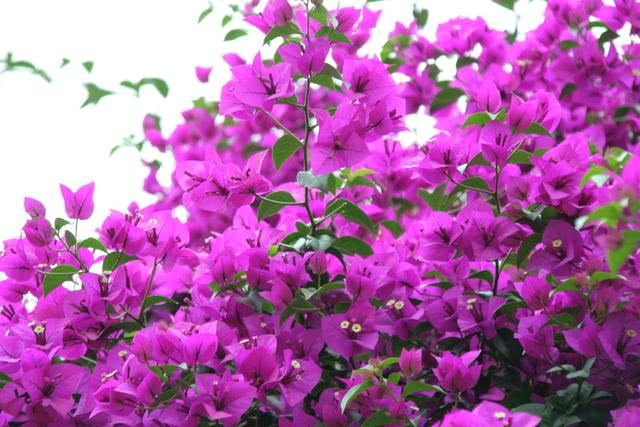
Below are my personal views on bougainvillea cuttings. Please advise and discuss, and if there is anything lacking, I hope friends can add to it, so we can learn better and it can be of some help to friends who like taking cuttings.
1. No matter what kind of medium is used for cuttings, tender branches that have just stopped growing or semi-lignified branches root relatively faster than old branches;
2. The root-promoting effect of naphthaleneacetic acid is basically not obvious;
3. If a rooting agent is used to treat branches, a short soaking time is better than a long one, because a long soaking time necessarily means a very small dosage, so it is basically ineffective. If the concentration is slightly increased, it is very easy to kill the branch tissue! (Especially friends who use water propagation will find that after soaking for a few days, a glue-like film forms on the surface of the branch.) No matter how you disinfect it or change the purified water every day, it will not help. So soaking for a few minutes at a reasonable concentration is actually more effective;
4. After white spots appear on water-propagated branches, switching them immediately to another growing medium for insertion will greatly shorten the cutting time;
5. For moisture retention during cuttings, a large space is better than a small one, as it can ensure greater consistency and is more conducive to branch growth;
6. Recently I found that when water-propagating branches, under the same environmental conditions, one-year-old smooth-skinned branches can simply be placed in water for propagation without any treatment (keeping them at 23--25 degrees, root points appear very quickly)! But if water-propagating perennial rough-skinned branches, sterilization treatment must be done, otherwise white fuzz will grow.
7. A very important point for water-propagated branches: the water must be changed every day, and do not insert too many branches in one container, because the branches will lack oxygen! After lacking oxygen, the epidermis of the branches will slowly rot. When changing the water, be careful that the temperature difference of the water is not too large; it is best to keep it consistent! (I generally use a thermometer to roughly check)
8. For water-propagated branches, it is best to select the part above 4/5 of a one-year-old branch. You will find that the epidermis of this section of branch is very smooth, while the epidermis of the lower part of the branch already has cracks. And many small black dots are densely concentrated in this part! They are the future root points. So soaking this part in water makes it very easy to produce roots!