Rose cutting experience summary: fast rooting with a high survival rate, big buds sprouting in just 20 days
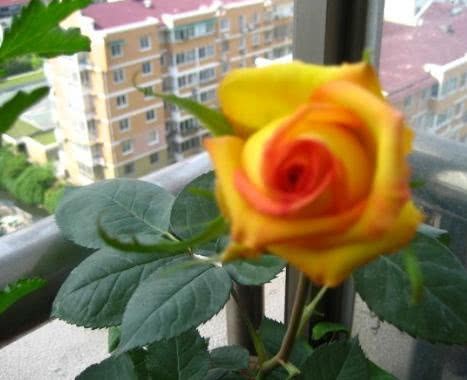
Roses are mainly propagated by cuttings and grafting. Generally, rose cuttings can be taken in spring or early summer, early autumn, the plum rain season, or late autumn. For spring cuttings, cut a sturdy, robust middle section of branch 15 cm long, keep 3 leaves, and insert two-thirds of it into the soil. Be careful to shade it and water it, and the cutting will sprout in 3-4 weeks. When taking cuttings in summer, the cut at the lower end must be below a node; this helps the plant heal its wound and take root. Spray water every morning, and it will sprout in about 20 days.
Place the rooted rose cuttings in a shaded spot or under the shade of a tree, where they can get a little sun in the morning and evening. For the first 4-5 days, spray water more often each day to keep the leaves from drying out; it does not matter if the temperature is a bit low, it will just take a little longer.
Summary of experience:
1. Be sure to use mineral water as the medium (tap water and cooled boiled water both tend to grow algae);
2. Tear off the advertising label on the outside of the mineral water bottle (to increase the light intensity inside the bottle);
3. Cuttings of 5-8 cm are ideal;
4. As much as possible, face the leaves inside the bottle toward the sun;
5. A tap water depth of about 1 cm is ideal. On the premise that the water surface covers the end of the cutting, the shallower the water the better (the shallower the water, the higher the average dissolved oxygen content in the water, which is good for rooting).
6. The water temperature must be well controlled (in the hot summer, it is best to place it on a south-facing windowsill in an air-conditioned room to receive diffused light; suitable for air-conditioned offices and laboratories; in spring and autumn, simply shading the bottom of the bottle is enough).
7. Keep all the leaves on the cutting, do not trim a single one (if they can fit inside the bottle). The humidity inside the bottle is high, so more leaves can be kept, photosynthesis works better, and rooting is faster.
8. Do not cap the bottle mouth (the inside of the bottle needs to breathe). Some roses will wither a small number of leaves after water propagation, but not all the leaves will wither. At this point, roots are beginning to sprout from the bottom; it may be that the old leaves withered and transferred their nutrients to the rooting at the bottom.
9. The difficulty lies in when to transplant after rooting and the survival rate of transplanting. After all, when moving it out of the water, with so many leaves, the transpiration rate will certainly be high, and the new roots are not very numerous, so there is a fear that they cannot absorb enough water to supply the plant. The cuttings should be somewhat thick; try not to take ones under 2 mm, and those over 3 mm are good. Once the roots are about 1 cm long, they can be transplanted into soil. Use plain soil, that is, infertile, clean soil. The peat soil sold on the market is also very good, and fine mountain soil works too. It is best not to use sawdust. After planting, avoid direct sunlight for about 15 days, but do not water at random; watering at random will rot the roots.
Steps:
These three bottles are for the roses
First cut branches from the current year's growth, then poke a hole in a disposable cup
Wash the sand once; my daughter came to help too. I hope this time it succeeds and roots smoothly!
Once planted, put them in a bucket with 3 cm of water in it.
Put the bucket by the air conditioner's outdoor unit, where an unknown plant happens to be growing well. I plan to spray water on the leaves once in the morning and once in the evening.
Putting it in the bucket can block part of the sun