What is Pachyveria 'Clavifolia'? Get to know this succulent plant
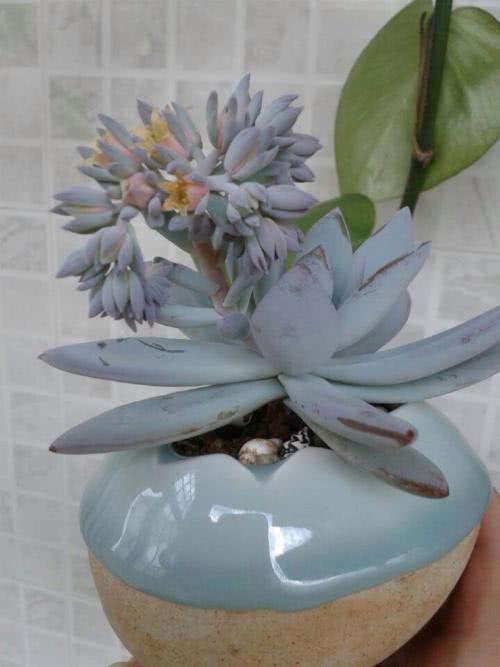
Pachyveria 'Clavifolia' is a succulent in the Crassulaceae family, a hybrid variety originating from the United States, bred in the 1970s. It was created by crossing Pachyphytum 'Amethyst' (Egg Beauty) of the genus Pachyphytum with Echeveria cante of the genus Echeveria [1]. It prefers a warm, well-lit, dry and ventilated environment, is relatively drought-tolerant, not cold-tolerant, and has strong adaptability. The leaf surface has a natural layer of thick white farina, giving the plant a pale blue appearance at first glance.
Pachyveria 'Clavifolia'
A perennial glabrous succulent plant, with leaves arranged in a rosette, flat elongated spindle-shaped leaves, with leaf tips, arc-shaped leaf margins, thick fleshy leaves, a ridged line on the back of the leaf, a sunken leaf surface, and the leaf blade curving slightly toward the center of the rosette. The leaves are smooth and covered with white farina; after the farina coating is wiped off, they appear green-blue or gray-green, and the farina does not grow back. In full sunlight the leaves are tightly arranged and take on a light purple or pink color; in low-light conditions the plant becomes leggy, the leaf color turns light blue or blue-green, the leaves become narrow and long, and the spacing between leaves stretches out. Racemose inflorescence, with flowers pink on the outside and orange-yellow on the inside, bell-shaped, arranged in a string, with five or six petals. It blooms in early summer.
Pachyveria 'Clavifolia'
Excellent leaf shape and leaf color. The plant is compact and small, resembling a lotus rosette carved from jade; multi-headed older plants have a rather lush, clustered feel, and the elongated stems of perennial old plants can be shaped into bonsai; the leaves are very plump, showing a hazy and dreamy light pink-purple, revealing a touch of cuteness within its elegance. Placed as an accent on a terrace or by a sunny window, it can serve as a focal point and catch the eye.
Pachyveria 'Clavifolia'
Pachyveria 'Clavifolia' is a very easy variety to propagate. Propagation can be done by beheading to encourage offset shoots, leaf cuttings, and many other methods. The success rate of propagation is very high.
In spring and autumn (it can also be done in winter in areas north of the Yangtze River), twist off healthy, mature and intact leaves for cuttings. Place the leaves slightly tilted or flat on vermiculite, peat or coconut coir, keep them slightly moist, and they will soon root at the base and grow new shoots; once the new shoots have grown a little larger, plant them separately and they become new plants.
In addition, young plants sprouting beside the old plant can also be used for cuttings. Before cutting, let the cut dry, then bury the lower part of the stem shallowly in sandy soil. The other precautions are the same as for leaf cuttings. The cutting medium should be loose sandy soil so that the plant's root system can grow well.