With proper daily care, clivia won't rot its roots, its leaves stay glossy green, and its blooms are truly beautiful
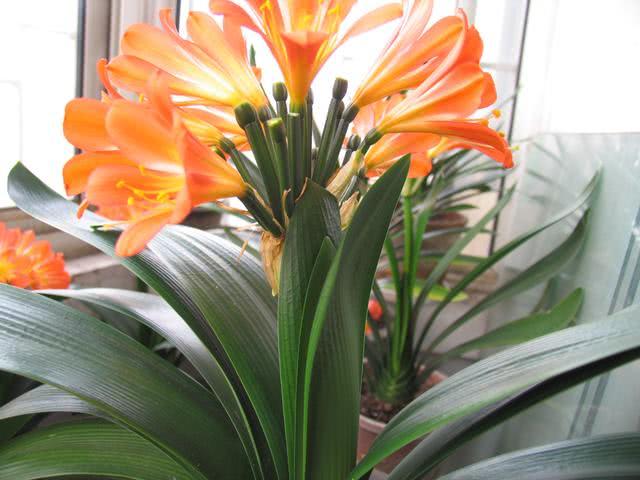
Daily care for clivia: no root rot, glossy green leaves, and truly beautiful blooms! First, select a superior mother plant. Generally, when the father and mother plants grow robustly, are free of pests and diseases, have strong stress resistance, and show good ornamental quality, their seeds have a stronger germination rate and the seedlings have good traits. If the mother plant suffers from conditions such as heart rot or root rot during seed setting and is not robust, the seeds it produces will have weak germination capacity. Although the seeds of some clivias have already matured, their development may be affected by certain factors, such as seeds with no obvious micropyle, strong pollination compatibility, and individual self-pollinated seeds, which are not easy to sprout or have weak sprouting vigor. In short, when selecting seeds, observe carefully and choose good seeds, so as to ensure more seedlings and strong seedlings
The optimal temperature for clivia seed germination is 30±2°C. Below this temperature, germination is slow, and below 10°C, germination cannot occur. During the germination period, clivia seeds have large water requirements and oxygen consumption. If the above conditions cannot be ensured, an ideal emergence rate cannot be obtained. Sawdust seedling method: put coarse sawdust into a pot, cover the drainage hole at the bottom of the pot with a tile, pour boiling water over the sawdust until thoroughly soaked, and wait for it to cool. Then take out some sawdust and keep it for covering. Use a thin bamboo stick to pull the remaining sawdust in the pot evenly and level it. When the temperature does not exceed 40°C, place the seeds evenly on the surface of the sawdust with the embryos pointing downward (for large-scale sowing, the direction of the embryos need not be considered), leaving a small distance of 1-2 mm between seeds
Root rot in clivia is a very troublesome problem. Many flower lovers give up and throw away their clivia as soon as they see root rot. Let me tell everyone a method to save a clivia with root rot. Before rooting, first remove the rotten roots, wash them clean, and after washing, let them dry. Choose sand the size of rice grains obtained from a construction site, disinfect it with boiling water, and set it aside for use. First spread some disinfected pine needles at the bottom of the pot, then dig a hole in the middle and put some sand in it to form a hollow, then roll the clivia in plant ash for disinfection, place it in the center of the flower pot, surround the roots with sand, and fill the pot with pine needles. At 10 days, 4 new roots were found to have emerged around it, and they were born very neatly and evenly distributed. During this period, occasionally let it get some sunlight. Soil moisture should be moderate, and air humidity can be slightly higher, but not too high. After all, it is recovering its vitality, and too high humidity easily breeds bacteria and root rot. After about another month, the roots grew out again, and the effect was quite good
Pine needle seedling method: This method is suitable for raising large numbers of seedlings. Soak pine needles in 40°C warm water for about 10 minutes, take them out and drain the water, put them into a pot or wooden trough, press lightly, and scatter the seeds evenly on the pine needles. The embryo direction and the distance between seeds need not be considered. Cover the seeds with water-soaked pine needles 2-3 cm thick, press lightly, and place on a warm bed to ensure the optimal germination conditions. Because pine needles have good permeability, note that there must be no lack of water before germination, especially during the seed water absorption period. After the seeds have absorbed enough water, that is, after 3 days, the water can be appropriately reduced. Clivia belongs to the Amaryllidaceae family and is a perennial evergreen herbaceous plant. Its leaves are broad and strap-shaped, hard and thick in texture, and have luster and veins. The flowers of clivia are not as magnificent as peonies, nor as fragrant as jasmine, still less as colorful and graceful as Chinese roses, but it has sword-like green leaves, broad, thick, and shiny; fire-like red flowers, blooming gracefully, with red and green setting each other off beautifully. It is an ideal potted flower for beautifying the environment